









How To Round Numbers And Estimate Their Sum To The Nearest Thousand
Estimating the sum to the nearest thousand is a common task that people often find hard. It requires a lot of mental math skills, and it's not easy to do in your head. Estimating the sum to the nearest thousand is a common math problem that people often get wrong in a lot of ways. The most common way people get it wrong is by rounding up or down when they should be estimating the number without any rounding.
The fundamentals of estimating the amount to the nearest thousand will be covered in this article. Writing down and adding up all of your numbers is the first step. Once you have done this, you can use a calculator to find out how many zeros are in that number. The number of zeros in your answer will tell you how many thousands there are in your answer.
Estimation
The estimation of a number is the process of making a reasonable guess about the actual value in order to make calculations easier and more realistic. Estimation means approximating a quantity to the degree of accuracy required. To get a quick and rough answer, round off the numbers involved in the calculation.
Let's say you want to calculate the total cost of a few different products on your grocery list or you want to purchase a few gifts.
How would you estimate how much money you would need? Given that money is involved and calculations are made easier when prices are rounded to the closest tenth, you would do so. You might want to round a number to the next million or billion if you're dealing with exceptionally huge figures. And this is how place value is used in estimation.
Estimate the Sum to the Nearest Thousand for Steps
Here are some steps related to estimating the sum to the nearest thousand, which is like this;
First, we obtain a number that roughly approximates the total to the nearest thousand.
Check the numbers in the hundreds place after that.
The sum of the nearest thousand should be approximated if the digit in the hundreds place is greater than 5 or 5.
Multiply the thousands digit by 1 and replace the hundreds, tens, and units digits with 0, keeping all other numbers the same.
Approximate the sum of the nearest thousand if the digit in the hundreds place place is less than 5 for the corresponding number, then replace each digit with a 0 in the hundreds, tens and units or units place. Keep all other numbers as they are.
In this way the sum of the nearest thousand is the number that is rounded off to the nearest thousand.
Estimate the Sum to the Nearest Thousand for Table
Here are some table related to estimating the sum to the nearest thousand, which is like this:
Estimate the Sum to the Nearest Thousand Related Example
Here are some examples related to estimating the sum of the nearest thousand, which is like this;
Example: Estimate the sum by rounding off to nearest thousand for 16466 and 32836?
Ans: Estimate the sum of 16466 and 32836 to the nearest thousand.

Example
Example: Estimate each sum to the nearest thousand for 39488 and 47005.
Ans: Estimate the sum of 39488 and 47005 to the nearest thousand.

Example
Example: Estimate the sum of 367 and 516 to the nearest hundred?
Ans: Estimate the sum of 367 and 516 to the nearest hundred.
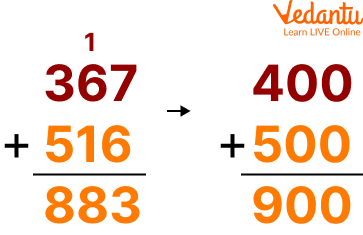
Example
Estimate the Sum to the Nearest Thousand Related Worksheet
Here are some worksheets related to estimating the sum of the nearest thousand, which is like this;
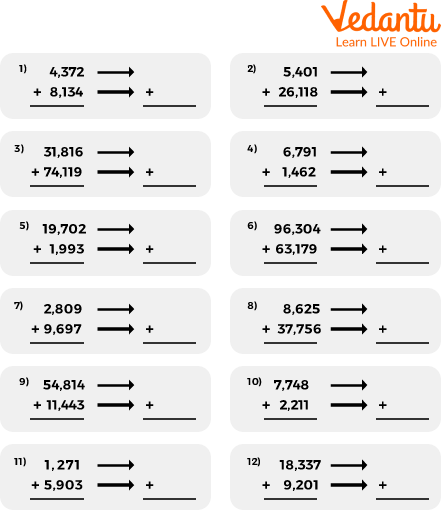
Worksheet
Summary
This is a very simple calculation that we use every day. It can be done by hand or with a calculator, but it is time-consuming and tedious. Estimating the sum to the nearest thousand is a very simple calculation that we use every day.
In the conclusion of this article, we will be discussing what we have learned and what we can do to make our estimation more accurate. In the first part of this article, I discussed why it is important for us to estimate a sum to the nearest thousand. In the second part, I discussed how you can estimate a sum using your knowledge of integers.
FAQs on Estimate The Sum To The Nearest Thousand With Clear Steps
1. What does estimate the sum to the nearest thousand mean?
Estimating the sum to the nearest thousand means adding numbers after rounding them to the closest multiple of 1,000. This makes large number addition easier and faster.
- Round each number to the nearest thousand.
- Add the rounded numbers.
- The result is an estimate, not the exact sum.
2. How do you round a number to the nearest thousand?
To round a number to the nearest thousand, look at the hundreds digit to decide whether to round up or down.
- If the hundreds digit is 5 or more, round up.
- If the hundreds digit is 4 or less, round down.
3. How do you estimate the sum of two numbers to the nearest thousand?
To estimate the sum to the nearest thousand, round each addend to the nearest thousand and then add them together.
- Step 1: Round each number.
- Step 2: Add the rounded numbers.
4. Can you give an example of estimating a sum to the nearest thousand?
Yes, estimating a sum to the nearest thousand involves rounding first and then adding. Example: 8,345 + 1,790.
- 8,345 ≈ 8,000 (hundreds digit is 3).
- 1,790 ≈ 2,000 (hundreds digit is 7).
- Estimated sum = 8,000 + 2,000 = 10,000.
5. Why do we estimate sums instead of finding the exact answer?
We estimate sums to get a quick and reasonable answer without detailed calculation. Estimation is useful for:
- Mental math and time-saving.
- Checking if an exact answer is reasonable.
- Real-life situations like budgeting or shopping.
6. What is the rule for rounding to the nearest thousand?
The rule for rounding to the nearest thousand is based on the value of the hundreds digit.
- If the hundreds digit is 5–9, increase the thousands digit by 1.
- If the hundreds digit is 0–4, keep the thousands digit the same.
- Change all digits after the thousands place to 0.
7. What is the difference between exact sum and estimated sum?
The exact sum is the precise total after full addition, while the estimated sum is an approximate total found by rounding first. For example:
- Exact sum of 4,678 + 2,345 = 7,023.
- Estimated sum (nearest thousand): 5,000 + 2,000 = 7,000.
8. Do you round before or after adding when estimating the sum?
When estimating the sum to the nearest thousand, you round before adding. The correct process is:
- Round each number to the nearest thousand.
- Add the rounded numbers.
9. How accurate is estimating to the nearest thousand?
Estimating to the nearest thousand gives a close but not exact value, usually within a few hundred of the real sum. The maximum rounding difference for each number is 500, so the total difference depends on how many numbers are rounded. It is accurate enough for quick calculations and reasonableness checks.
10. What are common mistakes when estimating sums to the nearest thousand?
Common mistakes when estimating sums to the nearest thousand include rounding incorrectly or adding before rounding. Avoid these errors:
- Looking at the tens digit instead of the hundreds digit.
- Forgetting to change digits after the thousands place to zero.
- Mixing exact addition with estimation steps.
