









How to Divide Fractions Using the Keep Change Flip Method with Examples
Introduction to Fractions
Before learning dividing fractions, let us first know what fractions are? Fractions are defined by division which represents the equal part of a whole. They are real numbers expressed in the form of \[\frac{a}{b}\], where a and b are integers.
The numerator is the top number, written above the horizontal line, representing how many parts we have. The denominator is the bottom number, written below the horizontal line, representing how many equal parts the given item is splitted into. Hence, in the fraction \[\frac{3}{4}\] (read as three fourths, and written as three-fourths), 3 is the numerator and 4 is the denominator. This tell us there are 3 parts, each of them is one-fourth (or \[\frac{1}{4}\] ) of a whole.

Fractions
Read below to know how to divide fractions.
Division of Fractions with Unlike Denominators in 5 Easy Steps
As we have learnt what fractions are, now let us learn to divide fractions. Dividing fractions is similar to multiplying fractions. The only difference is that while dividing fractions, you need to flip the second fraction, i.e., divisor into a reciprocal and change the division sign to multiplication sign and multiply. Also, simplify if possible. Let us understand the steps with an example:
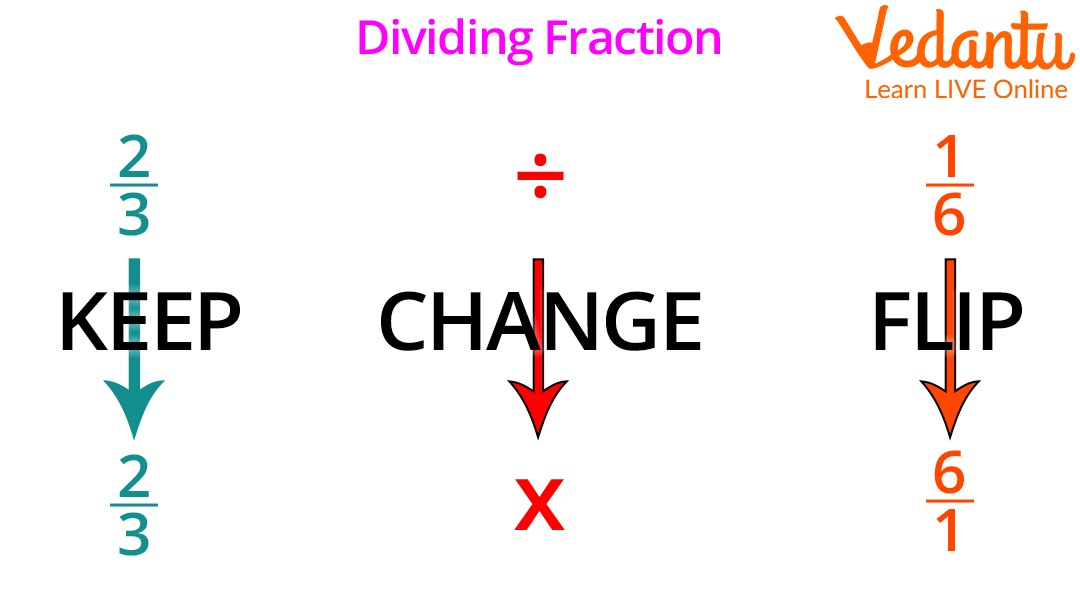
Dividing Fractions
Example: What is \[\frac{1}{2}\div\frac{1}{7}\] ?
Solution: The steps to divide the given fraction are as follows:
Step 1: Keep the first fraction and second fraction as it is given in the questions. This gives
\[\frac{1}{2}\div\frac{1}{7}\]
Step 2: Change the division symbol into a multiplication symbol.
\[\frac{1}{2}\times \frac{1}{7}\]
Step 3: Now, flip the second fraction or division into a reciprocal. To find the reciprocal, you just need to flip the numbers. That is, the numerator becomes the denominator and the denominator becomes the numerator. Accordingly, this gives:
\[\frac{1}{2}\times \frac{7}{1}\]
Step 4: Multiply the numerators and denominators of a fraction obtained in step 3. This gives:
\[\frac{1}{2}\times \frac{7}{1} = \frac{7}{2}\]
Step 5: Simply the result. Here, \[\frac{7}{2}\] cannot be simplified further.
Therefore, \[\frac{1}{2}\times \frac{1}{7} = \frac{7}{2}\].
Division of Fractions by a Whole Numbers
The steps to divide fractions by a whole number is the same as discussed above. The only difference is that the whole number here is converted into fractions by using the denominator as 1. Let us understand with an example:
Example: What is \[\frac{5}{2}\div{4}\] ?
Solution: The steps to divide the given fraction are as follows:
Step 1: Keep the first fraction as it is given in the questions. Now, convert the whole number written after the division sign into a fraction by putting denominator equals to 1. Here the number is 4. This gives
\[\frac{5}{2}\div\frac{4}{1}\]
Step 2: Change the division symbol into a multiplication symbol.
\[\frac{5}{2}\times \frac{4}{1}\]
Step 3: Now, flip the second fraction or division into a reciprocal. Accordingly, this gives:
\[\frac{5}{2}\times \frac{1}{4}\]
Step 4: Multiply the numerators and denominators of a fraction obtained in step 3. This gives:
\[\frac{5}{2}\times \frac{1}{4}=\frac{5}{8}\]
Step 5: Simply the result. Here, 58 cannot be simplified further.
Therefore, \[\frac{5}{2}\div {4}=\frac{5}{8}\] .
Division of Mixed Fractions
The steps to divide mixed fractions are the same as discussed above. The only difference is that the mixed number here is converted into improper fractions. Let us understand with an example:
Example: What is \[{25}\frac{5}{2}\div {4}\frac{1}{4}\].
Solution:
Step 1: Change the mixed fractions into an improper fractions as shown below:
\[{25}\frac{5}{2}=\frac{25\times 2+5}{2} =\frac{55}{2}\]
\[{4}\frac{1}{4}=\frac{4\times 4+1}{4} =\frac{17}{4}\]
Now, \[{25}\frac{5}{2}\div{4}\frac{1}{4} =\frac{55}{2}\div\frac{17}{4}\]
Step 2: Keep the first fraction and second fraction as it is given in the questions. This gives:
\[\frac{55}{2}\div\frac{17}{4}\]
Step 3: Change the division symbol into a multiplication symbol.
\[\frac{55}{2}\times\frac{17}{4}\]
Step 4: Now, flip the second fraction or division into a reciprocal. Accordingly, this gives:
\[\frac{55}{2}\times\frac{4}{17}\]
Step 5: Multiply the numerators and denominators of a fraction obtained in step 3. This gives:
\[\frac{55}{2}\times\frac{4}{17}=\frac{220}{34}\]
Step 6: Simply the result. Here, \[\frac{220}{34}\] can be simplified further as shown below:
Accordingly, \[\frac{{220}\div {2}}{{34}\div{2}}= \frac{110}{17}\]
Therefore, \[{25}\frac{5}{2}\div{4}\frac{1}{4} =\frac{110}{17} \:\text{or}\: {6}\frac {8}{17}\]
Dividing Fraction Song
Write the fractions to be divided
Flip the divisor and multiply
At the end, simplify the result.
So, the next time when you divide the fraction, don’t forget to follow the simple rule.
The simple rule is to flip and multiply.
In short, while dividing fractions, simply flip the second fraction or divisor into a reciprocal. Change the division sign into a multiplication sign. Multiply both numerator and denominator of a fraction. Simplify the result if possible.
FAQs on Division of Fractions Made Simple with Steps and Models
1. What is division of fractions?
Division of fractions is the process of multiplying the first fraction by the reciprocal of the second fraction. In other words, to divide fractions, you keep the first fraction, change the division sign to multiplication, and flip the second fraction. For example:
2/3 ÷ 4/5 = 2/3 × 5/4 = 10/12 = 5/6.
This method is commonly called the keep-change-flip rule.
2. How do you divide fractions step by step?
To divide fractions, multiply the first fraction by the reciprocal of the second fraction. Follow these steps:
- Keep the first fraction the same.
- Change the division sign (÷) to multiplication (×).
- Flip the second fraction (take its reciprocal).
- Multiply the numerators and denominators.
- Simplify the final fraction.
3. What is the formula for dividing fractions?
The formula for division of fractions is (a/b) ÷ (c/d) = (a/b) × (d/c), where b ≠ 0 and c ≠ 0. This works because dividing by a fraction is the same as multiplying by its reciprocal. For example: (7/9) ÷ (2/3) = (7/9) × (3/2) = 21/18 = 7/6.
4. Why do you flip the second fraction when dividing?
You flip the second fraction because dividing by a number is the same as multiplying by its reciprocal. The reciprocal of a fraction is found by swapping its numerator and denominator. For example, the reciprocal of 3/5 is 5/3. This rule ensures the division gives the correct result in fraction operations.
5. How do you divide a fraction by a whole number?
To divide a fraction by a whole number, multiply the fraction by the reciprocal of the whole number written as a fraction. Steps:
- Write the whole number as a fraction over 1.
- Flip it to get its reciprocal.
- Multiply and simplify.
6. How do you divide a whole number by a fraction?
To divide a whole number by a fraction, multiply the whole number by the reciprocal of the fraction. Steps:
- Write the whole number as a fraction over 1.
- Flip the divisor (second fraction).
- Multiply and simplify.
7. Can you give an example of dividing mixed fractions?
To divide mixed fractions, first convert them into improper fractions, then apply the division rule. Example:
- Convert: 1 1/2 = 3/2 and 3 1/4 = 13/4
- Apply rule: 3/2 ÷ 13/4 = 3/2 × 4/13
- Multiply: 12/26 = 6/13
8. Do you need common denominators to divide fractions?
No, you do not need common denominators to divide fractions. Unlike addition or subtraction of fractions, division only requires multiplying by the reciprocal. For example: 5/6 ÷ 2/3 = 5/6 × 3/2 = 15/12 = 5/4. No common denominator is needed.
9. What are common mistakes when dividing fractions?
Common mistakes in division of fractions include forgetting to flip the second fraction and not simplifying the final answer. Key errors to avoid:
- Not taking the reciprocal of the divisor.
- Multiplying straight across without changing ÷ to ×.
- Forgetting to simplify the result.
- Making arithmetic errors in multiplication.
10. How is dividing fractions used in real life?
Dividing fractions is used in real life when determining how many portions or groups fit into a quantity. Examples include:
- Cooking: How many 1/2-cup servings are in 3 cups? (3 ÷ 1/2 = 6)
- Construction: Measuring parts of materials.
- Time and distance calculations involving ratios.
