









How to Find the Area of a Quadrilateral Using Herons Formula with Steps and Examples
Application of Heron's Formula to Find Areas of Quadrilaterals
Application of Heron's formula to find areas of Quadrilaterals
In this article, we use Heron’s formula or Heron's formula to find the area of different types of triangles. To use this Heron’s formula, we don’t need to know the angle of the triangle; only the sides of the triangles are enough. Hero of Alexandria derived this formula. He then extended this heron’s formula to find the area of quadrilateral and higher-order polygons. Thus, we can find the area of a quadrilateral by dividing it into two triangles along its diagonal.
Steps to find Area using Heron’s Formula
The following are the steps used to find the area of the triangle using Heron’s formula:
i. First, find the perimeter of the given triangle.
ii. Next find the semi-perimeter value i.e. \[S = \frac{{a + b + c}}{2}\]
iii. And, then use Heron’s formula to find the area of triangle \[ = \sqrt {s(s - a)(s - b)(s - c)} \]
iv. Lastly add accurate units i.e. \[{m^2},c{m^2}\], etc.
Heron’s Formula for Equilateral Triangle
A triangle with all its sides equal is called an Equilateral Triangle.

Equilateral Triangle
First, we will find the semi-perimeter of the equilateral triangle, i.e. \[S = \frac{{a + a + a}}{2} = \frac{{3a}}{2}\] where a is the length of the side. Next, as per heron’s formula, we have the area of the triangle as:
Area \[ = \sqrt {s(s - a)(s - b)(s - c)} \]
As a=b=c
Area\[ = \sqrt {s{{(s - a)}^3}} \] is Heron's formula for an equilateral triangle.
Heron’s Formula for Isosceles Triangle
A triangle with all two sides equal is called the Isosceles Triangle, and the angles corresponding to these two sides are congruent.

Isosceles (Right angled) Triangle
First, we will find the semi perimeter of the isosceles triangle, i.e. \[S = \frac{{a + a + b}}{2} = \frac{{2a + b}}{2}\] where a is the length of the congruent sides and ‘b’ is the length of the base. Next, as per heron’s formula, we have the area of the triangle as:
Area \[ = \sqrt {s(s - a)(s - b)(s - c)} \]
As it is an isosceles triangles i.e. a = b, c = b
\[ = \sqrt {s(s - a)(s - a)(s - b)} \]
Area\[ = \sqrt {s{{(s - a)}^2}(s - b)} \] or Area \[ = (s - a)\sqrt {s(s - b)} \] is the Heron’s formula for isosceles triangle.
Heron’s Formula for Scalene Triangle
A triangle with all three sides not equal is called the Scalene Triangle. It is also known as the Irregular Triangle.
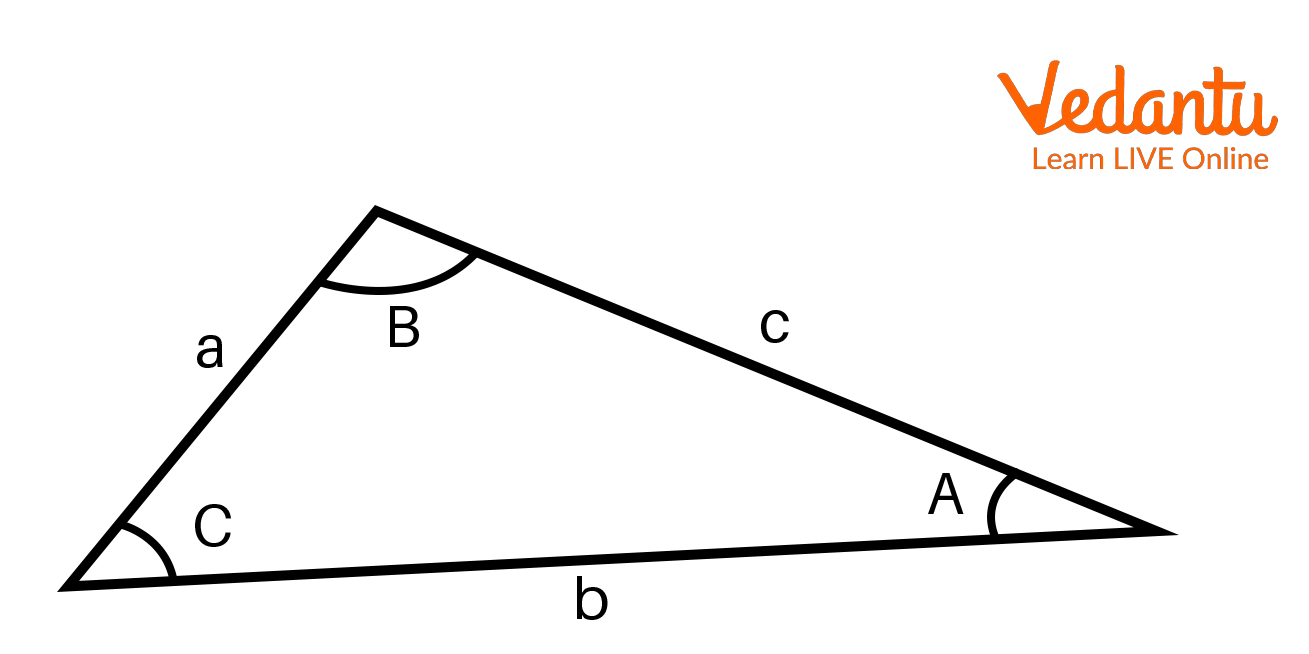
Scalene (Irregular) Triangle
First, we will find the semi-perimeter of the scalene triangle i.e. \[S = \frac{{a + b + c}}{2}\] where ‘a’, ‘b’, and ‘c’ are the length of the sides of the triangle. Next, as per heron’s formula, we have the area of the triangle as:
Area \[ = \sqrt {s(s - a)(s - b)(s - c)} \] is Heron’s formula for isosceles triangle.
Heron’s Formula for Quadrilateral
Suppose ABCD is a quadrilateral where \[AB\parallel CD\]and AC and BD are the diagonals. Let’s suppose AC divides into two triangles, i.e. \[\Delta ADC\]and\[\Delta ABC\].
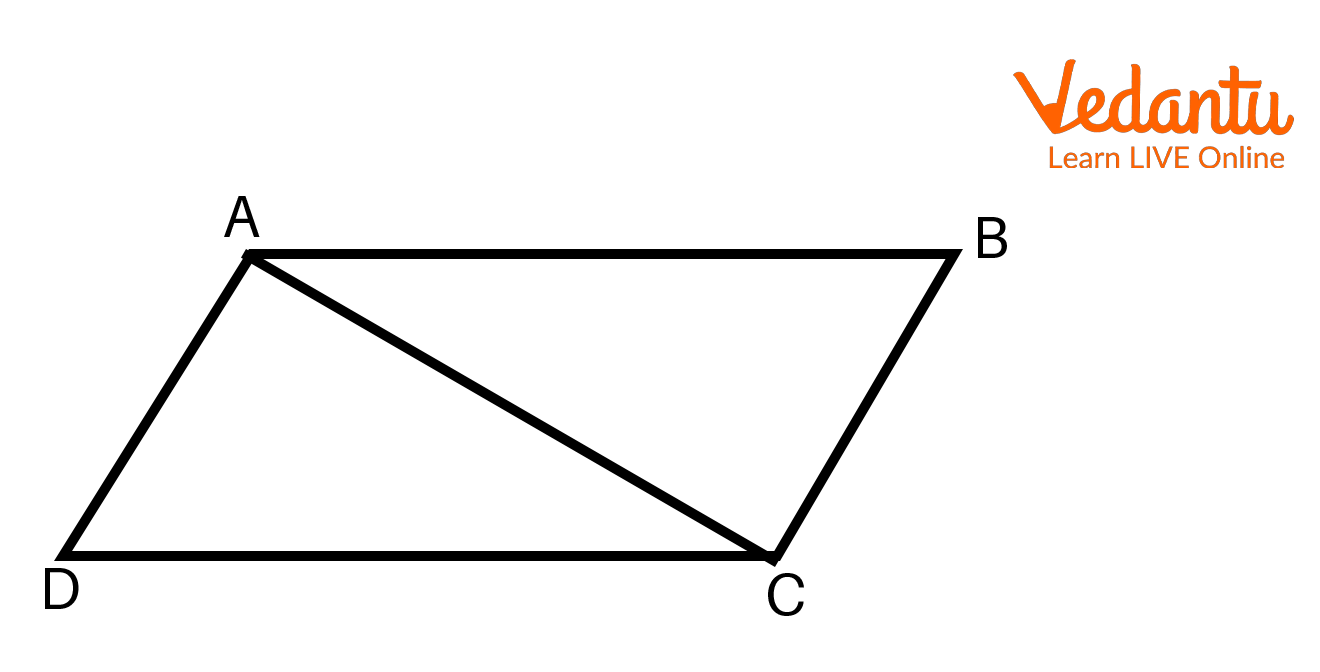
Quadrilateral ABCD
Area of = Area of \[\Delta ADC\] + Area of \[\Delta ABC\].
If we know the length of all the sides of the quadrilateral and the length of AC, we can know using Pythagoras's Theorem. After that, we can find the area of each triangle using Heron’s formulas and add the areas of the triangles to get the area of the quadrilateral using Heron’s formula.
Application of Heron’s Formula
The main applications of Heron’s formula (when all three sides/lengths are given) are:
Find the area of different types of a triangle.
Find the area of a quadrilateral.
Used in applications in trigonometry such as to provide the law of cosines, the law of cotangents, etc
Interesting Facts
Area of Right angled triangle \[ = \frac{1}{2} \times base \times height\]
If a triangle and a parallelogram lie on the same base and between the same set of parallel lines, then the area of the triangle is half of the area of the parallelogram.
Area of Right angled triangle \[ = \frac{1}{2} \times base \times height\]
If a triangle and a parallelogram lie on the same base and between the same set of parallel lines, then the area of the triangle is half of the area of the parallelogram.
Important Questions
1. We are given lengths of all three sides as 25cm, 6cm, and 39cm. Find the area of the triangle.
Solution:
First, we will find the semi-perimeter as:
\[S = \frac{{a + b + c}}{2}\]
\[ \Rightarrow S = \frac{{25 + 56 + 39}}{2}\]
\[ \Rightarrow S = \frac{{120}}{2} = 60\]
Next, the area of the triangle is:
\[ = \sqrt {s(s - a)(s - b)(s - c)} \]
\[ = 420\] sq cm
Hence, the area of the triangle is 420 sq cm.
2. If given the length of the three sides of the triangle as 17cm, 17cm, and 16cm. Find the area of the triangle using two methods.
Solution:
1) By using Pythagoras Theorem (\[\Delta ADB\]):
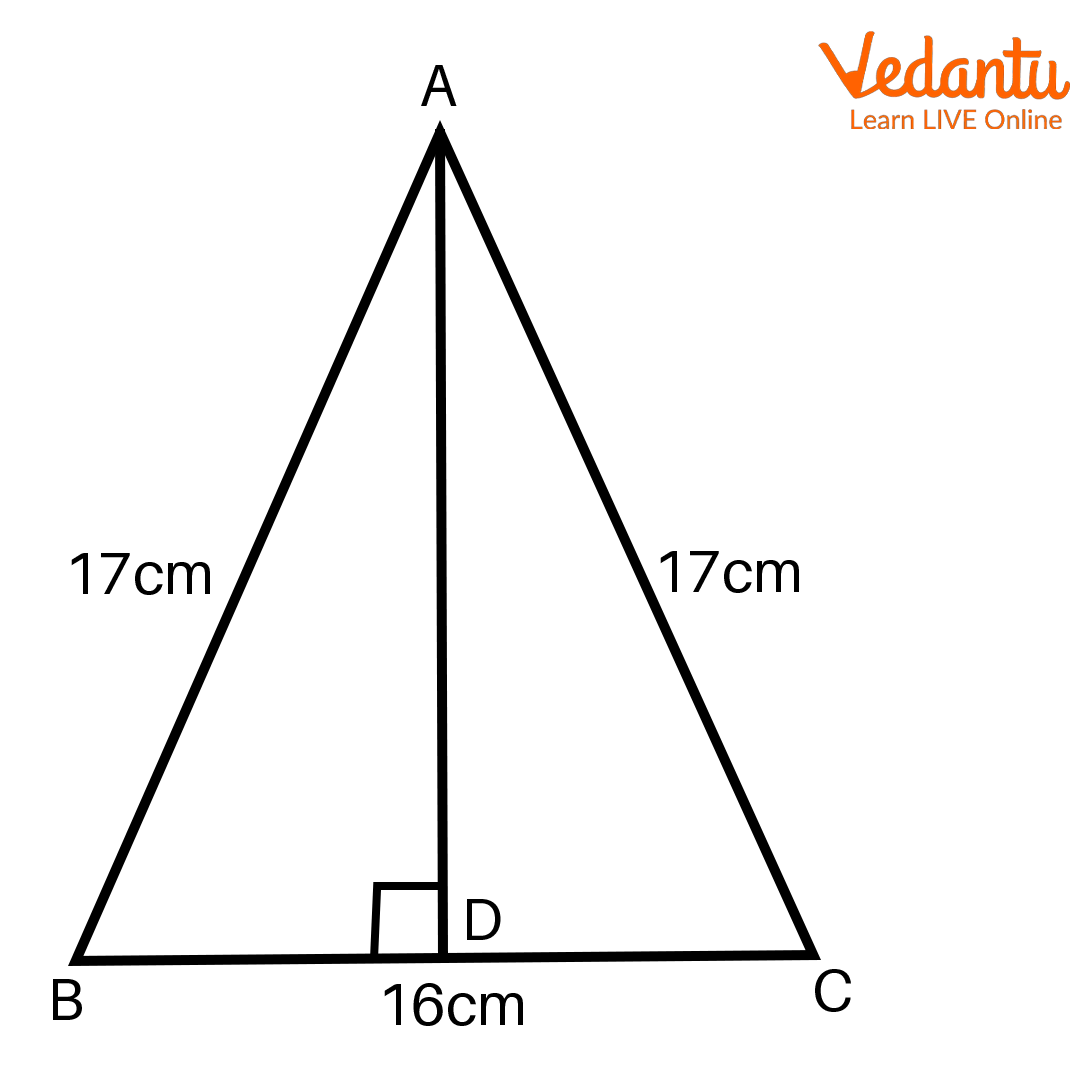
Find the Area of the Triangle
\[\therefore A{D^2} = A{B^2} - B{D^2}\]
\[ \Rightarrow A{D^2} = 289 - 64 = 225\]
\[ \Rightarrow AD = 15\] cm
Thus, the area of the isosceles \[\Delta ABC\]
\[ = \frac{1}{2} \times base \times height\]
\[ = \frac{1}{2} \times 16 \times 15\]
\[ = 120\]sq cm
2) Heron’s Formula
First, find the semi-perimeter of a triangle
\[S = \frac{{a + b + c}}{2}\]
\[ \Rightarrow S = \frac{{17 + 17 + 16}}{2}\]
\[ \Rightarrow S = \frac{{50}}{2} = 25\]
Next, the area of the triangle is
\[ = \sqrt {s{{(s - a)}^2}(s - b)} \]
\[ = \sqrt {25{{(25 - 17)}^2}(25 - 16)} \]
\[ = \sqrt {25{{(8)}^2}(9)} \]
\[ = \sqrt {{{(5)}^2}{{(8)}^2}{{(3)}^2}} \]
\[ = 5 \times 8 \times 3 = 120\]sq m
Hence, the area of the triangle is 120sq m.
3. In a parallelogram ABCD diagonal BD = 18 cm, perimeter of the parallelogram = 60 cm and AB = 2BC. Find the area of .
Solution:
According to the given information, we get the following:
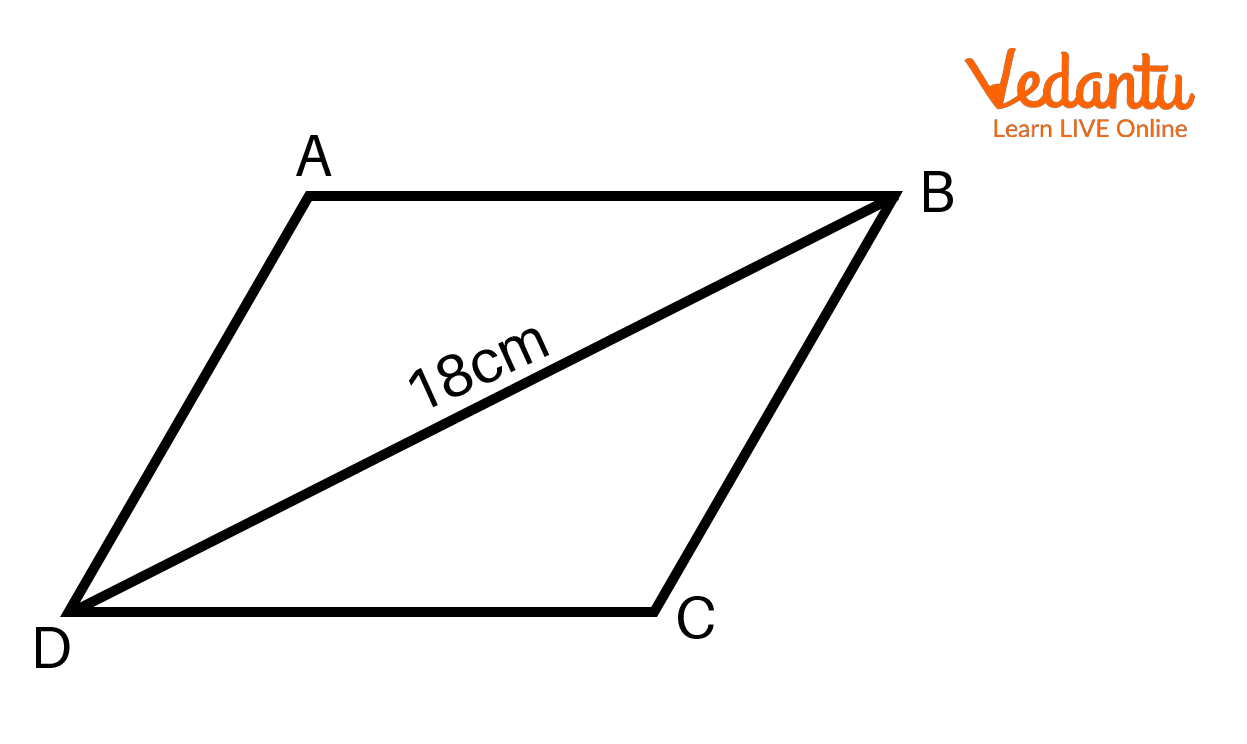
Parallelogram ABCD
As we know, opposite sides of the parallelogram are equal
AB = CD and BC = DA ------- (1)
Also, perimeter of = (AB + BC + CD + DA) = 60 cm (given) ------ (2)
\[\therefore AB + BC + AB + BC = 60\]
\[ \Rightarrow 2AB + 2BC = 60\]
\[ \Rightarrow 2(AB + BC) = 60\]
\[ \Rightarrow AB + BC = 30\]cm ------- (3)
Next,
\[\therefore 2BC + BC = 30\]
\[ \Rightarrow 3BC = 30\]
\[ \Rightarrow BC = 10\]cm -------- (4)
And, given that \[AC = 2BC\]
\[ \Rightarrow AB = 2 \times 10 = 20\] cm
Now from (1), we have
AB = CD = 20cm ------- (5)
BC = DA = 10cm ------- (6)
Also, we know that the diagonal of a parallelogram divides it into two congruent triangles
\[ \Rightarrow \Delta ABD \cong \Delta CDB\]
\[ \Rightarrow \] Area of \[\Delta ABD\]= Area of \[\Delta CBD\]
\[ \Rightarrow \]Area of = 2 (\[\Delta ABD\]) ------- (7)
Next, the Heron’s Formula is
\[ = \sqrt {s(s - a)(s - b)(s - c)} \] where a=20cm, b=18cm, c=10cm
So, the semi-perimeter is:
\[s = \frac{{a + b + c}}{2}\]
\[ \Rightarrow s = \frac{{AB + BD + DA}}{2}\]
\[ \Rightarrow s = \frac{{20 + 18 + 10}}{2} = 24\]cm
Thus, area of the \[\Delta ABD\] using the Heron’s Formula is:
\[ = \sqrt {s(s - a)(s - b)(s - c)} \]
\[ = \sqrt {24(24 - 20)(24 - 18)(24 - 10)} \]
\[ = \sqrt {24(4)(6)(14)} \]
\[ = 24\sqrt {14} \]sq cm
Now from (7), we have
\[\therefore \]Area of = 2 (\[\Delta ABD\])
\[ \Rightarrow \]Area of \[ = 2 \times 24\sqrt {14} \]\[ = 48\sqrt {14} \]sq cm
Hence, the area of parallelogram ABCD is \[48\sqrt {14} c{m^2}\]
Conclusion
The article summarizes the theorem of equal chords and their distances from the center i.e. equal chords are equidistant from the center and then converse too. Then we learned the theorem of the intersection of equal chords too. Also, this article has solved examples to understand the concepts easily.
Practice Questions
1. If the lengths of the sides are 12m, 11m, and 5m. Find the area of the triangle.
2. Can we find the area of these polygons?
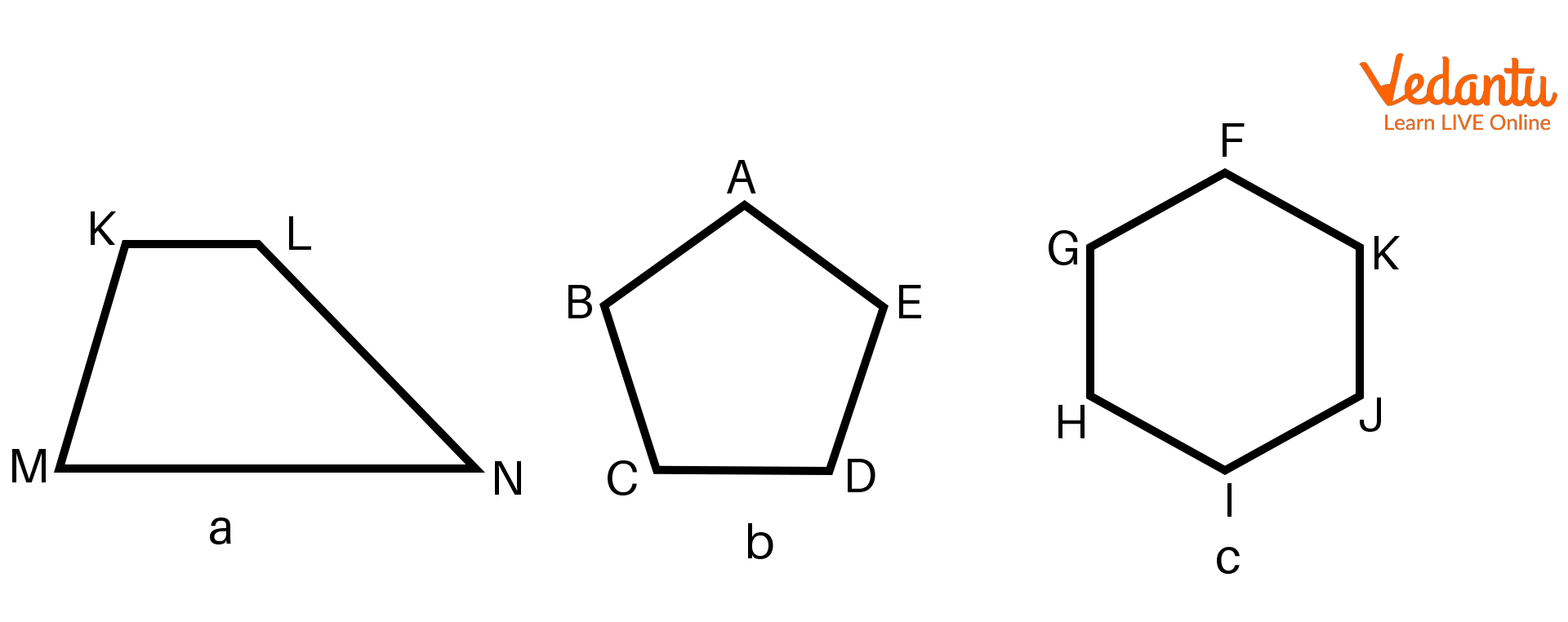
Different Types of Polygons
Yes
No
Can’t determined
Answers:
1) 27.5 sq m
2) A
List of Related Articles


FAQs on Application of Herons Formula in Finding Areas of Quadrilaterals
1. What is the application of Heron’s formula in finding the area of a quadrilateral?
The application of Heron’s formula in finding the area of a quadrilateral is to divide the quadrilateral into two triangles and calculate each triangle’s area using its three sides.
Steps involved:
- Divide the quadrilateral into two triangles by drawing a diagonal.
- Find the three sides of each triangle.
- Use Heron’s formula: Area = √[s(s − a)(s − b)(s − c)], where s = (a + b + c)/2.
- Add the two triangle areas to get the total area of the quadrilateral.
2. How do you find the area of a quadrilateral using Heron’s formula?
To find the area of a quadrilateral using Heron’s formula, divide it into two triangles and calculate each area separately.
Procedure:
- Draw a diagonal to form two triangles.
- Measure the three sides of each triangle.
- Compute the semi-perimeter: s = (a + b + c)/2.
- Apply Area = √[s(s − a)(s − b)(s − c)] for each triangle.
- Add both triangle areas.
3. What is Heron’s formula?
Heron’s formula is used to find the area of a triangle when all three sides are known and is given by Area = √[s(s − a)(s − b)(s − c)].
Where:
- a, b, c are the side lengths.
- s = (a + b + c)/2 is the semi-perimeter.
4. Can Heron’s formula be used for any quadrilateral?
Yes, Heron’s formula can be used for any quadrilateral if it can be divided into two triangles with known side lengths.
Important points:
- You must know all four sides and at least one diagonal.
- The diagonal helps form two triangles.
- Apply Heron’s formula separately to each triangle.
5. What information is required to apply Heron’s formula to a quadrilateral?
To apply Heron’s formula to a quadrilateral, you need the lengths of all four sides and one diagonal.
This ensures:
- Two triangles are formed.
- Each triangle has three known sides.
- Heron’s formula can be applied correctly.
6. Can you give an example of finding the area of a quadrilateral using Heron’s formula?
Yes, the area of a quadrilateral can be found by dividing it into triangles and applying Heron’s formula.
Example:
- Suppose a quadrilateral is divided into triangles with sides (5 cm, 6 cm, 7 cm) and (5 cm, 8 cm, 9 cm).
- For triangle 1: s = (5 + 6 + 7)/2 = 9 → Area = √[9(4)(3)(2)] = 6√6 cm².
- For triangle 2: s = (5 + 8 + 9)/2 = 11 → Area = √[11(6)(3)(2)] = 6√11 cm².
- Total area = 6√6 + 6√11 cm².
7. Why do we divide a quadrilateral into two triangles to use Heron’s formula?
We divide a quadrilateral into two triangles because Heron’s formula applies only to triangles, not directly to quadrilaterals.
Explanation:
- A quadrilateral has four sides.
- Drawing a diagonal creates two triangles.
- Each triangle’s area can be found using its three sides.
8. What is the semi-perimeter in Heron’s formula?
The semi-perimeter in Heron’s formula is half the perimeter of a triangle and is calculated as s = (a + b + c)/2.
Where:
- a, b, c are the three sides of the triangle.
9. What are common mistakes when using Heron’s formula for quadrilaterals?
Common mistakes when using Heron’s formula for quadrilaterals include incorrect semi-perimeter calculation and missing the diagonal length.
Typical errors:
- Not dividing the quadrilateral correctly.
- Using wrong side lengths for triangles.
- Miscalculating s = (a + b + c)/2.
- Forgetting to add both triangle areas.
10. How is Heron’s formula useful in mensuration problems involving quadrilaterals?
Heron’s formula is useful in mensuration problems because it helps calculate the area of irregular quadrilaterals when only side lengths are known.
Applications include:
- Finding land areas in surveying.
- Solving geometry exam problems.
- Calculating areas of non-rectangular plots.
