









How to Solve Addition Sums for Class 3 with Examples and Properties
If you bought fifty candies in the morning and thirty-six more at night, then what is the total number of candies you bought in a day? Do you know the answer to this question? Let us learn the concept of addition for class 3 with questions and various examples.
The basic concept of addition was taught in the previous classes. In addition for class 3, we will learn a little advanced concept of addition. We will see how to do two-digit add and three-digit add. We will also understand the concept of addition with carrying. We will be looking at the concept with various additional examples. Addition questions will also be provided at the end. Maths worksheets for class 3 will also be shared at the end. So, let us begin the module now.
Concept of Addition
The addition is the sum of two or more numbers, be it single digit, double-digit, triple-digit, or so on. We can add any two numbers together and see the outcome of adding two numbers.
For Example, there are 7 strawberries in one basket and 4 strawberries in another basket. What would be the total number of strawberries?
We can understand this by this diagram where it is given that first take 7 on the line and then from 7 add 4 more. The result of the addition would be 11. This picture makes the concept simple and understandable.

Addition
We can write this as 7 + 4 = 11 or seven + four = eleven. This is read as 7 plus 4 equals 11 in total. The addition of these can simply be done by using one’s fingers also.
Firstly, remember the digit 7 in your head and make 4 in your hand with the help of your fingers. As 7 is in your head, start counting 4 from 7 which is 8, 9, 10, and 11. Stop after counting 4 to 7 which would give you the result as 11.
Vertical Addition
Vertical addition is a method of adding where the numbers are lined up in columns according to their place values. The addition can be done vertically also. Let us see how to solve addition questions vertically. Firstly, let's learn the concept of place value.

Place Value
The digit which is placed at the rightmost is called Ones because it is at one's place, the digit left to the Ones is called Tens because it is at tens place, and the digit left to Tens is called Hundreds. After all, it is a hundred places and the digit left to Hundred is called Thousands and so on. In the example given above, 5 is Ones, 6 is Tens, 4 is Hundreds, and 3 is a Thousand places.
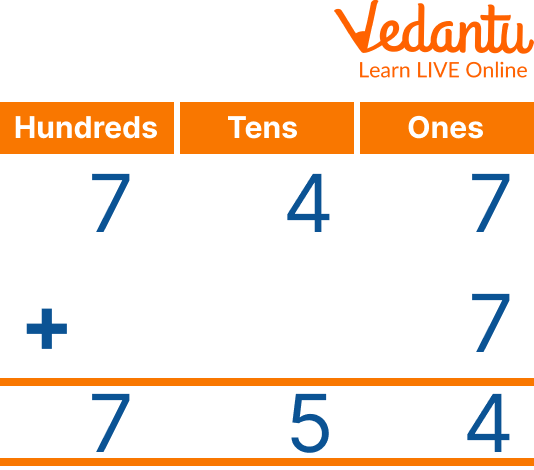
Addition of 747 and 7
Look at the example of vertical addition. Here firstly, we have to add the digits in one place i.e. 7+7 which is equal to 14. As per the rule 4 is the digit at one's place, so write 4 in the one's box. Put the 1 of 14 as a carry to 4, then we have to add 4+1 which is 5. 5 will come in tenth place. Finally, the seven at the hundredth place would remain as 7.
Hence, the total would be 754.
Solved Examples
Addition Examples
Q 1. The first question is 459 + 587 = ?
Ans: By placing them in the order of place value, the addition can be done by the simple method. Firstly arrange them in a vertical format where the larger number is at the top. Start adding the ones digit then tens and so on. 9+7 is 16 so 1 would go as a carry-on 8. 8 would become 9 and then 9 would be added to 5. The answer to this would be 1046.
Q 2. What would be the sum of 766 + 235 ?
Ans: By placing them in the order of place value, the addition can be done by the simple method. Firstly arrange them in a vertical format where the larger number is at the top. Start adding the ones digit then tens and so on. 6+5 would be 11, then 1 would go as a carry-on 6 at tens place. 7+3 would be 10 so 1 would go as a carry-on 7. The answer to this would be 1001.
Practice on your own
Addition Questions
Q 1. 879 + 55 = ?
Ans: 934
Q 2. 777 + 666 = ?
Ans: 1443
Summary
The addition for class 3rd is a little advanced and has to be understood well, all the concepts have to be understood at the base level only. It makes all the concepts of the future easy. These examples and methods have to be grasped well. Kids should solve as many maths worksheets as possible. Practice makes a man perfect. Here you will get new tricks for addition. This will make your studies fun. You can do addition in very less time after learning these rules.
FAQs on Addition for Class 3 Explained with Simple Steps
1. What is addition in Maths for Class 3?
Addition is the process of combining two or more numbers to find their total or sum. In Class 3 Maths, addition helps students add 2-digit and 3-digit numbers with or without carrying. For example:
- 23 + 15 = 38
- 120 + 130 = 250
2. How do you add 3-digit numbers step by step?
To add 3-digit numbers, arrange them by place value and add from right to left. Follow these steps:
- Step 1: Write numbers in columns (ones, tens, hundreds).
- Step 2: Add the ones digits first.
- Step 3: Add the tens digits.
- Step 4: Add the hundreds digits.
- 345 + 123 = 468
3. What is carrying in addition?
Carrying in addition happens when the sum of digits in a column is 10 or more, and we carry over to the next place value. For example:
- 27 + 18
- 7 + 8 = 15 → Write 5, carry 1
- 2 + 1 + 1 = 4
- Answer = 45
4. What is addition without carrying?
Addition without carrying means adding numbers where the sum in each column is less than 10. No regrouping is needed. Example:
- 34 + 25
- 4 + 5 = 9
- 3 + 2 = 5
- Answer = 59
5. What are the properties of addition?
The main properties of addition are the commutative property, associative property, and identity property.
- Commutative property: a + b = b + a (Example: 4 + 6 = 6 + 4)
- Associative property: (a + b) + c = a + (b + c)
- Identity property: a + 0 = a
6. What is the formula for addition?
The basic formula for addition is Addend + Addend = Sum. In simple form:
- a + b = sum
- 12 + 8 = 20
7. How do you check addition answers?
You can check addition answers by using subtraction. Subtract one addend from the sum to see if you get the other addend. Example:
- 45 + 23 = 68
- Check: 68 − 23 = 45
8. What is the difference between addition and subtraction?
Addition combines numbers to find the total, while subtraction finds the difference between numbers.
- Addition example: 20 + 10 = 30
- Subtraction example: 20 − 10 = 10
9. Can you give a word problem example of addition for Class 3?
A word problem in addition combines numbers to find the total quantity. Example:
- Riya has 35 apples and buys 25 more.
- Total apples = 35 + 25
- Answer = 60 apples
10. What are common mistakes in addition for Class 3?
Common mistakes in Class 3 addition usually happen due to place value errors or forgetting to carry.
- Not aligning digits by place value
- Forgetting to carry over
- Adding digits incorrectly
- Skipping a step while solving
