









How to Solve Addition and Subtraction Problems for Year 5 with Step by Step Examples
Every day, we face a variety of situations in which we do simple arithmetic operations. We are already familiar with numbers and the number system. Now we will discuss two simple arithmetic operations, that is, addition and subtraction.
These are two important arithmetic operations where we add and subtract two or more numbers or mathematical values. The symbol that represents addition is ‘+’ and subtraction is ‘-’.
Addition in Year 5
One of the most simple topics for school kids is addition of numbers.
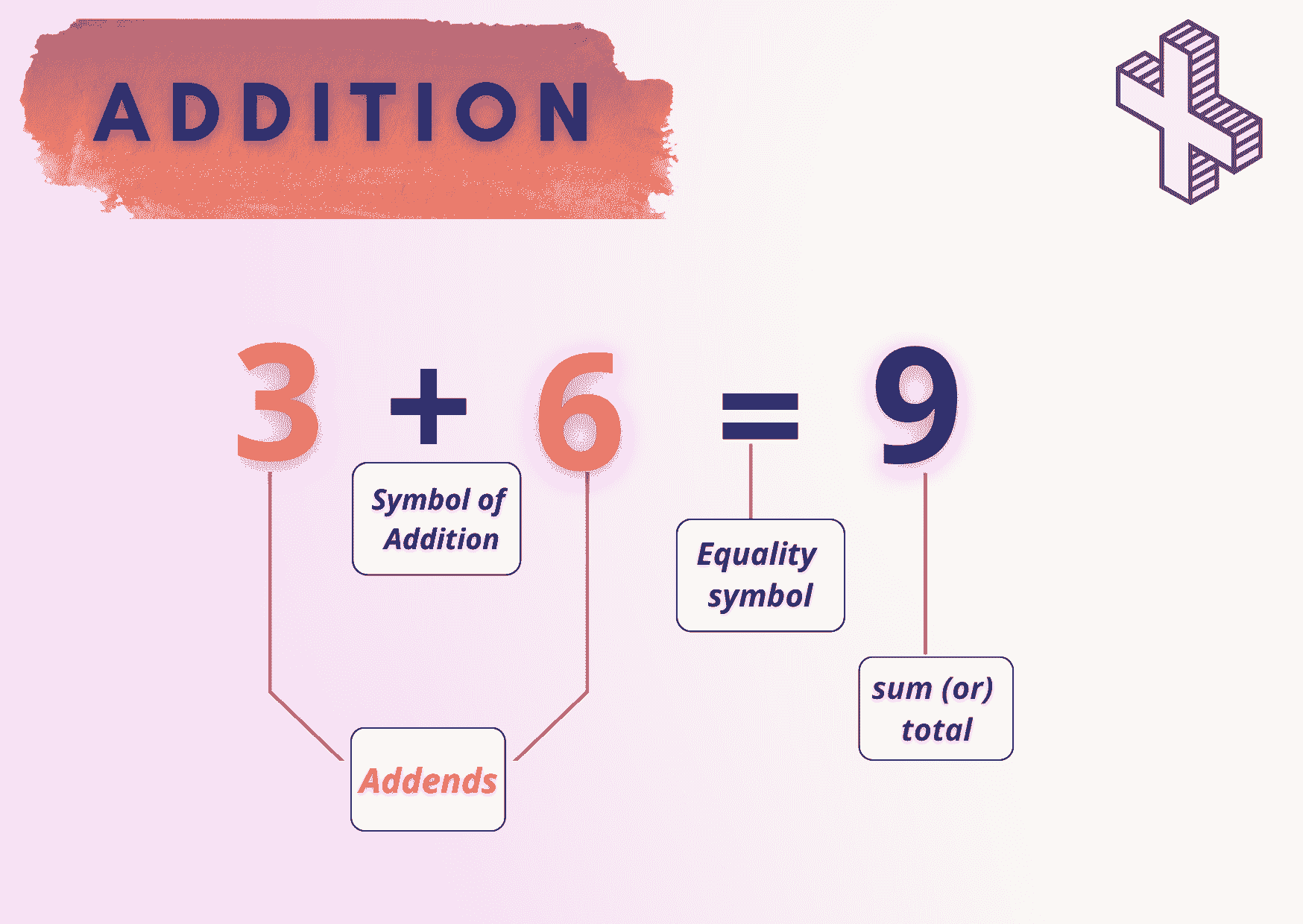
Parts of Addition Problem
The term "addition" means the process of adding two or more numbers. The plus sign '+' is used to signify addition. For example, the addition of 3 and 6 can be written as 3 + 6.
Addition Properties for Year 5 Kids
The addition of two or more numbers has some important properties. We’ll discuss list of those properties of addition below:
When two whole numbers are added together, the result is another whole number.
When two natural numbers are added together, the result is another natural number.
Two integers added together will give an integer; two positive integers added together will be a positive integer; two negative integers added together will be a negative number; and one positive and one negative integer added together will be an integer with the same sign which the largest number has.
When two rational numbers are added together, the result is a rational number once again. Also, the properties relating to positive and negative signs will be the same as they are for integers.
Any number added to 0 equals the number itself.
Methods of Addition
There are different methods to add numbers. They are:
By counting figures: Here we’ll just start counting the figures from 1.
With the help of a number line: On a number line, addition is as simple as counting positive numbers as you move towards the right-hand side. It helps you in imagining the addition operation with small numbers.
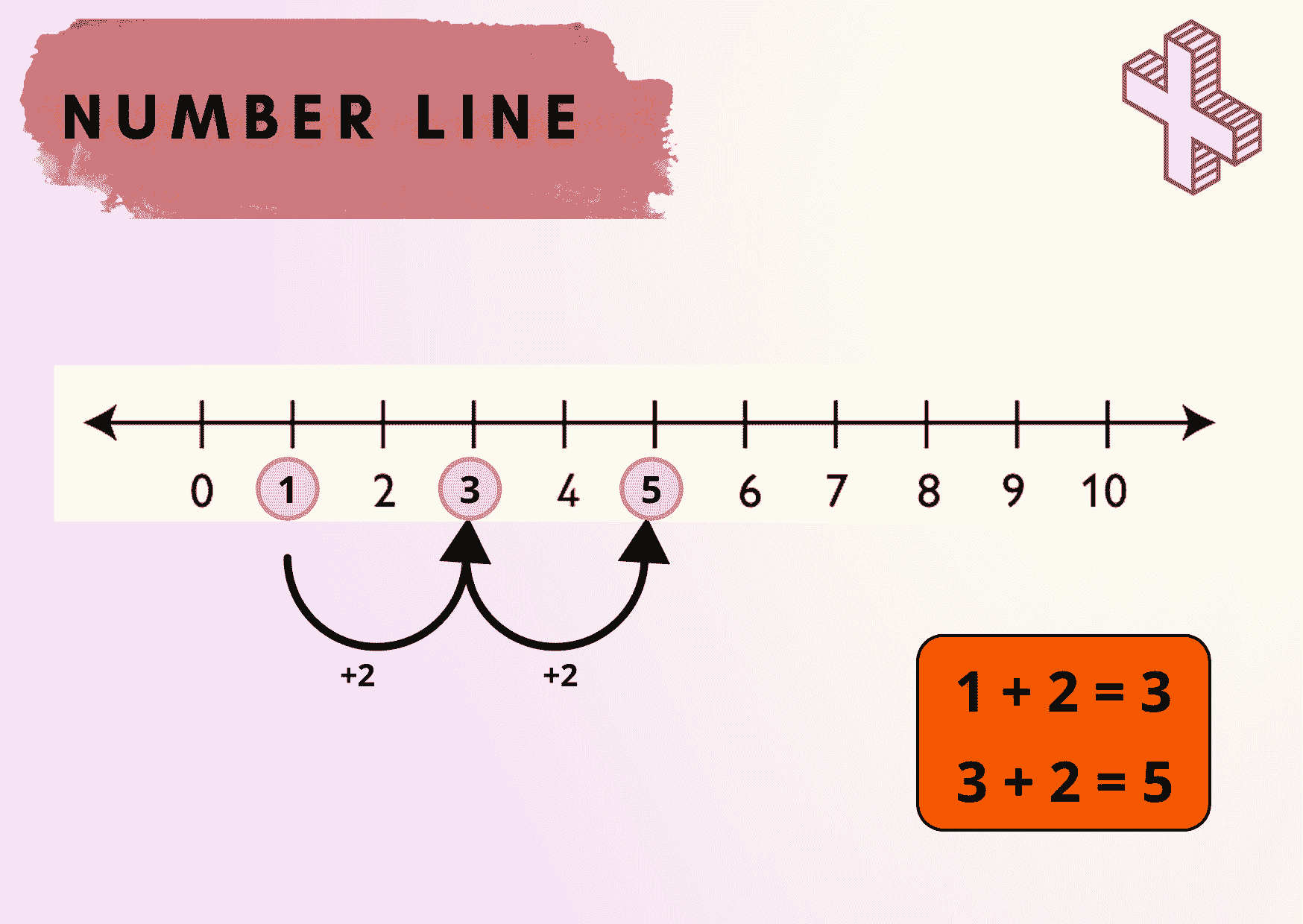
Addition Using a Number Line
With regrouping: When adding two or more numbers of any size, addition with regrouping is a method used. It's applied with the column method of addition, which arranges sums vertically and column numbers are added one at a time.
With the help of addition tables: The addition table chart from numbers 1 to 10 is shown in the figure below.
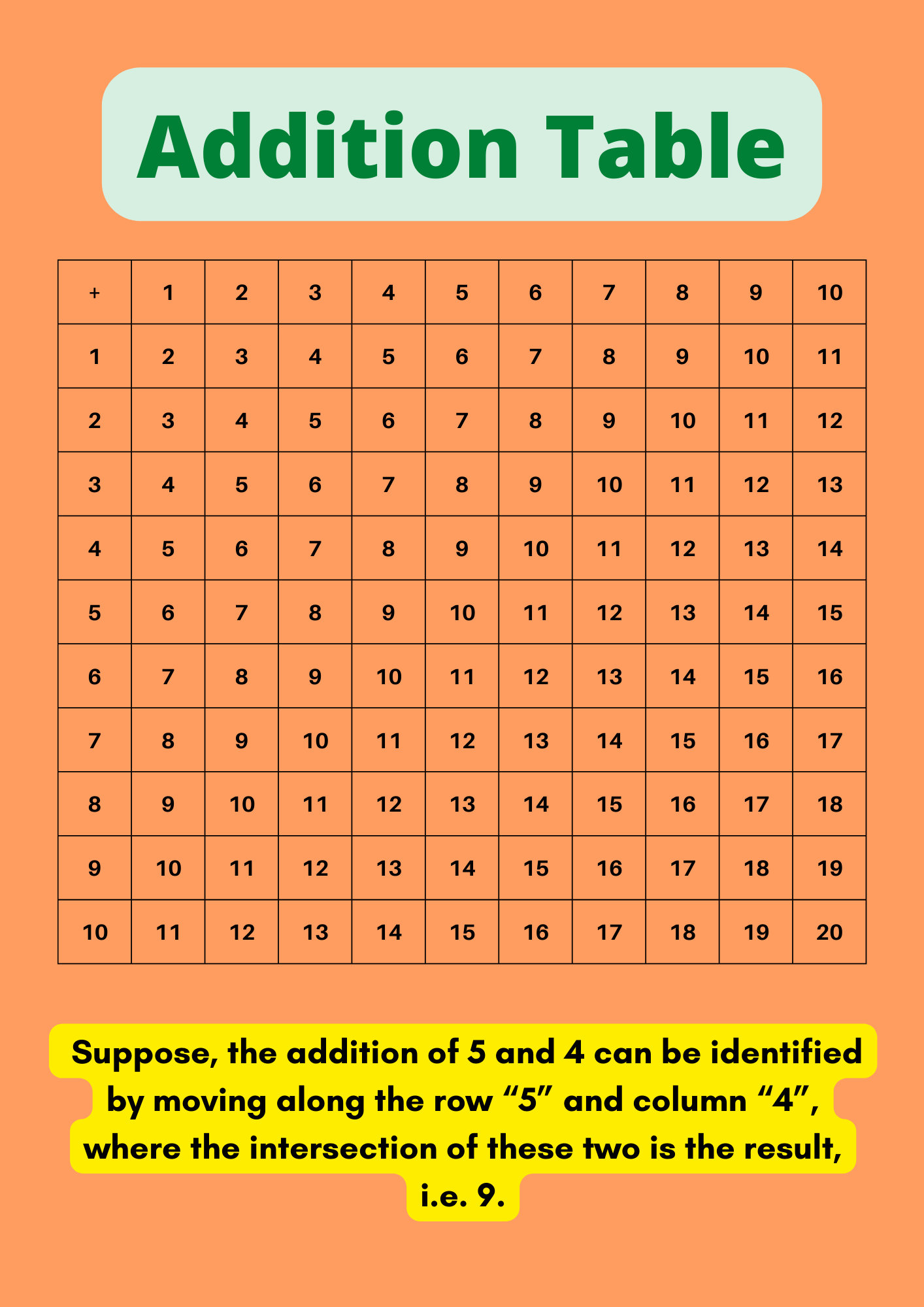
Addition Table
Subtraction for Year 5
The operation of removing objects from a collection is done by subtraction. Subtraction is symbolised by the minus sign. If there are 8 apples arranged in a basket, and 4 apples are taken out, there will be 8 – 4 apples left in the basket. So , the difference between 8 and 4 is 4, or 8 - 4 = 4.
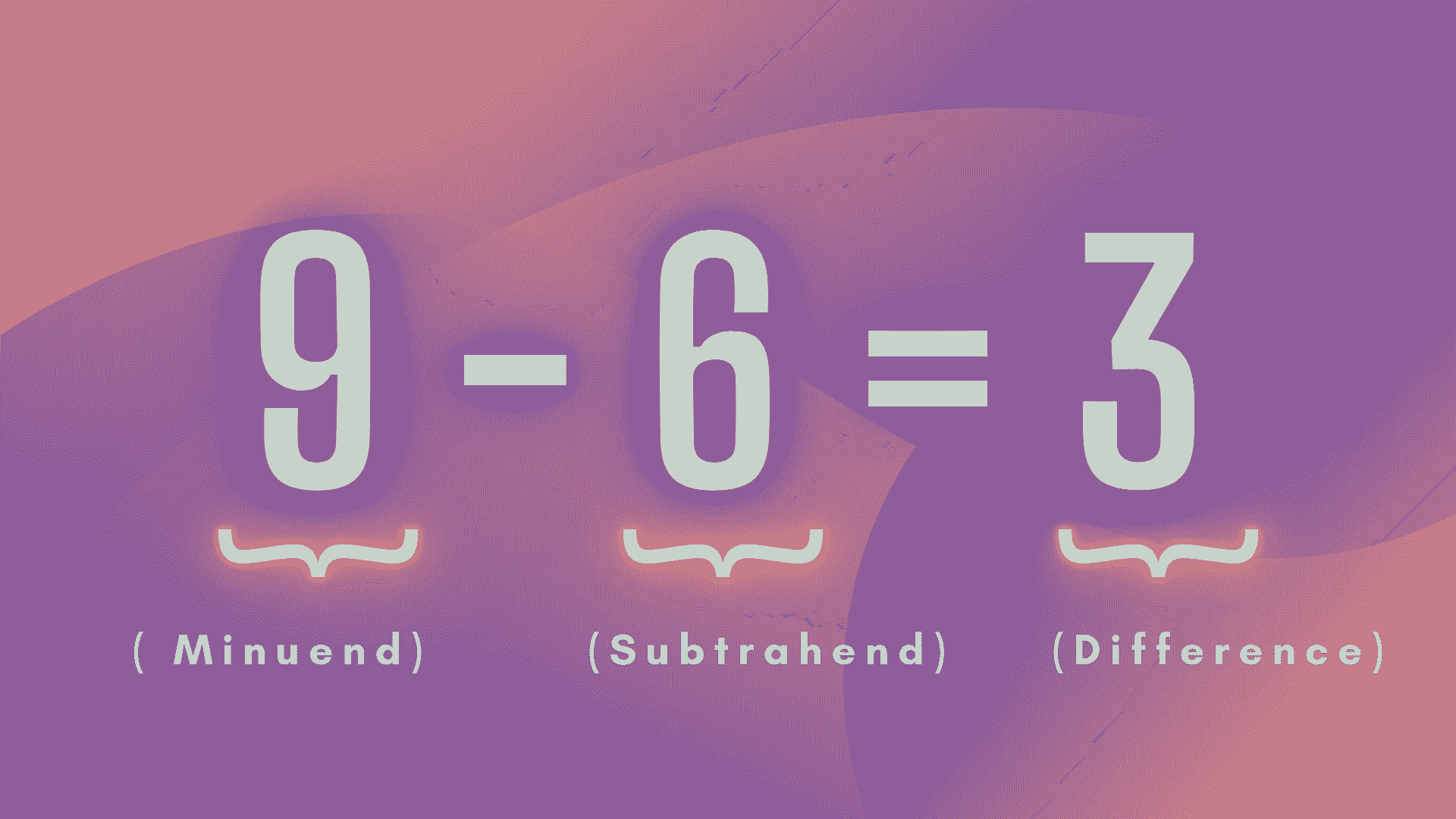
Parts of a Subtraction Problem
Subtraction Properties for Year 5 Kids
Subtraction of numbers possess some properties as given below:
Subtraction of 0 from any number gives the number itself, implying that the difference is nil.
When we subtract 1 from any number, the difference always equals the number's predecessor.
Number subtraction is anti-commutative.
Subtraction of numbers is a non-associative operation.
Solved Examples
1. What is the sum of 5071 and 3412?
Solution: Sum is nothing but the total of two given numbers.
⇒ 5071+3412= 8483
Hence, the sum of 5071 and 3412 is 8483.
2. What is the difference between 8731 and 3128?
Solution: Difference is nothing but subtraction.
⇒ 8731-3128= 5603
Hence, the difference between 8731 and 3128 is 5603.
3. How much smaller is 3512 than 9291?
Solution: To find the solution, we have to find the difference between 3512 and 9291.
So, we know that difference is nothing but subtraction.
⇒ 9291-3512= 5779
Therefore, 3512 is smaller as it is 5779 less.
4. Which is greater, 4929 or 9129 and by how much?
Solution: By looking at the numbers we can easily say that 9129 is greater than 4929.
To find how much greater, we have to find the difference between 4929 and 9129.
⇒ 9129-4929= 4200
Therefore, 9129 is bigger as it is 4200 more than 4929.
Conclusion
The progress of a strong understanding of addition and subtraction is required for the development of later concepts such as other arithmetic operations, measurements-based calculations, and algebra. A kid can learn the fundamentals of addition while studying the number system.
FAQs on Addition and Subtraction for Year 5 Maths Guide
1. What do Year 5 students learn in addition and subtraction?
In Year 5 addition and subtraction, students learn to add and subtract numbers up to 6 digits, including decimals, using formal written methods. Key skills include:
- Adding and subtracting whole numbers up to 1,000,000
- Using the column method with regrouping (carrying and borrowing)
- Adding and subtracting numbers with up to 3 decimal places
- Solving multi-step word problems involving addition and subtraction
- Checking answers using the inverse operation
These skills build strong number sense and prepare learners for upper Key Stage 2 maths.
2. How do you add large numbers using the column method?
To add large numbers using the column method, line up the digits by place value and add from right to left. Follow these steps:
- Write the numbers one under the other, aligning units, tens, hundreds, etc.
- Add the digits in the ones column first.
- Carry over (regroup) if the total is 10 or more.
- Continue column by column to the left.
Example: 45,678 + 23,456 = 69,134. This formal method ensures accuracy with large numbers.
3. How do you subtract large numbers with borrowing?
To subtract large numbers, use the column subtraction method and regroup when needed. Follow these steps:
- Line up numbers by place value.
- Start subtracting from the ones column.
- If the top digit is smaller, borrow from the next column.
- Continue subtracting across each column.
Example: 52,403 − 18,759 = 33,644. Borrowing ensures correct subtraction when digits are smaller on top.
4. How do you add and subtract decimals in Year 5?
To add or subtract decimals, line up the numbers by the decimal point before calculating. Key steps include:
- Write numbers in columns with decimal points aligned.
- Add zeros where needed to make equal decimal places.
- Add or subtract as with whole numbers.
- Bring the decimal point straight down into the answer.
Example: 4.75 + 2.60 = 7.35. Correct alignment prevents place value errors.
5. What is the inverse operation in addition and subtraction?
The inverse operation means that addition and subtraction undo each other. For example:
- If 345 + 120 = 465
- Then 465 − 120 = 345
In Year 5 maths, inverse operations are used to check answers and solve missing number problems accurately.
6. How do you solve multi-step word problems with addition and subtraction?
To solve multi-step word problems, identify the operations needed and calculate in the correct order. Follow these steps:
- Read the question carefully and underline key numbers.
- Decide whether to use addition, subtraction, or both.
- Solve one step at a time.
- Check your answer using the inverse operation.
Example: A shop sold 2,450 apples on Monday and 1,275 on Tuesday. Total sold = 3,725 apples.
7. What is the difference between addition and subtraction?
The difference is that addition combines numbers to find a total, while subtraction finds the difference between numbers. In simple terms:
- Addition answers: “How many altogether?”
- Subtraction answers: “How many left?” or “What is the difference?”
For example, 8 + 5 = 13, but 13 − 5 = 8. They are inverse operations.
8. What are common mistakes in Year 5 addition and subtraction?
Common mistakes in Year 5 addition and subtraction usually involve place value errors or incorrect regrouping. These include:
- Not lining up digits correctly by place value
- Forgetting to carry in addition
- Incorrect borrowing in subtraction
- Misplacing the decimal point
Careful alignment and checking with the inverse operation help avoid these errors.
9. How do you estimate answers in addition and subtraction?
To estimate in addition and subtraction, round numbers to the nearest 10, 100, or 1,000 before calculating. Steps include:
- Round each number to a friendly number.
- Add or subtract the rounded numbers.
- Compare the estimate with the exact answer.
Example: 4,782 + 2,119 ≈ 4,800 + 2,100 = 6,900. Estimation helps check if answers are reasonable.
10. Can you give an example of a Year 5 addition and subtraction calculation?
A typical Year 5 addition and subtraction calculation involves large numbers or decimals. Example:
- Addition: 67,845 + 12,367 = 80,212
- Subtraction: 90,000 − 27,458 = 62,542
These examples use the formal column method and require accurate place value alignment.
