






Who Are the Padma Award Winners in India and How Are They Selected?
The Padma Awards are among the highest civilian honors in India, recognizing exceptional achievements and distinguished service in various fields. Instituted in 1954, these awards celebrate individuals who have made significant contributions to society in areas such as art, literature, education, science, sports, public affairs, medicine, social work, and more. Padma Awardees in India represent excellence, dedication, and national pride, making this topic highly important for General Knowledge, competitive exams, and academic awareness.
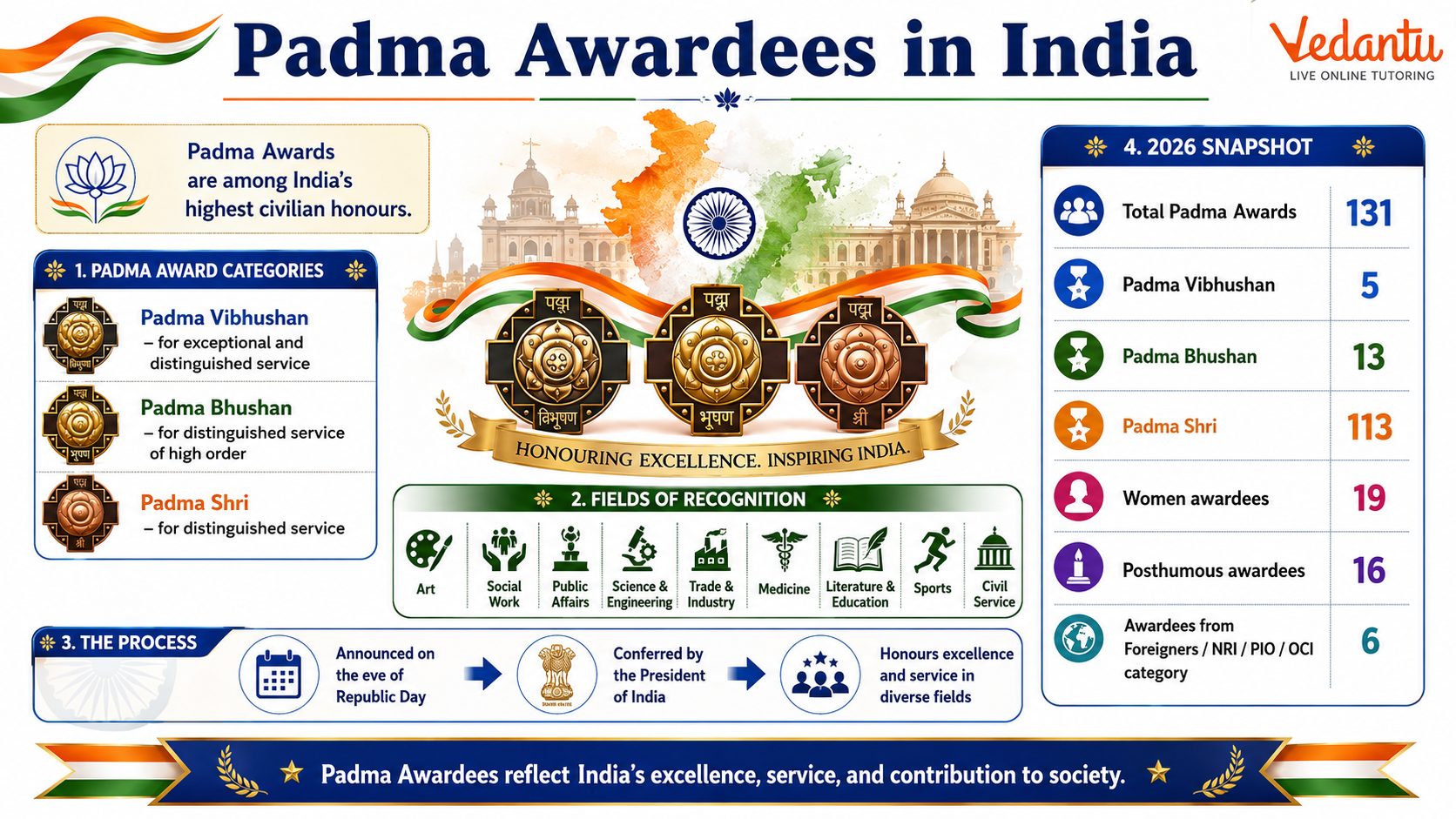
Overview of Padma Awards
The Padma Awards are announced annually on the occasion of Republic Day, January 26. They are conferred by the President of India at ceremonial functions held at Rashtrapati Bhavan. The awards are categorized into three distinct levels based on the degree of contribution and impact of the individual's service.
Categories of Padma Awards
| Award Name | Year Instituted | Level of Recognition |
|---|---|---|
| Padma Vibhushan | 1954 | Exceptional and distinguished service |
| Padma Bhushan | 1954 | Distinguished service of high order |
| Padma Shri | 1954 | Distinguished service in any field |
The Padma Vibhushan is the second highest civilian award after the Bharat Ratna. Padma Bhushan and Padma Shri follow in descending order of prestige. These awards are open to all persons without distinction of race, occupation, position, or gender.
Fields of Recognition
Padma Awards are given in a wide range of disciplines. The government recognizes both popular personalities and unsung heroes who have worked selflessly at the grassroots level.
- Art and Culture
- Literature and Education
- Science and Engineering
- Medicine
- Social Work
- Public Affairs
- Civil Service
- Sports
- Trade and Industry
Selection Process of Padma Awardees
The selection of Padma Awardees follows a structured and transparent process. Nominations are open to the public and can be submitted online. Self nominations are also allowed.
Steps in the Selection Process
- Public nominations are invited by the Ministry of Home Affairs.
- A Padma Awards Committee reviews all nominations.
- Recommendations are submitted to the Prime Minister and President.
- Final approval is granted by the President of India.
The committee is constituted every year and includes eminent persons from various fields. The aim is to ensure fairness, inclusivity, and recognition of genuine contributions.
Notable Padma Awardees in India
Over the years, many distinguished personalities have received Padma Awards. These awardees come from diverse backgrounds and have significantly impacted Indian society.
Examples of Renowned Padma Awardees
- Dr. A. P. J. Abdul Kalam - Awarded Padma Bhushan and Padma Vibhushan for contributions to science and public service.
- Lata Mangeshkar - Honored for exceptional contribution to Indian music.
- Sachin Tendulkar - Recognized for outstanding achievements in cricket.
- M. S. Swaminathan - Awarded for contributions to agricultural science.
- Mary Kom - Honored for excellence in boxing.
Key Facts About Padma Awardees
- The awards are civilian honors and do not carry any monetary grant.
- The total number of awards in a year is generally limited to 120, excluding posthumous awards and foreign nationals.
- The awards can be given posthumously.
- Foreign nationals and Non Resident Indians are also eligible.
- The awards were briefly suspended between 1978 to 1979 and 1992 to 1995.
Importance of Padma Awardees in General Knowledge
Padma Awardees are frequently asked about in competitive examinations such as UPSC, SSC, Banking, State PSC, and other government exams. Questions may relate to recent award winners, categories of awards, eligibility, or notable personalities. Staying updated with the latest list of awardees each year is essential for exam preparation.
Understanding Padma Awardees in India also helps students appreciate the diverse talents and services that contribute to national development. It builds awareness about individuals who inspire society through excellence and dedication.
Conclusion
Padma Awardees in India symbolize the spirit of service, innovation, and commitment across various sectors. Since 1954, these awards have honored thousands of individuals who have enriched the nation through their work. For students and aspirants, knowledge about Padma Awards is essential for General Knowledge preparation and understanding India's system of civilian honors. Keeping track of recent awardees and their contributions ensures a strong foundation in current affairs and national recognition systems.
FAQs on Padma Award Winners in India – Complete Guide for Students
1. What are the Padma Awards in India?
The Padma Awards are one of the highest civilian honours in India, given for distinguished service in various fields.
• Instituted in 1954 by the Government of India
• Announced annually on the Republic Day (26 January)
• Conferred by the President of India
• Recognise excellence in fields like art, literature, education, science, sports, medicine, public affairs, and social work
These awards are a key part of India’s civilian award system and are often searched under terms like Indian national awards and civilian honours in India.
2. What are the different categories of Padma Awards?
The Padma Awards are divided into three categories based on the level of achievement and service.
• Padma Vibhushan – For exceptional and distinguished service
• Padma Bhushan – For distinguished service of a high order
• Padma Shri – For distinguished service in any field
These categories rank below the Bharat Ratna, India’s highest civilian award, and are commonly asked in GK and competitive exams.
3. Who selects the Padma Awardees in India?
The Padma Awardees are selected by a committee constituted by the Government of India.
• The Padma Awards Committee is formed annually by the Prime Minister
• It includes senior officials and distinguished citizens
• Recommendations are submitted to the President of India for approval
This transparent selection process ensures recognition of deserving individuals from diverse backgrounds.
4. Can foreigners receive Padma Awards?
Yes, foreign nationals and Non-Resident Indians (NRIs) can receive Padma Awards for their exceptional contributions.
• Awards are given for promoting India’s culture, diplomacy, science, or global cooperation
• Several international personalities have been honoured
• Such awards strengthen India’s global relations
This makes the Padma Awards internationally recognized civilian honours.
5. Who are some famous Padma Awardees in India?
Many prominent personalities have received Padma Awards for their outstanding achievements.
• Dr. APJ Abdul Kalam – Padma Bhushan, Padma Vibhushan
• Lata Mangeshkar – Padma Bhushan, Padma Vibhushan
• Sachin Tendulkar – Padma Shri, Padma Vibhushan
• Mary Kom – Padma Bhushan
These awardees are frequently mentioned in GK questions about famous Indian personalities.
6. What is the eligibility criteria for Padma Awards?
Any person who has rendered distinguished service in any field is eligible for a Padma Award.
• Open to Indian citizens and eligible foreigners
• Government servants are generally not eligible, except doctors and scientists
• Achievements must demonstrate excellence and societal impact
Self-nominations are allowed, promoting inclusivity and public participation.
7. How are Padma Award nominations submitted?
Nominations for Padma Awards are submitted online through an official government portal.
• Citizens can recommend deserving individuals
• Self-nomination is permitted
• Detailed achievements and supporting documents are required
This open nomination system enhances transparency in selecting Padma Awardees in India.
8. What is the difference between Bharat Ratna and Padma Awards?
The Bharat Ratna is the highest civilian award in India, while Padma Awards are the next highest honours.
• Bharat Ratna – For exceptional service of the highest order
• Padma Vibhushan, Padma Bhushan, Padma Shri – For distinguished services in various fields
• Bharat Ratna recipients are fewer in number
This distinction is important for competitive exams and general knowledge preparation.
9. When were the Padma Awards first instituted?
The Padma Awards were instituted in the year 1954 by the Government of India.
• Initially included three classes: Pahela Varg, Dusra Varg, and Tisra Varg
• Renamed in 1955 as Padma Vibhushan, Padma Bhushan, and Padma Shri
• Have been awarded annually since then (with brief interruptions)
This historical background is frequently asked in GK quizzes and UPSC exams.
10. Why are Padma Awardees important for Indian society?
The Padma Awardees are important because they inspire citizens through their excellence and service to the nation.
• Recognise grassroots heroes and unsung champions
• Promote values like dedication, innovation, and social service
• Highlight achievements across diverse sectors
• Encourage youth participation in nation-building
These awards strengthen national pride and celebrate India’s diverse talent pool.
