







What is a Lens?
A lens is a transparent object made of glass that has one or both sides that are curved. Thus, it is an optical device which has the ability to converge or diverge a beam of light depending on the situation. Simple lenses are made of a single transparent piece, while compound lenses are made up of multiple simple lenses that are aligned along a single axis. In contrast to a prism, which simply refracts light without focusing it, a lens can focus light to create an image. Lens are of basically two types:
Convex Lens: Convex lenses are considered as converging lenses. They are thick in the middle with tapering ends.
Concave Lens: Concave lenses are considered as diverging lenses. They are flat in the middle with broad bases.
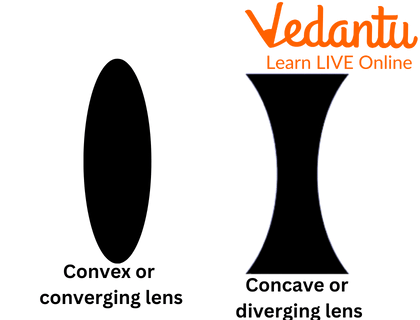
Lenses
Magnifying Glasses
Magnifying glasses are basic optical tools used to view objects' details with a small amount of magnification. It is basically made of a convex lens and the lens is fixed inside of a frame with a handle. Magnifying glasses are typically used farther away from the eye, are bigger, and typically have focal lengths of at least 125 mm. As we know it is an emblem of detective fiction, particularly that of Sherlock Holmes. The zoom or search function is frequently represented by a magnifying glass, especially in computer software and websites.

Magnifying Glass
Uses of Converging Lens
It directs all of the light toward a particular object and is used in microscopes, telescopes, and magnifying glasses.
It is utilised in camera lenses because it concentrates light to produce clear images.
It is positioned in front of the eye to sharply bend incoming light, shortening the focal point and ensuring proper illumination of the retina.
It is utilised in optical microscopes, projectors, and binoculars.
It is used in magnifying glasses.
It can be used in the spyhole of doors.
It is used to correct far-sightedness.
Application of Converging Lens
A magnifying glass, farsightedness glasses, cameras, and microscope all use convergent lenses. If an object is at or within the focal length of a magnifying glass, it will produce an image that is upright, magnified, and virtual. Similar to this, eyeglasses are used to correct vision by making sure that light is directed toward the retina rather than away from it.
Solved Questions
1. Define Lens.
Ans: A lens is a transparent object used alone or in combination in an optical instrument to focus light on two opposing regular surfaces, either both of which are curved or one of which is curved and the other is plane.
2. Mention some uses of lenses in everyday life.
Ans: In general, lenses are of varied importance in our day-to-day life for example:
It is used in basic cameras.
It is used in telescopes as an eye lens.
It is used to cure vision problems such as long and short sightedness.
It is used in a microscope to see an enlarged image of the object.
It is also used in magnifying glasses.
3. What kind of image is formed by convex and concave lenses, respectively.
Ans: Concave and convex lenses can produce virtual and real images depending upon the condition. Some of the examples are as follows:
The real image of an object is created at the other centre of curvature when it is at the centre of curvature. In comparison to the object, the image is the same size.
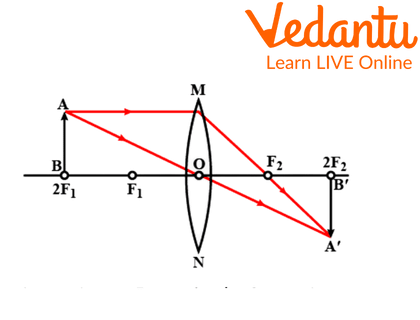
Formation by Convex Lens
When the object is between infinity and the optical centre of the concave lenses, it leads to the formation of a diminished, virtual, and erect image.
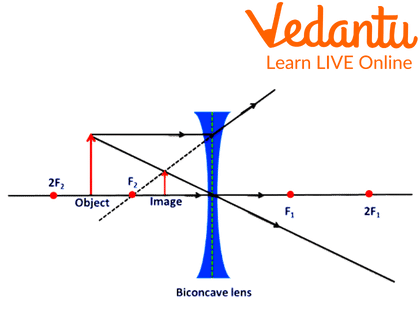
Image Formation by Concave Lens
Summary
A lens is a piece of transparent, thick glass that has two spherical surfaces enclosing it. It is an optical apparatus where light rays converge or diverge prior to transmission. There are basically two types of lenses that are convex and concave and they lead to the formation of both virtual and real images. A magnifying glass is an optical device made of convex lenses.
FAQs on Uses of Converging Lenses
1. What is a converging lens?
A converging lens is an optical lens that causes parallel light rays passing through it to bend inward and converge at a single point known as the principal focus. Because of its shape, which is typically thicker in the centre and thinner at the edges, it is also commonly called a convex lens. Its primary function is to form images by focusing light.
2. What are the five most common uses of a converging lens in daily life?
Converging lenses are essential in many everyday devices. The five most common applications are:
- Eyeglasses: To correct hypermetropia (long-sightedness) by helping the eye focus light onto the retina.
- Magnifying Glass: To produce a magnified virtual image of a small object, making it appear larger.
- Cameras: The lens system uses a converging lens to focus light from a scene to form a real, inverted image on the sensor.
- Microscopes: Used as both the objective and eyepiece lenses to create a highly magnified image of a tiny specimen.
- Telescopes: Used as the objective lens to gather and focus light from distant celestial objects.
3. How does a converging lens work as a simple magnifying glass?
A converging lens functions as a magnifying glass when an object is placed within its focal length. In this position, the lens does not form a real image. Instead, it produces a magnified, virtual, and erect image on the same side as the object. Our eyes perceive the diverging rays from the lens as if they are coming from this larger, virtual image, allowing us to see fine details.
4. How do converging lenses correct the vision defect of hypermetropia?
In a hypermetropic or long-sighted eye, the eyeball is too short or the eye's lens has insufficient converging power. As a result, light from nearby objects focuses at a point behind the retina, causing blurry vision. A converging (convex) lens in eyeglasses provides the necessary additional converging power. It pre-converges the light rays before they enter the eye, allowing the eye's natural lens to focus them correctly onto the retina, resulting in a clear image.
5. What is the role of a converging lens in a camera versus a projector?
The role of a converging lens is similar but with a different goal in cameras and projectors.
- In a camera, the converging lens is used to gather light from a distant or large object and form a real, inverted, and diminished (smaller) image that can fit onto the digital sensor or film.
- In a projector, the converging lens takes an image from a small slide or digital display and forms a real, inverted, and magnified (larger) image on a distant screen for viewing.
6. Why is a converging lens able to form both real and virtual images?
The type of image formed by a converging lens is determined entirely by the position of the object relative to the focal point (f) of the lens.
- A real image is formed when the object is placed outside the focal length (at a distance > f). The refracted light rays physically converge and meet at a point, creating an image that can be projected onto a screen.
- A virtual image is formed when the object is placed inside the focal length (at a distance < f). The refracted rays spread out (diverge) and only appear to meet when traced backward. This image cannot be projected onto a screen and can only be seen by looking through the lens.
7. How are converging lenses used differently in a compound microscope and an astronomical telescope?
Although both instruments use converging lenses to magnify objects, their arrangement and the properties of the lenses are different. In a compound microscope, a powerful objective lens with a very short focal length creates a magnified real image of a nearby specimen. This image is then further magnified by an eyepiece, which also uses a converging lens. In an astronomical telescope, the objective lens has a very long focal length to gather maximum light from a distant object and form a small real image. The eyepiece, with a shorter focal length, then magnifies this intermediate image.
