







Learn Who Invented the First Camera
In 1816, Frenchman Joseph Nicéphore Niépce invented the first photographic camera. A camera is an optical device that captures pictures that can be kept internally, sent to another place, or both.
These visuals might be simple photos or moving images like videos or movies. The term camera is derived from the phrase "Camera Obscura" (Latin for "dark chamber'').
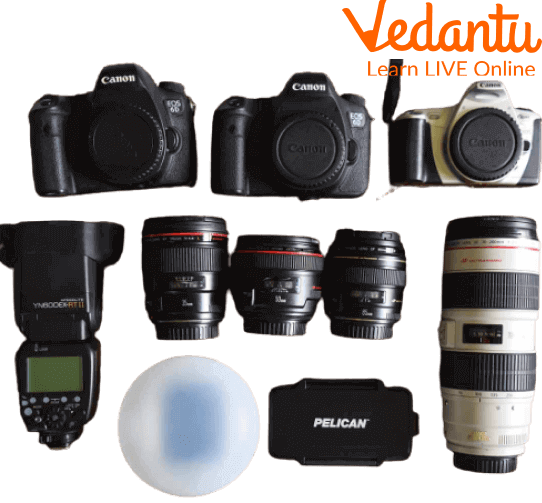
Camera and its Parts
The camera developed into a modern camera. The camera's obscurity and functioning are very similar to the human eyes. In this article, the invention of the camera and how the camera was invented will be discussed.
Who Invented the Camera?
How did the discovery of the camera take place? Let's read about it to know more! Johann Zahn invented the first portable camera in 1685. For the next 130 years, there was little growth in development. Most attempts to create cameras in between failed.
In 1816 Joseph Nicephore Niepce took the first image. Nicephore's photograph was not lasting. It was shot on silver chloride-coated paper with a camera he built himself. On the paper, the areas that were not exposed to light became black. In 1816, Frenchman Joseph Nicéphore Niépce invented the first photographic camera.
The camera did not capture images, instead, it projected them onto another surface. The camera obscura was small enough to be portable by the 17th century. Around this period, basic lenses for focusing light were introduced. The first image was taken by Nicéphore Niepcé, a French inventor who invented the heliograph in 1816.
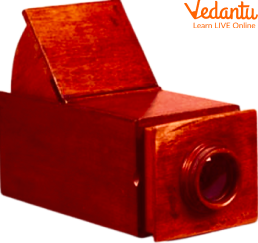
The first Pinhole Camera by Alhazen
Getting into the History
You must be thinking who made the camera? let us read more about it by getting into the depth of it. A man named Joseph Niepce took the first picture in 1827. It took hours to obtain a stable exposure to the photograph. A few years later, Louis Daguerre invented the first fully functional camera.
By now you must have known when was the camera invented. Now, do you know who invented the first camera? Alphonse Giroux invented the first commercially manufactured photographic camera, the photo camera, in 1839. Giroux agreed to build the cameras in France with Daguerre and Isidore Niépce with each gadget and accessory costing 400 francs. This shot, labelled simply "View from the Window at Le Gras," is thought to be the world's oldest surviving photograph.
How Was the Camera Invented?
Niepce engraved a bitumen-coated metal plate and then exposed it to light. The darkest sections of the engraving absorbed light, whereas the whiter areas allowed light to react with the chemicals on the plate.
These heliographs are also known as sun prints which are commonly considered the first photographic photographs. Niepce's method on the other hand took eight hours of light exposure to generate a picture that would quickly fade away.
Summary
In this article, we provided a detailed discussion about cameras and their invention, along with images. Johann Zahn invented the first portable camera in 1685. For the next 130 years, there was little growth in development. Alphonse Giroux invented the first commercially manufactured photographic camera, the photo camera, in 1839. Cameras have proven to be excellent tools for visual arts, mass media, and a fun hobby of being able to record moments to remember, whether you're a professional or an amateur photographer.
FAQs on Who Invented the Camera? Knowing the History behind It
1. Who is considered the inventor of the first camera?
The person most often credited with inventing the first camera to take a permanent photograph is Joseph Nicéphore Niépce from France. In 1826, he used a simple box camera to capture the view from his window, a process that took many hours to complete.
2. What is a Camera Obscura and why is it important in the history of the camera?
A Camera Obscura is a darkened box or room with a small hole on one side that projects an image from the outside onto the opposite surface. It is important because it was the first device to demonstrate the basic scientific principles of photography—how light can be focused to create an image—making it the direct ancestor of all modern cameras.
3. What was the contribution of the Arab scholar Ibn al-Haytham to the camera's development?
The Arab scholar Ibn al-Haytham made a critical contribution by being one of the first to scientifically explain how the Camera Obscura worked. Around 1000 AD, he described how light travels in straight lines and forms an inverted image when passing through a small hole (aperture). His work on optics provided the essential scientific theory that later inventors needed to build the first cameras.
4. How did the invention of the camera alter the world?
The invention of the camera changed the world in many ways. It allowed people to:
- Preserve memories: Families could capture special moments and keep them forever.
- Share information: News and scientific discoveries could be shared visually, making them easier to understand.
- Explore the world: We could see images of faraway places, animals, and cultures without leaving home.
- Advance science: Cameras helped in fields like astronomy and medicine by capturing things the human eye couldn't see easily.
5. What is the main difference between a digital camera and an old film camera?
The main difference is how they capture and store images. An old film camera used a special chemical film to record an image, which had to be developed in a lab. In contrast, a digital camera uses an electronic sensor to instantly convert light into a digital file, which is stored on a memory card and can be viewed immediately.
6. How can you make a simple pinhole camera at home?
You can make a basic pinhole camera using a shoebox. The main steps are:
- Make the box completely light-proof, for example, by painting it black inside.
- Create a tiny, neat hole (a pinhole) on one side of the box. This acts as the lens.
- On the opposite side inside the box, place a screen made of tracing paper. This is where the image will form.
- When you point the pinhole at a bright object, an upside-down image will appear on the screen inside.
7. Who invented the popular Kodak camera that made photography easier for everyone?
The famous Kodak camera was invented by George Eastman in 1888. His great idea was to create a simple, easy-to-use camera that used a roll of flexible film. His slogan was "You press the button, we do the rest," which made photography accessible to everyone, not just professional photographers.
8. What was the subject of the first-ever photograph?
The first surviving photograph, taken by Joseph Nicéphore Niépce, was titled "View from the Window at Le Gras." It captured the blurry view of the buildings and courtyard from his estate in France. It is famous for being the first successful permanent image captured from nature, requiring an exposure time of at least eight hours.
