







Subject Verb Agreement Rules Examples And Practice Questions For Class 9
Mastering subject-verb agreement is essential for constructing grammatically correct sentences in English. This specially crafted page provides a comprehensive subject verb agreement exercise for class 9, with important rules, examples, and MCQs designed to strengthen students’ grammar skills. The exercises below will help class 9 students confidently identify and apply subject-verb agreement principles in varied contexts.
Subject Verb Agreement Exercise for Class 9: Definition and Importance
Subject-verb agreement means the verb must match the subject in number and person. If the subject is singular, use a singular verb; if plural, use a plural verb. Understanding subject verb agreement is crucial for class 9 students because incorrect subject-verb pairing can confuse the reader and weaken writing quality. These rules form the backbone of clear sentence construction.
The exercise of subject verb agreement for class 9 focuses on day-to-day examples to make learning familiar and easy. By consistently practicing, students avoid common errors and excel in academic writing.
Rules of Subject Verb Agreement: Quick Reference Table
| Rule | Example | Notes |
|---|---|---|
| Singular Subject → Singular Verb | She reads daily. | “Reads” agrees with “she”. |
| Plural Subject → Plural Verb | Boys play football. | “Play” matches “boys”. |
| Subjects joined by 'and' → Plural Verb | Ram and Shyam are friends. | “Are” matches two subjects. |
| Each/Every → Singular Verb | Every student works hard. | Always singular verb. |
| Neither/Either → Singular Verb | Neither answer is correct. | “Is” suits “neither”. |
Understanding the table above will help you quickly spot the right verb forms during any subject verb agreement exercise for class 9. Pay attention to special words like “every”, “either”, “neither”, and words joined with "and" or "or".
Common Types and Rules: Exercise on Subject Verb Agreement for Class 9
Subject-verb agreement exercises for class 9 come in many formats, such as gap-filling, MCQs, and error correction. These challenge students to match the verb correctly to the subject, focusing on trickier cases like collective nouns, indefinite pronouns, and compound subjects.
Here are the main rules to remember when attempting any exercise for subject verb agreement class 9:
Compound subjects: When two nouns are joined with "and", use a plural verb. Example: “Tom and Jerry are friends.”
Each/Every/Neither/Either: These always take singular verbs. Example: “Each boy has a book.”
Collective nouns: Use singular verb when referring to the group as a whole. Example: “The team is winning.”
Subjects joined by 'or'/'nor': The verb should agree with the subject closest to it. Example: “Neither the teacher nor the students are present.”
Plural nouns with singular meaning: Words like “news”, “mathematics” take singular verbs: “Mathematics is important.”
Difference Between Singular and Plural Verbs
Subject Verb Agreement Exercise for Class 9 MCQ and Worksheets
Practice makes mastery. Below are MCQs and short exercises designed as per the latest CBSE and ICSE curriculum for class 9. Students looking for subject verb agreement exercise for class 9 MCQ or subject-verb agreement worksheet class 9 pdf can solve these right here.
One of the girls (is/are) absent today.
Neither of the answers (is/are) correct.
My mother and sister (cooks/cook) delicious food.
The team (was/were) happy with its performance.
Bread and butter (is/are) my breakfast.
Answers: 1) is 2) is 3) cook 4) was 5) is
Explore more grammar worksheets on Grammar Exercises for deeper understanding.
Subject Verb Agreement Exercise for Class 9 with Answers: Key Examples
Subject verb agreement exercise for class 9 with answers are invaluable for self-assessment. Here are some typical examples using real-life situations similar to those found in CBSE and ICSE exams.
Each of the players was excited for the match. (Correct)
The books on the table are new. (Correct)
Neither Rina nor her friends were present at the party. (Correct)
The police are investigating the case. (Correct: When indicating people, use plural.)
Mathematics is my favourite subject. (Correct: Treated as singular.)
For additional challenging exercises, check out error correction activities at Error Correction Exercises.
Tips and Tricks to Master Subject Verb Agreement for Class 9
Consistent practice is vital for scoring full marks in subject-verb agreement questions. Try to:
Identify the real subject—ignore words between the subject and verb.
Remember that words like “everybody”, “someone”, “each”, and “nobody” are singular.
Watch out for collective nouns and special plural nouns.
Practice subject-verb agreement exercise for class 9 ICSE or CBSE regularly with MCQs and worksheets.
Check out resources on Grammar and Parts of Speech for more practice.
Following these suggestions will help you excel at any exercise of subject verb agreement for class 9th exams.
Related Grammar Topics for Class 9 Students
In addition to subject verb agreement exercises for class 9 online test, students benefit from exploring related grammar areas. Topics like Pronoun Rules, Determiners, and Verb Forms further boost grammatical confidence. Vedantu offers clear explanations and self-check quizzes across English grammar topics to sharpen your language skills.
Subject-verb agreement is a foundation of English grammar for class 9. Regular practice with MCQs, error correction, and real-world examples ensures students avoid common mistakes. By mastering these exercises, learners gain clarity and accuracy in communication, building a strong base for all future academic writing.
What are Subject Verb Agreement?
Subject-verb agreement refers to the grammatical rule that the subject of a sentence must agree with its verb in number and person. This means that if the subject is singular, the verb must also be singular, and if the subject is plural, the verb must be plural.
Examples
Singular: The cat runs quickly.
Plural: The cats run quickly.
The illustration below provides a detailed explanation of the Subject Verb Agreement:

Common Confusions:
Indefinite Pronouns: Words like "everyone" and "nobody" are singular, even though they refer to multiple people.
Compound Subjects: When subjects are joined by "and," they usually take a plural verb. But if they refer to a single thing, use a singular verb (e.g., "Bread and butter is my favorite breakfast").
Subjects after the Verb: Even if the subject comes after the verb (e.g., "There are many challenges"), the verb must still agree with the subject.
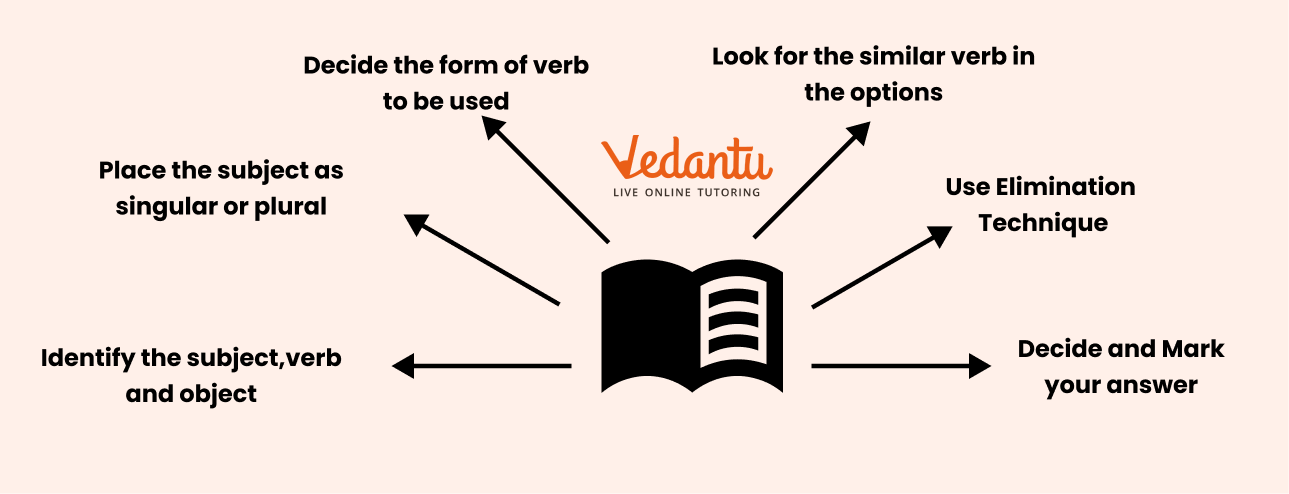
Tips for Mastery:
Test Your Understanding of the Topic by Completing the following Tasks:
1. A sentence where the subject is singular and the verb must be singular.
2. A sentence where the subject is plural and the verb must be plural.
3. A sentence starting with "There is" or "There are" followed by the correct subject and verb agreement.
Check Your Answers
Singular Subject: The dog barks loudly.
Plural Subject: The children play in the park.
There is/There are: There are many books on the shelf.
Solve the Worksheet!
Complete the following exercises to practice subject-verb agreement. Ensure that each verb agrees with its subject in number and person.
Part 1: Fill in the Blanks
Choose the correct verb form to complete each sentence.
The cat (run/runs) across the yard every morning.
The students (is/are) excited about the upcoming trip.
There (is/are) several options to choose from.
The news (was/were) broadcasted last night.
Neither the teacher nor the students (has/have) completed the assignment.
Part 2: Correct the Errors
Identify and correct the subject-verb agreement errors in the following sentences.
The group of dancers are performing at the event.
Each of the books have been placed on the shelf.
Either John or his friends is coming to the party.
The committee have decided to postpone the meeting.
There is many reasons to be happy today.
Part 3: Create Sentences
Write sentences according to the following guidelines:
A sentence with a singular subject and a singular verb.
A sentence with a plural subject and a plural verb.
A sentence using "There is" or "There are" with correct subject-verb agreement.
Part 4: Select the Correct Verb form for Each Sentence.
The bouquet of flowers (is/are) on the table.
Either my brother or my parents (is/are) going to pick me up.
The team (wins/win) the championship every year.
The dogs (barks/bark) loudly when someone approaches the house.
Mathematics (is/are) difficult for some students.
Part 5: Identify the Correct Sentence
Circle the sentence that has correct subject-verb agreement.
a) The list of items are on the desk.
b) The list of items is on the desk.a) The children was playing in the garden.
b) The children were playing in the garden.a) Either the teacher or the students has finished their work.
b) Either the teacher or the students have finished their work.a) The information provided by the documents are correct.
b) The information provided by the documents is correct.a) There is many challenges to overcome.
b) There are many challenges to overcome.
Part 6: Sentence Correction
Rewrite the following sentences with the correct subject-verb agreement.
The books on the shelf needs to be arranged properly.
Neither of the options are appealing to me.
The staff has decided to take a holiday next week.
One of the students have forgotten their assignment.
The weather in the mountains are unpredictable.
Answer Key
Part 1: Fill in the Blanks
The cat runs across the yard every morning.
The students are excited about the upcoming trip.
There are several options to choose from.
The news was broadcasted last night.
Neither the teacher nor the students have completed the assignment.
Part 2: Correct the Errors
The group of dancers is performing at the event.
Each of the books has been placed on the shelf.
Either John or his friends are coming to the party.
The committee has decided to postpone the meeting.
There are many reasons to be happy today.
Part 3: Create Sentences
The bird sings every morning.
The children play outside after school.
There is a cat under the table.
Part 4: Multiple Choice
The bouquet of flowers is on the table.
Either my brother or my parents are going to pick me up.
The team wins the championship every year.
The dogs bark loudly when someone approaches the house.
Mathematics is difficult for some students.
Part 5: Identify the Correct Sentence
b) The list of items is on the desk.
b) The children were playing in the garden.
b) Either the teacher or the students have finished their work.
b) The information provided by the documents is correct.
b) There are many challenges to overcome.
Part 6: Sentence Correction
The books on the shelf need to be arranged properly.
Neither of the options is appealing to me.
The staff have decided to take a holiday next week.
One of the students has forgotten their assignment.
The weather in the mountains is unpredictable.
Takeaways from the Topic “Subject Verbs Agreement”
Understanding and mastering subject-verb agreement is crucial for clear and effective communication in English.
By practicing regularly and being mindful of common pitfalls, you can ensure that your writing and speech are grammatically sound.
Keep these rules in mind, and with consistent practice, you'll find subject-verb agreement becomes second nature.
FAQs on Subject Verb Agreement Exercises For Class 9 Students
1. What is subject verb agreement in English grammar?
Subject verb agreement is the rule that the verb must match the subject in number and person. In simple words, a singular subject takes a singular verb, and a plural subject takes a plural verb.
- Singular: She plays football.
- Plural: They play football.
2. What are the basic rules of subject verb agreement for Class 9?
The basic rules of subject verb agreement state that verbs must agree with their subjects in number and person. The main rules include:
- A singular subject takes a singular verb (The boy runs).
- A plural subject takes a plural verb (The boys run).
- Two subjects joined by and usually take a plural verb (Riya and Sita are friends).
- Subjects joined by or/nor agree with the nearest subject (Neither the teacher nor the students are ready).
3. How do you identify the subject and verb in a sentence?
You can identify the subject by asking “who” or “what” before the verb, and the verb shows the action or state of being. Follow these steps:
- Step 1: Find the verb (action or state), e.g., is running.
- Step 2: Ask “Who is running?”
- Step 3: The answer is the subject, e.g., The boy.
4. What happens to the verb when two subjects are joined by 'and'?
When two subjects are joined by and, the verb is usually plural. This is because the combined subject becomes plural.
- Example: Riya and Meena are dancing.
- Example: Bread and butter is my breakfast (treated as one item).
5. How does subject verb agreement work with 'or' and 'nor'?
With or and nor, the verb agrees with the subject closest to it. This is called the rule of proximity.
- Neither the teacher nor the students are present.
- Neither the students nor the teacher is present.
6. What is the rule of subject verb agreement with indefinite pronouns?
Most indefinite pronouns like everyone, someone, nobody, and each take a singular verb. Even though they may refer to many people, they are grammatically singular.
- Everyone is ready.
- Each of the players has a bat.
7. What are common mistakes in subject verb agreement for Class 9?
Common mistakes in subject verb agreement occur when students confuse singular and plural subjects. Frequent errors include:
- Ignoring words between subject and verb (The bouquet of roses is beautiful, not are).
- Using plural verbs with singular indefinite pronouns (Everyone is, not are).
- Confusion with collective nouns (The team is winning).
8. How does subject verb agreement work with collective nouns?
A collective noun usually takes a singular verb when the group acts as one unit. Examples include team, family, jury, and committee.
- The team is playing well.
- The jury has given its verdict.
9. What is subject verb agreement in the present tense?
In the simple present tense, a singular third-person subject takes a verb ending in -s or -es. This change applies to he, she, it, and singular nouns.
- He plays cricket.
- She watches TV.
- They play cricket.
10. Can you give some examples of subject verb agreement sentences for practice?
Yes, correct subject verb agreement sentences clearly show matching subjects and verbs. Here are practice examples:
- The dog barks loudly.
- The dogs bark loudly.
- Each student has completed the work.
- Ravi and Aman are friends.
- Neither the boys nor the teacher is late.
