







What is punctuation for Class 1 with rules and examples
When someone asks us to define punctuation, the first image that comes to our brain is of special characters which are used while forming sentences. These special characters are the image of punctuation and are used while writing sentences. There are different kinds of punctuation used while forming sentences that portray different kinds of expression in written sentences. These types of punctuation have different usages and motives used in depicting expressions. Punctuations should be learnt from the very beginning of their learning such that the sentences they form pose a clear meaning and give a sense of emotion to the reader.
Different Kinds of Punctuation
Since different kinds of punctuation are used in the English language, the punctuation for class 1 kids to remember are given below, along with their meaning and punctuation examples with answers for clear understanding.
1. Period (.)
This punctuation mark is the most important and the basic mark which everyone should know how and when to use. Especially for kids in class 1, this punctuation mark is very necessary to learn. The period symbol is used as a punctuation mark at the end of every sentence to signify the end of a sentence or a conversation. Without using the period symbol, one cannot start with another sentence.
For example, The cat ran under the table.
2. Question Mark (?)
This is another punctuation mark that is important to learn. It is a question mark as punctuation for class 1. This question mark is used for expressing a question and for asking things through writing.
For example, where is your home?
3. Exclamation Point (!)
The exclamation point is another necessary punctuation mark to learn which has vast usage. These punctuation marks are used to show the emotion of surprise, joy, anger, or any other important expression according to the usage required in the sentence.
For example, Oh god, look beside you!
4. The comma (,)
A comma is one of the most common punctuation marks every kid should know how to use and learn how to use it while writing different sentences. A comma is another punctuation that comes into use extensively. A comma is used to generate a small pause between different emotions of the sentence.
For example, Jacob, it was very nice to see you.
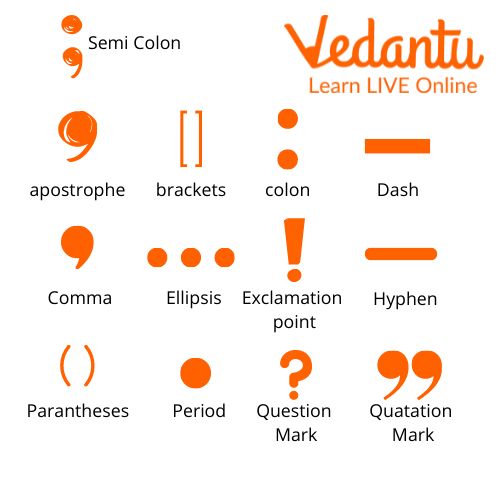
Different Punctuation Marks
These four punctuation marks are the most important for a class 1 student to write and express their sentences well enough. Apart from these four marks, there are several more punctuation that can be learned further in use, like a semicolon, colon hyphens, etc.
Punctuation Worksheet with Answers
Since now you have understood the working of different punctuations, let us now try to solve some questions from our punctuation worksheets with answers to ace our skills through which we can understand their usage better.
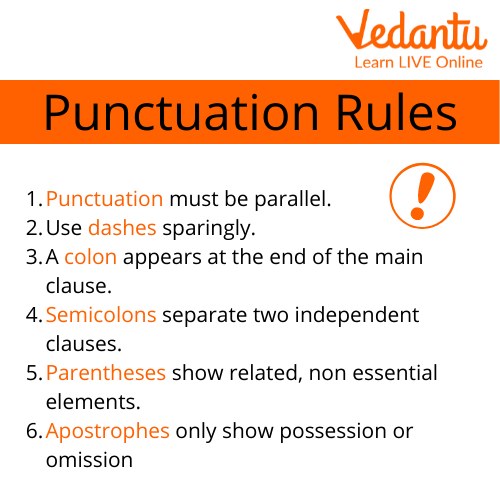
Rules for Punctuation Marks
Now, given below are some of the sentences where you have to determine which type of punctuation has been used.
1. Where are you going?
Question mark
2. There has been a small mishap.
Period punctuation mark
3. Wow, that is a beautiful rainbow!
Exclamation mark
4. You should go to school tomorrow, there will be a picnic.
Comma and period punctuation mark
5. Arun, what have you done?
Comma and question mark
6. Hey! What is your name?
Exclamation and question mark
With the above worksheet, one can practice their skill with punctuation marks. One has to keep in mind that different punctuation marks can be used in one sentence to convey the emotion and exact meaning of the sentence. Punctuation exercises should be solved by kids to master the making of punctuation sentences.
Summary
Punctuation marks are an integral part of the writing process; they have a lot of significance and can express the actual meaning of different sentences or stories. Without the question marks, one will not be able to express the emotions in sentences which will make it hard for the reader to understand. Solving punctuation sentences with answers can help us understand the concept better. Punctuation symbols make the meaning of the sentences more clear. It shows the reader where to stop, where to pause and where to ask questions.
FAQs on Punctuation for Class 1 Students
1. What is punctuation for Class 1?
Punctuation for Class 1 means using simple punctuation marks like full stops, capital letters, and question marks to make sentences clear and correct. In early English learning, children are taught basic rules such as:
- Starting a sentence with a capital letter
- Ending a sentence with a full stop (.)
- Using a question mark (?) for questions
2. What are the basic punctuation marks taught in Class 1?
The basic punctuation marks taught in Class 1 English are full stop, question mark, exclamation mark, and capital letters. These include:
- Full stop (.) – used at the end of a sentence
- Question mark (?) – used at the end of a question
- Exclamation mark (!) – used to show strong feelings
- Capital letters – used at the beginning of sentences and for names
3. When do we use a full stop in a sentence?
A full stop (.) is used at the end of a telling sentence. It shows that the sentence is complete.
- Example: I have a cat.
- Example: She is my friend.
4. How do you use a question mark correctly?
A question mark (?) is used at the end of a sentence that asks a question. It replaces the full stop when we are asking something.
- Example: What is your name?
- Example: Are you happy?
5. What is an exclamation mark and when is it used?
An exclamation mark (!) is used to show strong feelings like surprise, joy, or anger. It is placed at the end of an exclamatory sentence.
- Example: Wow!
- Example: That is amazing!
6. Why do we use capital letters in sentences?
We use capital letters to begin sentences and to write special names correctly. Capitalization is one of the first punctuation rules taught in Class 1.
- At the beginning of a sentence: The dog is big.
- For names of people: Riya, Tom
- For places: India, Delhi
7. What is the rule for using capital letters in names?
The rule is that all proper nouns (special names of people, places, or things) must begin with a capital letter. In Class 1 grammar, children practice writing names correctly.
- Person: Aman
- Place: London
- Day: Monday
8. What is the difference between a full stop and a question mark?
A full stop (.) ends a statement, while a question mark (?) ends a question. The meaning of the sentence changes depending on the punctuation mark used.
- Statement: You are happy.
- Question: Are you happy?
9. Can you give simple examples of punctuation for Class 1?
Yes, simple examples of Class 1 punctuation show how different marks are used in sentences.
- Full stop: This is my book.
- Question mark: Where is my bag?
- Exclamation mark: Hooray!
- Capital letter: My name is Sam.
10. Why is punctuation important for Class 1 students?
Punctuation is important for Class 1 students because it makes sentences clear, correct, and easy to understand. Without proper punctuation, sentences can be confusing.
- It shows where a sentence ends.
- It helps readers know if something is a question or statement.
- It teaches correct writing habits from an early stage.
