







Articles Exercises with Answers Rules and Usage Examples
Articles are a crucial part of English grammar that help specify nouns. Understanding how to use them correctly can significantly enhance your writing and communication skills. In this guide, we will explore what articles are, how they are used, and provide examples to clarify their application.
 Table of Content
Articles play a crucial role in English grammar. Practising with a variety of articles exercises helps learners clearly understand how and when to use "a," "an," and "the." On this page, you will find detailed explanations, practice exercises with answers, and real-life examples to strengthen your grasp of articles in English.
Articles in English: Rules and Examples Table
| Article | Usage Rule | Example Sentence |
|---|---|---|
| a | Before singular nouns beginning with a consonant sound | a cat, a book, a university |
| an | Before singular nouns beginning with a vowel sound | an apple, an hour, an umbrella |
| the | Before specific or previously mentioned nouns | the sun, the car in the garage |
| No Article | Before plural or uncountable nouns when speaking generally | Cats are friendly. Water is life. |
Understanding these rules is essential before moving on to articles exercises with answers. Observe how "a," "an," and "the" are used in context and try out the sample sentences to test your knowledge. For advanced learning, explore zero article and determiners and how they contrast with the use of articles.
What are Articles? Concepts for Articles Exercises
Articles are words used before nouns to show whether the noun refers to something specific or something unspecific. The three main articles in English are "a," "an," and "the." Mastering articles is essential for clear communication and accurate sentence construction in English.
There are two major types: Definite Article ("the"), and Indefinite Articles ("a" and "an"). Indefinite articles are used for non-specific things, while "the" refers to a particular item or group already mentioned or easily identified. For greater clarity, review the definite article and indefinite articles explanations.
Use "a" before words that start with a consonant sound. Example: a doctor, a European country.
Use "an" before words that start with a vowel sound. Example: an engineer, an honest person.
Use "the" for specific or known nouns. Example: the book you gave me was interesting.
Explore More Grammar Topics
Articles Exercises with Answers and Practice Questions
Practising articles grammar exercises sharpens your ability to choose the right article for every situation. Below are sample exercises, including fill-in-the-blanks, multiple choice, and sentence corrections, all designed for beginners and advanced learners. Printable versions and articles exercises with answers PDF are commonly sought for self-study.
Try these questions. The answers are highlighted for self-check. If you want a broader set, look for downloadable articles exercises or visit our grammar exercises section.
She is __ engineer living in __ apartment near __ park. Answer: an, an, the
I saw __ elephant and __ monkey in __ zoo. Answer: an, a, the
Could you pass me __ salt, please? Answer: the
__ honesty is __ best policy. Answer: (No article), the
He studies at __ university in Delhi. Answer: a
Try Error Correction Exercises
Tips to Solve Articles Practice Exercises
To do well in articles in English exercises, keep these key strategies in mind: identify whether a noun needs to be definite or indefinite, listen for vowel and consonant sounds, and watch out for special cases like unique names or general statements. Practise regularly for improvement.
For young learners or beginners, articles practice exercises should start simple and become more comprehensive, covering a, an, the, and when to use no article. Use real-life contexts to reinforce learning. For additional practice, visit Vedantu's worksheets for kids.
Read the whole sentence first, then fill in each blank.
Remember "an" comes before vowel sounds, not just vowel letters.
"The" is often used with superlatives and unique things (e.g. the tallest building, the Earth).
Learn About Vowel and Consonant Sounds
Advanced Exercises on Articles and Common Mistakes
Exercises of articles at intermediate and advanced levels include sentence corrections, transformations, and error spotting. Common mistakes in articles usually arise from confusion over zero articles or misuse with proper nouns. Practise sentences such as "Mount Everest is __ highest mountain in __ world" (the, the).
Explore higher-level exercises, such as omission of article, and compare articles with determiners and other parts of speech for a solid foundation in English grammar.
Identify and edit sentences with missing or unnecessary articles.
Practice with academic and real-world passages for context-based understanding.
Explore Parts of Speech Exercises
Real-World Examples for Articles Usage
Articles show up everywhere: “I read a book yesterday,” “She is the president of the club,” or “He is an honest man.” These demonstrate how articles communicate clear meaning in daily conversation and writing.
Customized Articles Exercises for Classes 5–10
For school students, articles exercises for class 5, 6, 7, 8, 9, and 10 are available in increasingly complex formats, including fill-in-the-blank, transformations, and multiple-choice. Answers are included for each, helping students self-evaluate.
Class 8 English Grammar | More Articles Exercises
Articles exercises, with answers and examples, help learners of all ages master one of the most fundamental concepts in English grammar. Whether you want simple practice or advanced questions, regular work with these exercises sharpens your grammar skills. Vedantu’s resources provide structured practice, explanations, and answers for all levels of learners.
What are Articles, Its Types, and Its Uses?
Articles are words that define a noun as specific or unspecific. There are two main types:
Definite Article: "The" – is used to refer to a specific item known to both the speaker and listener.
Indefinite Articles: "A" and "An" – used to refer to a non-specific item. "A" is used before words that begin with a consonant sound, while "an" is used before words that begin with a vowel sound.
Here are the Its Type and their uses
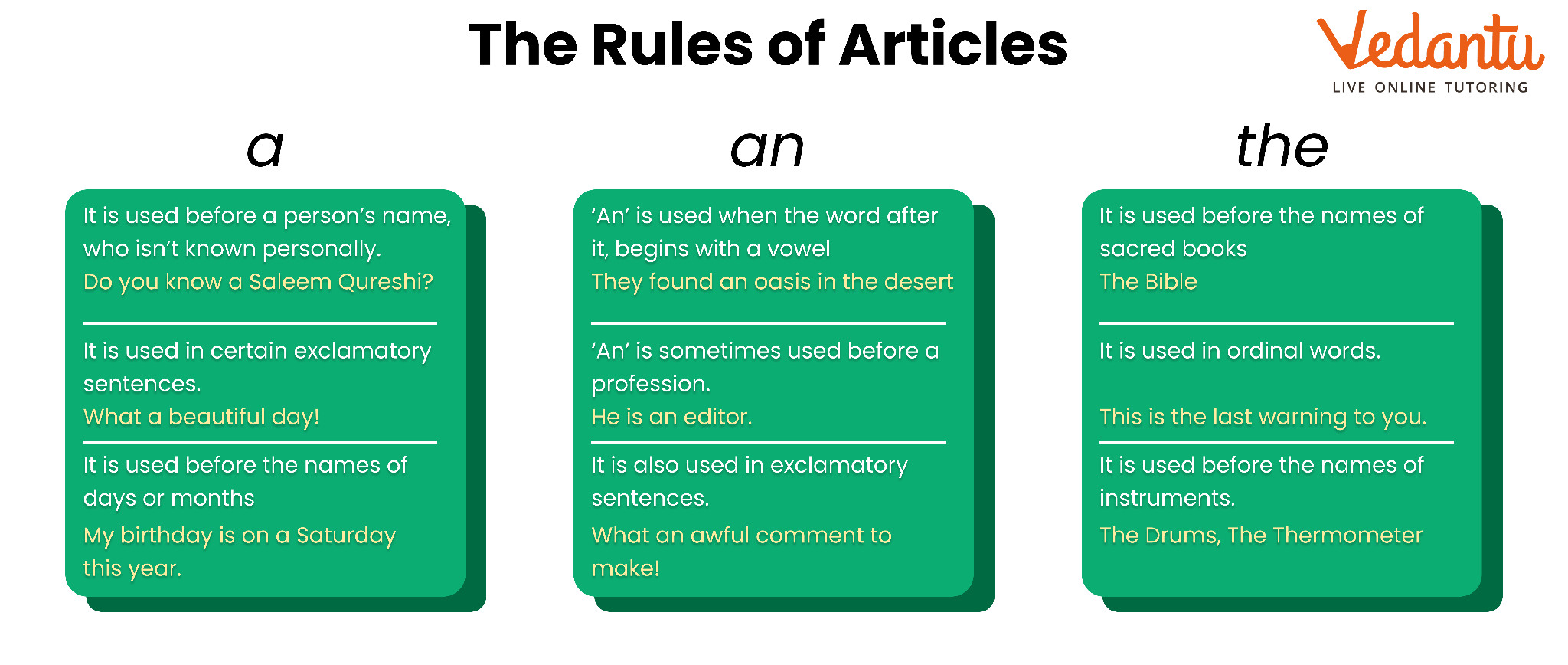
Now Let's Look at the Examples:
Test Your Understanding of Articles:
Identify and underline the articles in the provided sentences.
Sentences:
The cat sat on a mat.
I saw an apple on the table.
She is reading a book in the park.
The dog barked at the stranger.
He wants to buy an umbrella for the rainy day.
Create sentences using both definite and indefinite articles.
Check your Answers:
1. Identify and Underline the Articles:
Articles Underlined:
The cat sat on a mat.
I saw an apple on the table.
She is reading a book in the park.
The dog barked at the stranger.
He wants to buy an umbrella for the rainy day.
2. Create Sentences Using Both Definite and Indefinite Articles:
Sentences:
The teacher gave a lesson on grammar.
I would like to buy an orange from the market.
A dog is barking outside the house.
She wore a dress to the party last night.
The children played with a ball in the park.
Solve the Articles Worksheet!
Exercise 1: Fill in the blanks with the correct articles ("a," "an," or "the").
___ cat sat on ___ mat.
Can you pass me ___ pencil from ___ table?
___ sun rises in ___ east.
I bought ___ apple and ___ banana from ___ market.
___ book on ___ shelf is mine.
She is ___ excellent dancer.
We went to ___ museum yesterday.
___ dog barked loudly at ___ stranger.
I need ___ umbrella because it looks like ___ rain is coming.
He found ___ old coin in ___ backyard.
Exercise 2: Read the Passage and Identify the Articles. Underline Each Article Used.
The sun was setting over the hills as the children walked down the path. They had spent the whole day at the park, playing games and enjoying the beautiful weather. As they passed by the old oak tree, they noticed a small bird perched on a branch. The bird was singing sweetly, and the children stopped to listen. One of the children pointed out a butterfly fluttering near the flowers in the garden. They continued their walk until they reached the ice cream shop. It was the end of a perfect day.
Exercise 3: Correct the Mistakes
Identify and correct the mistakes related to articles in the following sentences.
She has a unique talent for playing the guitar.
He visited the London last summer.
I need a advice on this matter.
They saw an lion at the zoo.
She is the best dancer in an group.
Exercise 4: Rewrite the Sentences
Rewrite the sentences by adding the correct article ("a," "an," or "the") where necessary.
___ dog chased ___ ball down ___ street.
___ earth orbits around ___ sun.
___ artist painted ___ beautiful portrait.
I want to buy ___ new car.
___ elephant is ___ large animal.
Exercise 5: Mixed Practice
Complete the following sentences by filling in the blanks with the correct article ("a," "an," or "the") or leaving the blank empty if no article is needed.
She is studying to become ___ engineer.
They live in ___ house by ___ river.
I saw ___ owl in ___ tree last night.
___ Mount Everest is ___ highest mountain in the world.
Please hand me ___ book on ___ shelf.
Exercise 6: Articles with Adjectives
Fill in the blanks with the correct article ("a," "an," or "the") before the adjective-noun combination.
She wore ___ beautiful dress to the party.
He gave me ___ interesting idea for the project.
We had ___ amazing trip to ___ mountains.
It was ___ unforgettable experience.
She is ___ talented musician.
Takeaways from the Topic “Articles”
Understanding articles helps in accurately specifying nouns and clarifying meaning.
Proper use of "the," "a," and "an" improves the precision and clarity of your sentences.
FAQs on Articles Exercises for Practice and Concept Clarity
1. What are articles in English grammar?
Articles in English grammar are determiners used before nouns to show whether the noun is specific or general. There are three articles in English:
- Definite article: the (used for specific nouns)
- Indefinite articles: a and an (used for non-specific singular nouns)
2. What is the difference between “a” and “an”?
The difference between a and an depends on the sound that follows, not the spelling.
- Use a before words that begin with a consonant sound: a dog, a university.
- Use an before words that begin with a vowel sound: an apple, an hour.
3. When do we use the definite article “the”?
We use the when referring to a specific or previously mentioned noun.
- When the listener knows which thing we mean: the teacher in the room.
- With unique things: the sun, the Earth.
- With superlatives: the best student.
- With rivers, seas, and mountain ranges: the Nile, the Himalayas.
4. When should we not use articles in English?
We do not use articles before plural or uncountable nouns when speaking generally.
- Plural general nouns: Dogs are loyal.
- Uncountable nouns: Milk is healthy.
- Names of people and most countries: John, India.
- Abstract ideas used generally: Love is powerful.
5. How do you use articles with countable and uncountable nouns?
Articles depend on whether a noun is countable or uncountable.
- Singular countable nouns need an article: a car, the car.
- Plural countable nouns may use no article or “the”: cars, the cars.
- Uncountable nouns use no article or “the”: water, the water.
6. What are some common mistakes in articles exercises?
Common mistakes in articles exercises include using the wrong article or omitting it completely.
- Using “the” for general statements: The life is hard. ❌
- Forgetting articles before singular countable nouns: I saw cat. ❌
- Confusing vowel letters with vowel sounds: a hour ❌
7. How do articles work with proper nouns?
Articles are generally not used with proper nouns, but there are important exceptions.
- No article: India, Mary, Mount Everest.
- Use “the” with rivers, oceans, newspapers, and some countries: the Amazon, the Pacific, the United States.
8. How do you practice articles exercises effectively?
You can practice articles effectively by focusing on rules, patterns, and context-based exercises.
- Identify if the noun is specific or general.
- Check if it is singular, plural, or uncountable.
- Read sentences aloud to hear vowel or consonant sounds.
- Complete fill-in-the-blank articles worksheets.
9. What is the zero article in English?
The zero article refers to situations where no article is used before a noun.
- General plural nouns: Books are useful.
- Uncountable nouns used generally: Information is important.
- Meals and languages: We had dinner. She speaks English.
10. Can you give examples of articles used in sentences?
Yes, here are clear examples showing how a, an, and the are used in sentences.
- She is reading a book. (any book)
- He ate an apple. (vowel sound)
- I liked the movie we watched yesterday. (specific movie)
