







What Is an Adverb Of Time Definition Rules Types and Examples
Adverbs of time are essential in English grammar as they provide information about when, how often, and how long an action occurs. Understanding adverbs of time helps in constructing sentences that convey the timing of events. This topic page will give insights into the meaning, definition, uses, and examples of adverbs of time, offering insights into their proper usage. Whether you’re preparing for exams to improve your writing skills, mastering adverbs is crucial.
 Table of Content
What is the Adverb of Time?
An adverb of time is a word or phrase that provides information about when, how often, or for how long an action takes place. These adverbs answer questions like "When did it happen?" "How often does it occur?" and "For how long does it last?"
Examples
When: She will visit tomorrow.
How often: He always arrives early.
For how long: They stayed for two weeks.
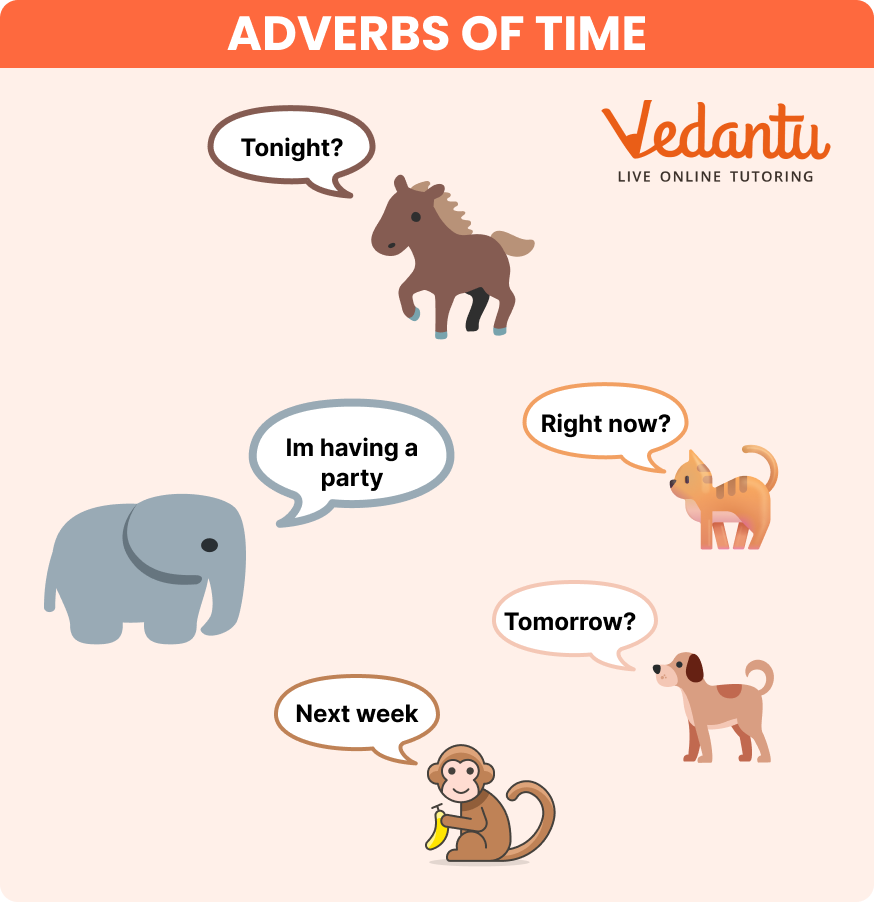
The illustration below provides a Concise explanation of Adverb of Time
Common Confusions:
Adverbs of Frequency vs. Time: Frequency focuses on how often something happens, while time includes when and duration.
Position in Sentences: Adverbs of time can be placed at the beginning, middle, or end of a sentence, but placement may affect emphasis or clarity.
Complex Adverbial Phrases: Longer phrases like "at the end of the day" can make it tricky to identify the adverb's function.
Tips for Mastery:
Practice Positioning: Experiment with placing adverbs of time in different parts of a sentence to see how it affect meaning.
Identify Adverbs of Time in Sentences: Regularly read and identify adverbs of time in different texts to get a feel for how they are used in context.
Use Varied Adverbs: Expand your vocabulary by using a variety of adverbs of time to make your writing more precise and engaging.
Test Your Understanding of the Topic by Completing the Following Tasks:
Identify the adverb of time in each sentence and specify its position (beginning, middle, or end).
Sentence: I will finish my homework tomorrow.
Adverb of Time: __________
Position: __________
Sentence: Yesterday, we went to the park.
Adverb of Time: __________
Position: __________
Sentence: She has already eaten dinner.
Adverb of Time: __________
Position: __________
Check Your Answers
Sentence: I will finish my homework tomorrow.
Adverb of Time: Tomorrow
Position: End
Sentence: Yesterday, we went to the park.
Adverb of Time: Yesterday
Position: Beginning
Sentence: She has already eaten dinner.
Adverb of Time: Already
Position: Middle
Solve the Worksheet!
Exercise 1: Identify the Adverb of Time
Read the sentences below and underline the adverb of time. Then, write its position (beginning, middle, or end) in the space provided.
Sentence: We will go to the beach next week.
Adverb of Time: ___________________
Position: ___________________
Sentence: Later, I will call you.
Adverb of Time: ___________________
Position: ___________________
Sentence: He has already finished his lunch.
Adverb of Time: ___________________
Position: ___________________
Sentence: She is going to start her new job tomorrow.
Adverb of Time: ___________________
Position: ___________________
Sentence: Yesterday, they celebrated their anniversary.
Adverb of Time: ___________________
Position: ___________________
Exercise 2: Rewrite the Sentence
Rewrite the following sentences by moving the adverb of time to a different position in the sentence. Ensure the sentence remains grammatically correct.
Original: I will meet you later.
Rewrite: _____________________________________________________
Original: She is leaving soon.
Rewrite: _____________________________________________________
Original: Tomorrow, we will go shopping.
Rewrite: _____________________________________________________
Original: He finished the project yesterday.
Rewrite: _____________________________________________________
Original: We will start the meeting shortly.
Rewrite: _____________________________________________________
Exercise 3: Fill in the Blanks
Complete the sentences by adding an appropriate adverb of time from the options given.
I will visit my grandparents __________. (yesterday, soon, last year)
She has __________ completed her assignment. (now, later, already)
We had lunch together __________. (tomorrow, last week, next month)
He will start his new job __________. (next month, earlier, yesterday)
They will be here __________. (later, last night, already)
Answer Key
Exercise 1: Identify the Adverb of Time
Sentence: We will go to the beach next week.
Adverb of Time: Next week
Position: End
Sentence: Later, I will call you.
Adverb of Time: Later
Position: Beginning
Sentence: He has already finished his lunch.
Adverb of Time: Already
Position: Middle
Sentence: She is going to start her new job tomorrow.
Adverb of Time: Tomorrow
Position: End
Sentence: Yesterday, they celebrated their anniversary.
Adverb of Time: Yesterday
Position: Beginning
Exercise 2: Rewrite the Sentence
Rewrite: Later, I will meet you.
Rewrite: Soon, she is leaving.
Rewrite: We will go shopping tomorrow.
Rewrite: Yesterday, he finished the project.
Rewrite: Shortly, we will start the meeting.
Exercise 3: Fill in the Blanks
I will visit my grandparents soon. (yesterday, soon, last year)
She has already completed her assignment. (now, later, already)
We had lunch together last week. (tomorrow, last week, next month)
He will start his new job next month. (next month, earlier, yesterday)
They will be here later. (later, last night, already)
Takeaways from the Topic “Adverb of Time”
Mastering adverbs of time is essential for expressing when, how often, and for how long actions occur.
By understanding their usage, you can add clarity and detail to your sentences, making your communication more effective.
Regular practice and awareness of common confusions will help you become more confident in using adverbs of time.
FAQs on Adverb Of Time in English Grammar
1. What is an adverb of time?
An adverb of time is a word that tells us when, how long, or how often an action happens. It gives information about the time of an action in a sentence.
- Examples: yesterday, now, tomorrow, soon, recently
- Example sentence: I met her yesterday.
2. What are some examples of adverbs of time?
Common adverbs of time include words that show when or how long an action occurs.
- Time reference: today, tomorrow, now, then
- Duration: already, still, yet
- Frequency (time-related): always, often, never
- Example: She has already finished her homework.
3. Where do adverbs of time usually come in a sentence?
An adverb of time usually appears at the end of a sentence, but it can also come at the beginning or before the main verb.
- End position: I will call you tomorrow.
- Beginning position: Yesterday, we went to the park.
- Before main verb (with frequency words): She always wakes up early.
4. What is the difference between adverbs of time and adverbs of frequency?
The main difference is that adverbs of time tell us when something happens, while adverbs of frequency tell us how often it happens.
- Adverb of time: I met him yesterday.
- Adverb of frequency: I often meet him.
- Frequency adverbs are a type of time-related adverb but focus on repetition.
5. Can an adverb of time come at the beginning of a sentence?
Yes, an adverb of time can come at the beginning of a sentence for emphasis or style.
- Example: Tomorrow, we will start the project.
- A comma is usually used after it in formal writing.
- This position emphasizes the time of the action.
6. What is the function of an adverb of time in English grammar?
The function of an adverb of time is to modify a verb by giving specific information about the time of the action.
- It answers questions like: When? How long? How often?
- Example: She is leaving soon.
- It adds clarity and detail to sentences in writing and speaking.
7. Are “already,” “yet,” and “still” adverbs of time?
Yes, already, yet, and still are adverbs of time because they relate to the timing of an action.
- Already: used in positive sentences (She has already eaten.)
- Yet: used in questions and negatives (Have you finished yet?)
- Still: shows continuation (He is still working.)
8. What are common mistakes with adverbs of time?
A common mistake with adverbs of time is placing them in the wrong position in the sentence.
- Incorrect: I tomorrow will go.
- Correct: I will go tomorrow.
- Another mistake is confusing yet and already in negative sentences.
9. How do you identify an adverb of time in a sentence?
You can identify an adverb of time by asking when, how long, or how often the action happens.
- Ask: When? → She arrived late.
- Ask: How long? → He stayed overnight.
- Ask: How often? → They frequently travel.
10. Why are adverbs of time important in writing and speaking?
Adverbs of time are important because they make sentences clear by showing the exact time of an action.
- They improve clarity and sequence in storytelling.
- They help describe routines and schedules.
- Example: Later, we discussed the problem.
