







What Are Adjectives for Activities With Definitions and Examples
Children gradually level up in the study of Grammar; they pick up many basic learning lessons and develop those in the classes they further proceed to. Similarly, one such learning is the study of adjectives. We all have studied the meaning of adjectives probably in classes 2 and 3. Now we will understand the Adjectives for Activities.
Before that, let us refine our study on adjectives then we will smoothly proceed to our main discussion.
What Do You Mean by Adjectives?
Adjectives simply mean the describing words which describe the qualities or the state of a noun. Example - Silly, yellow, fast, fun, slow, giant-like, etc.
We see that these words can be used in describing anything or anyone and thus they are called adjectives.
Now, what are adjectives for activities?
Adjectives for Activities are those adjectives that describe various activities. Let us understand this vividly in our next section.
Understand the Adjectives for Activities
Adjectives for activities are those describing words that describe or show the state of the activity. Is the activity performed fast? Or is it performed slowly? This can be understood with the help of these adjectives for activities precisely. Now we will understand more about the context with a number of examples. Let us begin.
Examples of Adjectives for Activities
Fast - Sahil is a fast runner.
Good - Mehtaj is a good singer.
Vigorous - He vigorously opened the casket to find a bag of gold.
Passionately - Mr. Dravid plays golf passionately.
Determination - She worked hard for her exam with full determination.
Slow - The tortoise is a slow animal.
Sluggish - His walking style is more like a sluggish one.
Dog-tired - I am dog-tired after the 12 hours of journey.
Loudly - She was crying loudly after her mom left.
Hysterically - The demon laughed hysterically.
Cleverly - She planned cleverly for their escape.
Confidently - He lied confidently to his parents.
Beautiful - The team’s record is to play in a beautiful manner.
Carefully - Father listened to her daughter carefully while she was narrating her story.
Calmly - Meena read calmly to her children.
How to Teach Kids Adjectives for Activities?
This is important for the kids to know the basic understanding of adjectives. For this the students must refer to the previous classes or be given a summary of the same. Then they should be made aware of the different actions going on in their surroundings. Then they are required to understand that those actions are to be classified based on their respective state.
Things needed to follow:
Introduce adjectives to the students.
Then make them understand about the adjectives for activities.
Also the kids can learn adjectives for activities with some gaming activities like-
Making them run and fast and asking them the adjectives for the activity.
Exercise to Understand Better
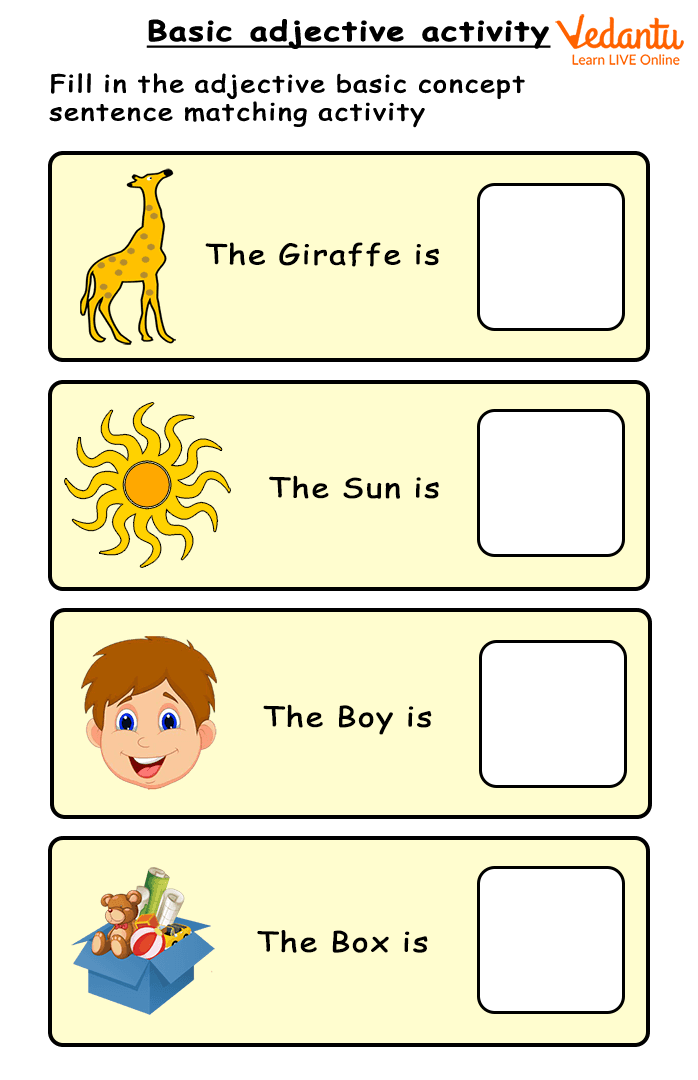
Exercises for kids to Help them Understand Adjectives
Refer to the above picture and write the different adjectives.
Answers:
Tall
Sunny
Grumpy
Full)
Adjectives for activities thus will help your kids have another level up understanding about adjectives. In this lesson, they will ponder upon the types of adjectives which are present in English Grammar. This will provide them a scope for improved imagination capacity and urge them to learn more.
FAQs on Adjectives for Activities in English Grammar
1. What are adjectives for activities?
Adjectives for activities are describing words that tell us what an activity is like. They describe the nature, quality, or feeling of an action or event.
- They modify nouns such as game, sport, class, or trip.
- Examples: fun activity, challenging task, exciting game, boring lecture.
- They help make writing and speaking more vivid and specific.
2. What are some examples of adjectives used to describe activities?
Common adjectives used to describe activities include words that show difficulty, emotion, or energy.
- For difficulty: easy, difficult, simple, complex
- For feelings: fun, boring, exciting, relaxing
- For energy level: active, energetic, calm, intense
- Example sentence: “We had an exciting adventure at the park.”
3. How do you use adjectives to describe activities in a sentence?
You use adjectives before the noun or after a linking verb to describe an activity.
- Before a noun: “It was a fun game.”
- After a linking verb: “The game was fun.”
- Make sure the adjective clearly describes the activity, not another noun in the sentence.
4. What is the difference between adjectives for activities and adverbs?
Adjectives describe nouns, while adverbs describe verbs, adjectives, or other adverbs.
- Adjective example: “It was a challenging exercise.” (describes the noun exercise)
- Adverb example: “She completed the exercise quickly.” (describes the verb completed)
- Adverbs often end in -ly, but adjectives do not always.
5. Can you give examples of positive adjectives for activities?
Positive adjectives for activities describe enjoyable or beneficial experiences.
- Enjoyable workshop
- Productive meeting
- Entertaining show
- Rewarding project
- Inspiring seminar
- Example: “The training session was very productive.”
6. What are some negative adjectives to describe activities?
Negative adjectives for activities describe unpleasant or difficult experiences.
- Boring lecture
- Tiring workout
- Stressful event
- Confusing task
- Pointless exercise
- Example: “The instructions made the task confusing.”
7. What are common -ing adjectives used for activities?
Common -ing adjectives describe the effect an activity has on people’s feelings.
- Exciting game
- Interesting book club
- Boring class
- Relaxing walk
- Rule: -ing adjectives describe the thing that causes the feeling.
8. How can adjectives make activity descriptions more engaging?
Adjectives make activity descriptions more engaging by adding detail, emotion, and clarity.
- They create vivid images: “a thrilling race”
- They express opinion: “a fantastic performance”
- They improve storytelling and descriptive writing.
- Without adjectives, sentences sound plain: “We had a trip” vs. “We had an amazing trip.”
9. What are common mistakes when using adjectives for activities?
A common mistake is confusing -ed and -ing adjectives or using an adverb instead of an adjective.
- Incorrect: “It was very excited.”
- Correct: “It was very exciting.”
- Incorrect: “It was a quickly game.”
- Correct: “It was a quick game.”
- Remember: adjectives describe the activity, not how someone performs it.
10. How do you choose the right adjective to describe an activity?
You choose the right adjective by considering the activity’s purpose, feeling, and level of difficulty.
- Ask: Was it fun, hard, useful, or relaxing?
- Match tone and context: formal writing may use productive, while casual speech may use fun.
- Be specific: instead of “good activity,” say “interactive workshop” or “challenging exercise.”
