









What is DNA Polymerase and Why is it Essential for Life?
DNA polymerase is a crucial enzyme responsible for synthesising new DNA strands during replication, ensuring that genetic information is accurately copied from one cell generation to the next. It plays a central role in maintaining the continuity of life by duplicating DNA before cell division.
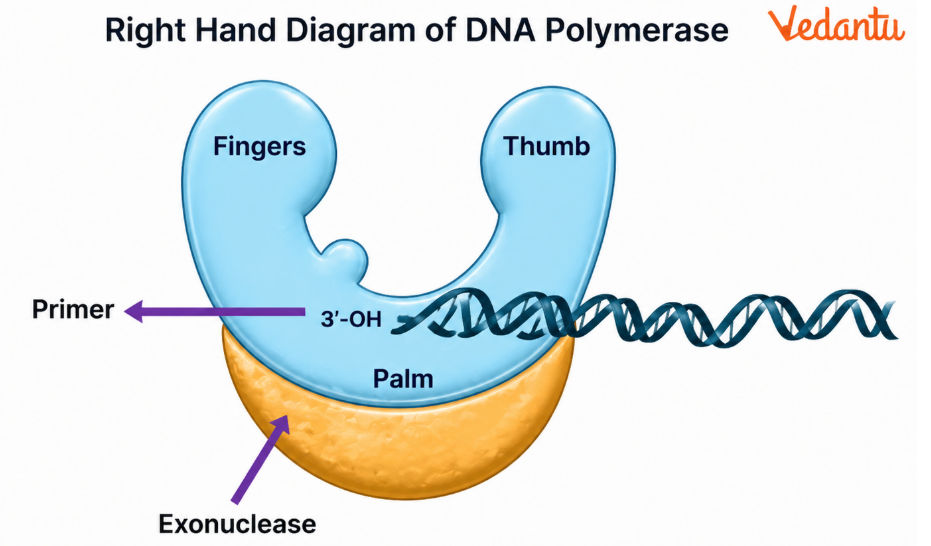
In simple terms, DNA polymerase is the molecular machine that builds DNA, adding nucleotides one by one to form a new strand complementary to the template strand. This process ensures that each daughter cell receives an identical copy of genetic material.
DNA polymerase cannot start synthesis on its own. It requires a primer with a free 3’-OH group, from which it begins adding nucleotides. The direction of synthesis is always 5’ → 3’, which is a key concept frequently tested in NEET.
DNA Polymerase Function: Replication, Repair and Proofreading
The DNA polymerase function is not limited to just copying DNA. It performs multiple highly coordinated roles:
1. DNA Replication (Primary Function)
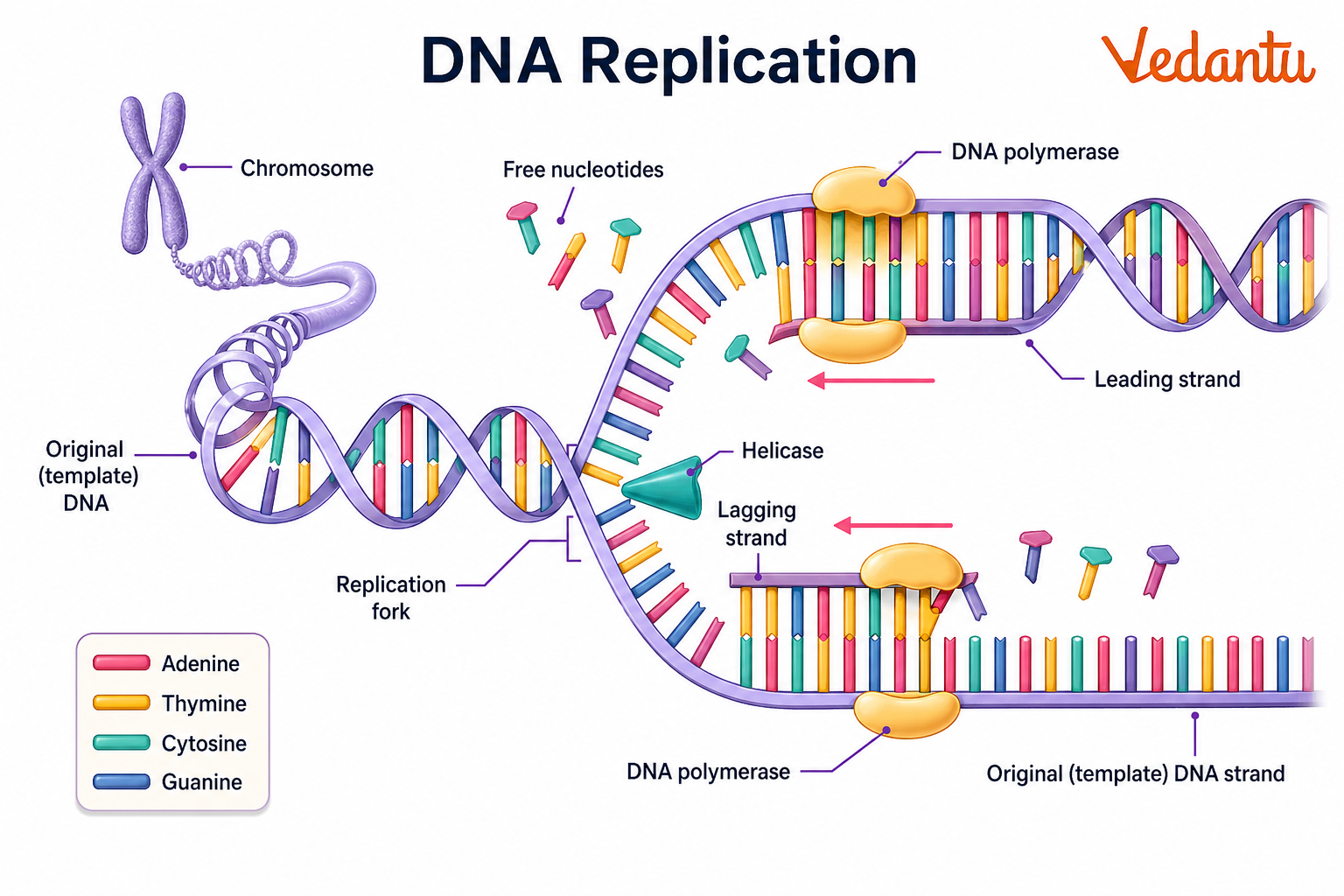
The main role of the DNA polymerase enzyme is to synthesise DNA during replication. It:
Adds nucleotides to the growing DNA strand
Works on both leading and lagging strands
Ensures complementary base pairing (A–T and G–C)
Extends the strand using the 3’-OH group
DNA polymerase operates in coordination with other enzymes to replicate both strands simultaneously.
2. DNA Repair Mechanism
DNA is constantly exposed to damage from environmental factors. DNA polymerase helps:
Repair damaged DNA segments
Replace incorrect nucleotides
Maintain genomic stability
This function is critical to prevent mutations and diseases.
3. Proofreading Activity
DNA replication is not 100% error-free. DNA polymerase ensures accuracy through proofreading:
Detects mismatched nucleotides
Removes incorrect bases using 3’ → 5’ exonuclease activity
Replaces them with correct ones
This proofreading significantly reduces mutation rates.
DNA Polymerase Structure
The DNA polymerase structure is often described as resembling a human hand, which helps understand its working mechanism:
Palm → Catalytic site for bond formation
Fingers → Bind incoming nucleotides
Thumb → Holds DNA in position
The enzyme has:
An active site where nucleotides are added
A post-insertion site where the newly formed base pair shifts after addition
This structure allows DNA polymerase to function with both speed and accuracy.
Types of DNA Polymerase in Prokaryotes
In prokaryotes like E. coli, multiple enzymes exist, each with a specific role.
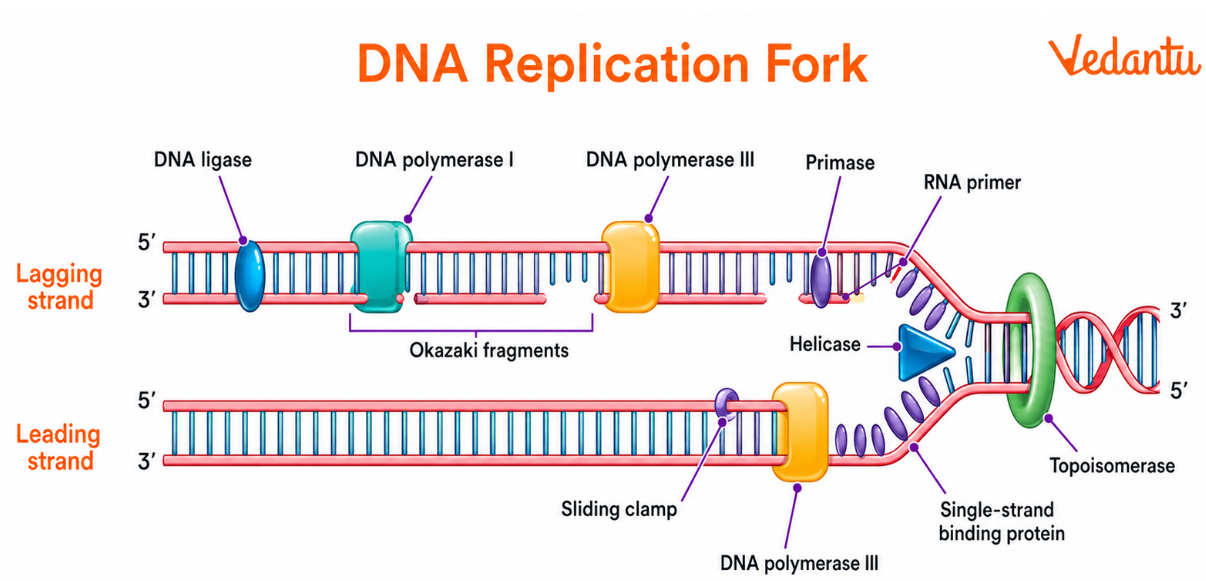
DNA Polymerase I
Removes RNA primers
Fills gaps in lagging strand
Has both 5’→3’ and 3’→5’ exonuclease activity
DNA Polymerase II
Involved mainly in DNA repair
Acts as a backup enzyme
Has proofreading ability
DNA Polymerase III
Main enzyme for DNA replication
High speed and efficiency
Responsible for synthesising most of the DNA
Possesses proofreading activity
DNA Polymerase IV and V
Involved in DNA repair under stress conditions
Help bypass damaged DNA regions
Participate in translesion synthesis
DNA Polymerase in Eukaryotes
The DNA polymerase in eukaryotes is more complex, with multiple specialised enzymes:
DNA Polymerase α (Alpha)
Initiates DNA synthesis
Synthesises RNA primer
Has primase activity
DNA Polymerase δ (Delta)
Main enzyme for lagging strand synthesis
Performs proofreading
DNA Polymerase ε (Epsilon)
Involved in leading strand synthesis
DNA Polymerase γ (Gamma)
Responsible for mitochondrial DNA replication
Humans have 15+ types of DNA polymerases, each performing specific functions in replication and repair
DNA Polymerase 1, 2, 3 Functions
How DNA Polymerase Works in DNA Replication?
DNA replication involves coordinated action:
DNA unwinds
Primer is added
DNA polymerase attaches
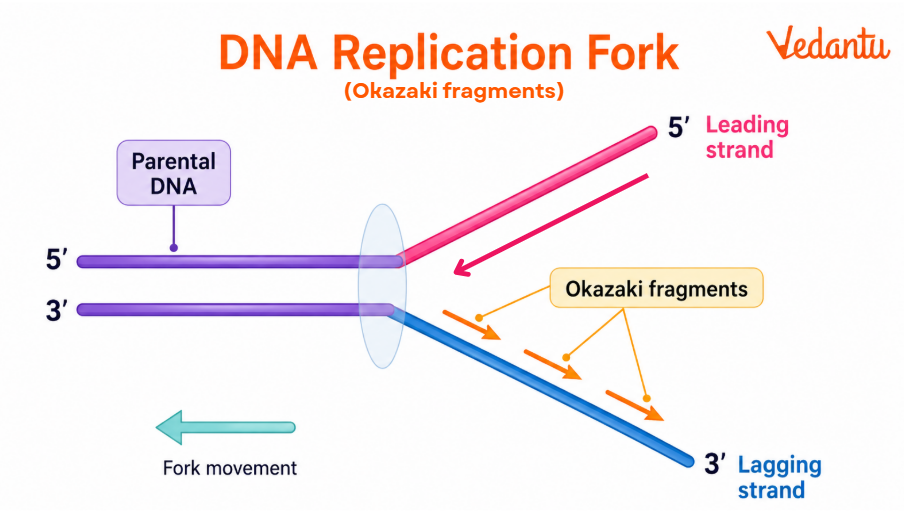
Nucleotides are added continuously (leading strand)
Lagging strand forms Okazaki fragments
RNA primers are removed
Gaps are filled and sealed
DNA polymerase plays a role at almost every stage of this process.
Key Properties of DNA Polymerase
Works only in 5’ → 3’ direction
Requires a primer
Has proofreading ability
Ensures high fidelity replication
Cannot initiate DNA synthesis independently
Importance of DNA Polymerase in Biology
DNA polymerase is essential because it:
Maintains genetic stability
Prevents mutations
Supports cell division
Enables inheritance
Plays a role in biotechnology (PCR, DNA sequencing)
Without DNA polymerase, life cannot sustain itself across generations.
Common Exam Concepts Related to DNA Polymerase
DNA polymerase cannot initiate replication
Leading vs lagging strand difference
Role of Okazaki fragments
Proofreading mechanism
Enzyme differences in prokaryotes vs eukaryotes
These are frequently asked in conceptual MCQs.
A Note from the Expert: What Makes DNA Polymerase Unique?
DNA polymerase is not just a replication enzyme—it is a highly precise biological system that:
Copies DNA
Repairs errors
Maintains genetic integrity
Its ability to ensure accuracy while replicating billions of nucleotides makes it one of the most important enzymes in molecular biology.
FAQs on DNA Polymerase: Structure, Function, Types and Role in DNA Replication
1. What does a DNA polymerase do?
DNA polymerase is an enzyme that builds a new DNA strand during replication. It adds nucleotides to the growing strand, helps repair damaged DNA, and corrects mistakes through proofreading.
2. What best describes DNA polymerase?
DNA polymerase is the enzyme that copies DNA by adding nucleotides one by one to the 3′ end of a growing DNA strand.
3. What are the 5 types of DNA polymerase?
In eukaryotic cells, the five main DNA polymerases are:
DNA polymerase α
DNA polymerase β
DNA polymerase γ
DNA polymerase δ
DNA polymerase ε
4. Is DNA polymerase 3 to 5 or 5 to 3?
DNA polymerase synthesizes the new DNA strand in the 5′ to 3′ direction. It reads the template strand in the 3′ to 5′ direction.
5. What are DNA 3 functions?
The three main functions of DNA are:
storing genetic information
passing hereditary information to the next generation
directing protein synthesis
6. Why is 98% of our DNA called junk DNA?
It is called junk DNA because most of it does not code for proteins. However, much of this DNA may still have important regulatory or structural functions.
7. What are the 7 steps of DNA replication in order?
The main steps of DNA replication are:
Unwinding of DNA
Formation of replication fork
Primer synthesis
DNA strand elongation
Primer removal
Gap filling
Joining of fragments and termination
8. What are 5 components of PCR?
The five main components of PCR are:
template DNA
primers
DNA polymerase
dNTPs
magnesium ions (Mg²⁺)
9. Why 5 prime to 3 prime?
DNA is synthesized in the 5′ to 3′ direction because new nucleotides can only be added to the free 3′-OH end of the growing strand.
10. Is DNA polymerase 3 only for prokaryotes?
Yes, DNA polymerase III is the main replication enzyme in prokaryotes. In eukaryotes, the main replication enzymes are DNA polymerase δ and ε.
