








An Overview of Class 9 Biology Study The Life Cycle Of Mosquito Experiment
Biology Experiment - Features of Monocots and Dicots
Have you looked at a blade of grass closely? Its leaves are distinctly different from those of a rose plant, or a mango plant, aren’t they? If you dig up to see the root systems, they’ll appear different too.
Grasses and well-developed plants such as the rose or mustard are all flowering plants whose seeds are enclosed within fruits.
However, the external morphologies and internal anatomies of their stems, leaves, flowers, and roots are different, based on the number of cotyledons present in their seeds.
Let’s perform this simple experiment to understand the differences between monocots and dicots.
Table of Content
Aim
Apparatus Required
Theory
Procedure
Observations
Result
Precautions
Lab Manual Questions
Viva Questions
Practical Based Questions
Aim
To study the features of the stem, leaves, flowers, roots, and seeds of monocots and dicots and understand the differences between the two groups of plants.
Apparatus Required
An intact monocot plant (maize, onion, paddy, etc.), intact dicot plant (mustard, pea, rose, hibiscus, etc.), simple microscope, hand lens, glass slide, cover slip, a razor blade, water, Petri dish, and pre-soaked seeds of gram and maize.
Theory
The angiosperms are distinctly known for their characteristic flowers and seeds enclosed within fruits.
They are further divided into two groups - plants with seeds that bear a single cotyledon (namely, the monocots) and those plants that bear two cotyledons in their seeds (the dicots).
Features of Monocots
The embryo within the seed contains only one cotyledon.
Stems are non-woody and weak. Vascular bundles are scattered.
Parallel venation present in leaves.
The root system is fibrous type.
The flowers are trimerous - The different floral parts including the sepals, petals, stamens, and carpels are present in multiples of three.
Examples of monocots include maize, wheat, rice, bamboo, etc.
Features of Dicots
Seeds with two cotyledons within their embryos.
Strong, woody stems. Vascular bundles are arranged in the form of a ring.
Reticulate venation present in leaves.
The root system is characteristic of taproot type.
The flowers are pentamerous.
Examples of dicots include peas, beans, mango, magnolia, rose, tomatoes, etc.
Procedure
Carefully separate the leaves, roots, and flowers of both plants.
Observe the roots of each of the plants. Note down your observations.
Now, move on to the leaves. Observe their shape.
Using a hand lens, observe the pattern of venation in the leaves of both plants.
For the flower, count the number of petals, sepals, and stamens in each plant.
Now observe the stems of both plants.
Cut an even, thin transverse section of the stem using a razor blade. Be careful!
Now, take a glass slide and add just one drop of water to its centre. Carefully transfer the stem T.S. onto a glass slide. Cover the slide with its cover slip.
Observe the T.S. of the stem under the microscope.
Remove the seed coat of each of the two seeds and open them up. Record the number of cotyledons present in them.
Observations
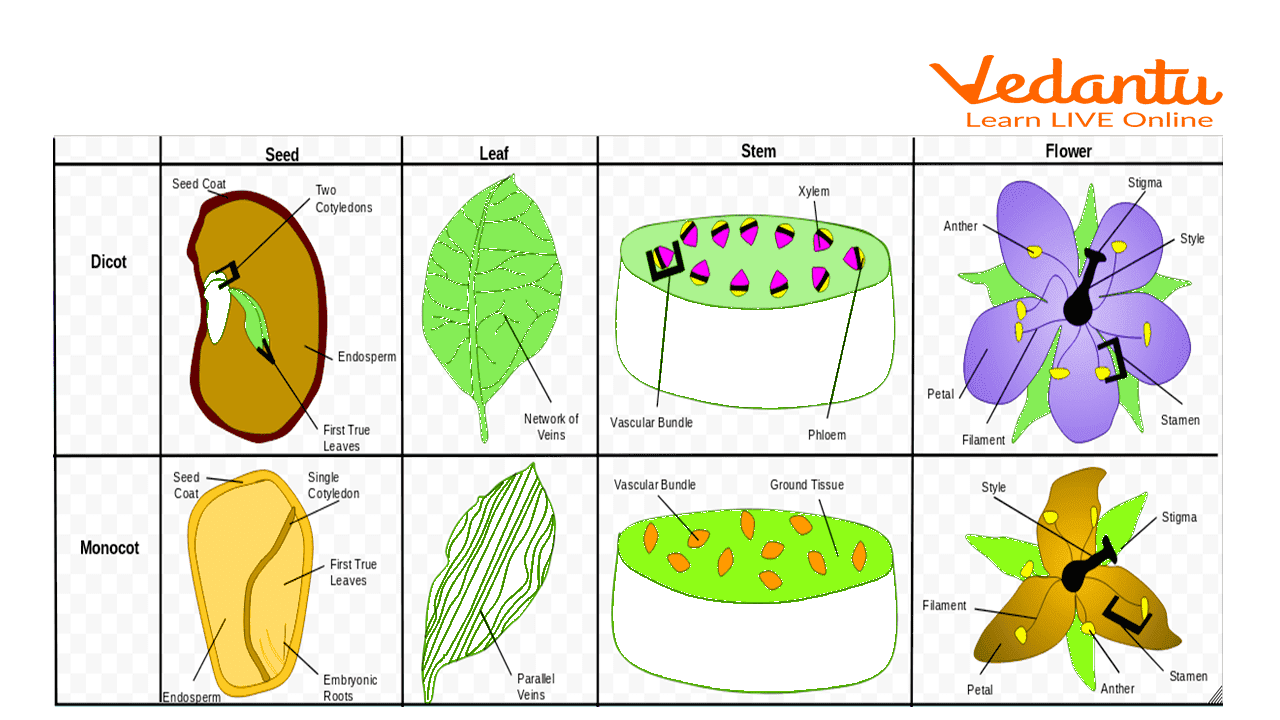
Differences between dicots and monocots
Result
From this experiment, it is revealed that the monocots have tuft-like roots, leaves with parallel venation, scattered vascular bundles, and tetramerous flowers. Contrarily, the dicots have taproots, leaves with reticulate venation, vascular bundles arranged in a ring, and pentamerous (or tetramerous) flowers.
Precautions
Handle the specimens with care, ensuring that there’s no breakage or loss of any parts.
Care must be taken while handling the razor blade.
The T.S. must be very thin and evenly cut.
Do not keep the T.S. out in the open for long, as the section may dry.
The coverslip must be placed gently with the help of a needle, to avoid air bubbles.
Lab Manual Questions
What are the features of a typical dicot seed?
Ans: A typical dicotyledonous seed has a seed coat, a hilum, a micropylar pore, two cotyledons, the endosperm and radicle, and a plumule.
What are the differentiating features of the vascular bundles of maize and gram?
Ans: Maize is a monocot, hence its vascular bundles will appear scattered under a microscope. Contrastingly, the vascular bundles of the gram appear arranged as a ring, owing to its dicot nature.
Pentamerous flowers are a feature of which group of plants?
Ans: Pentamerous flowers are seen in dicots.
Viva Questions
Do the plants selected for this experiment have anything in common?
Ans: Yes. Both the plants belong to the sub-kingdom angiosperms of kingdom Plantae; hence, they bear flowers and their seeds are covered with fruits.
If a plant has been randomly given to you, how will you determine the number of cotyledons that its seeds bear?
Ans: I will look at the leaves of the plant. If the leaves have parallel venation, it is a monocot. If reticulate venation is observed, the plant is a dicot.
A monocotyledonous seed has a single cotyledon. What are the other distinguishing parts of a monocot seed?
Ans: Apart from the cotyledon, a monocot seed possesses a seed coat, the endosperm, an aleurone layer, the embryo, a scutellum, and the coleoptile and the coleorhiza.
What are some other examples of monocots?
Ans: Maize, wheat, onion, orchids, ginger, bamboo, etc.
How many whorls do a typical flower have? What are they?
Ans: A flower typically has 4 whorls - the sepals, petals, the androecium, and the gynoecium.
What do you understand by the term incomplete flowers?
Ans: An incomplete flower lacks one or more whorls typical of a flower.
What are the radicle and the plumule?
Ans: The radicle is that part of the embryo of the seed, which eventually develops into the root system of the plant. It is the first structure of a plant that arises in the plant embryo. The plumule is the initial shoot of the embryo that forms above the epicotyl of the embryonic axis.
What do you understand by the term carpel?
Ans: The carpel is the female reproductive organ of the plant. A flower may contain one or more carpels. Each carpel comprises an ovary, a stigma, and a style.
Practical Based Questions
You’ve been given a plant that has reticulate venation in its leaves. Which of the following options is the plant most likely to be?
Maize
Bamboo
Corn
Mustard
Ans: D) Mustard
Which of the following is not a characteristic of monocot plants?
Parallel venation
Scattered vascular bundles
Tetramerous flowers
Scutellum in seed
Ans: C) Tetramerous flowers
In monocot stems, a greater number of vascular bundles are seen near the
Centre
Pith
Periphery
Stele
Ans: C) Periphery
Which of the following is an exclusive characteristic of a dicot seed?
Scutellum
Cotyledons
Seed coat
Hilum
Ans: D) Hilum
Floral whorls in a dicot are present in multiples of:
3
4
5
Both b and c
Ans: D) Both b and c
Which of the following groups comprises only dicot plants?
Maize, wheat, corn, mango
Mango, palm, mustard, apple
Corn, maize, castor, mustard
Mustard, gram, pea, hibiscus
Ans: D) Mustard, gram, pea, hibiscus
A particular plant is found to have 24 petals and leaves that have parallel venation. The root system that is most likely to be found in this plant is:
Tap root
Adventitious root
Fibrous root
Stilt roots
Ans: C) Fibrous roots
In the T.S. of the stem of a hibiscus, the most likely observation is
Scattered vascular bundles
A greater amount of vascular bundles at the periphery
A greater amount of vascular bundles at the centre
Vascular bundles in a circular arrangement
Ans: D) Vascular bundles in a circular arrangement
Conclusions
From the observations made, we can conclude that since specimen A has a fibrous root system, parallel venation, tetramerous flowers, and a single cotyledon in its seed, it is a monocot. On the other hand, specimen B is conclusively a dicot, since it has a tap root system, reticulate venation, pentamerous flowers, and two cotyledons in its seeds.


FAQs on Class 9 Biology Study The Life Cycle Of Mosquito Experiment
1. What are the five key differences between monocot and dicot plants that are important for the CBSE Class 9 exam 2025-26?
For the Class 9 exam, it is crucial to know the following five differences between monocots and dicots:
- Cotyledons: Monocots have a single cotyledon in their seed, while dicots have two.
- Root System: Monocots typically have a fibrous root system, whereas dicots have a main taproot system.
- Leaf Venation: The leaves of monocots exhibit parallel venation. In contrast, dicot leaves show reticulate (net-like) venation.
- Flowers: Monocot flowers are usually trimerous (floral parts in multiples of three). Dicot flowers are typically tetramerous or pentamerous (parts in multiples of four or five).
- Vascular Bundles: In the stem, vascular bundles are scattered in monocots, while in dicots, they are arranged in a ring.
2. How can you differentiate between a monocot and a dicot plant by observing only its root and leaves? This is a frequently asked 3-mark question.
You can easily differentiate between a monocot and a dicot by observing their roots and leaves. A monocot will have a fibrous root system, where many thin roots emerge from the base of the stem. Its leaves will show parallel venation, with veins running parallel to each other. A dicot, on the other hand, will have a primary taproot system with smaller secondary roots branching off it. Its leaves will display reticulate venation, forming a web-like pattern.
3. Provide two examples each for monocot and dicot plants, stating one primary characteristic for their classification.
Here are examples that are important for your exams:
- Monocot Examples:
- Maize: It is a monocot because its seed has only one cotyledon and its leaves show parallel venation.
- Grass: It has a fibrous root system, a key characteristic of monocots.
- Dicot Examples:
- Pea Plant: It is a dicot because it has two cotyledons in its seed and its leaves have reticulate venation.
- Sunflower: It has a taproot system and pentamerous flowers (petals in multiples of five), which are characteristic of dicots.
4. If you find a plant with leaves showing parallel venation and trimerous flowers, can you definitively classify it? Justify your answer.
Yes, you can definitively classify it as a monocot. The presence of parallel venation in leaves and trimerous flowers (floral parts in multiples of three) are two of the most distinct and reliable characteristics of monocotyledonous plants. These features almost always occur together in this group, making the classification straightforward.
5. Why is the number of cotyledons considered the primary basis for classifying flowering plants into monocots and dicots?
The number of cotyledons (seed leaves) is considered the primary basis because this fundamental difference is established at the embryonic stage of the plant. This initial divergence into one or two cotyledons is linked to a whole suite of other structural characteristics that remain consistent within each group, such as the type of root system, leaf venation pattern, and arrangement of floral parts. It is the most fundamental trait from which other differences arise.
6. How do the structural differences in root systems (taproot vs. fibrous) impact the survival of dicots and monocots?
The different root systems provide distinct survival advantages. The taproot system in dicots grows deep into the soil, anchoring the plant firmly and allowing it to access water and nutrients from deeper soil layers. This makes them more drought-resistant. The shallow, spreading fibrous root system of monocots is excellent at holding topsoil together, preventing soil erosion, and rapidly absorbing surface water from rainfall.
