



The curved surface area of a frustum cone is \[240{\text{ }}c{m^2}\]. The larger circle area is \[50{\text{ }}c{m^2}\]. The total surface area is \[750{\text{ }}c{m^2}.\] Find the smaller circle area of a cone.
A. \[560{\text{ }}c{m^2}\]
B.\[\;460{\text{ }}c{m^2}\]
C. \[660{\text{ }}c{m^2}\]
D. \[760{\text{ }}c{m^2}\]
Answer
 Verified
640.8k+ views
Hint: We are given the curved surface area of a frustum cone, the larger circle area, and the total surface area, as the total surface area of the frustum is curved surface area plus larger circle area plus smaller circle area, so as we are given all the values we can find the smaller circle area by subtracting larger circle area and curved surface area from the total surface area.
Complete step by step Answer:
Let us draw the figure:
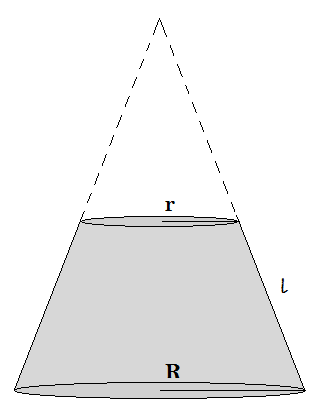
We know that, curved surface area of a frustum cone is given by \[ = \;\pi \left( {R + r} \right)l\;\]
Total surface area of a frustum of cone =\[\pi \left( {R + r} \right)l{\text{ }} + \pi {r^2}\; + \;\pi {R^2}\]
Larger circle area $ = \;\pi {R^2}\; \Rightarrow \;50{\text{ }}c{m^2}$
We need to find the smaller circle area i.e. \[\pi {r^2}\]
Now, the curved surface area of a frustum cone is \[240{\text{ }}c{m^2}\].
\[\pi \left( {R + r} \right)l\;\]\[ = 240\]\[c{m^2}\]
Again, the total surface area of a frustum cone is \[750{\text{ }}c{m^2}\].
Therefore,
\[\pi \left( {R + r} \right)l{\text{ }} + \pi {r^2}\; + \;\pi {R^2} = 750c{m^2}\]
Since \[\pi {R^2}\; = \;50{\text{ }}c{m^2}\], we get,
\[ \Rightarrow \pi \left( {R + r} \right)l{\text{ }} + \pi {r^2}\; + \;50 = 750\]
On simplification we get,
\[ \Rightarrow \pi \left( {R + r} \right)l{\text{ }} + \pi {r^2}\; = 700\]
Since \[\pi \left( {R + r} \right)l\; = 240c{m^2}\], we get,
\[ \Rightarrow 240 + \pi {r^2}\; = 700\]
On simplification we get,
\[ \Rightarrow \pi {r^2}\; = 460\]\[c{m^2}\]
Therefore, area of the smaller circle of frustum cone is \[460{\text{ }}c{m^2}\]
Hence option (B) is the correct option.
Note: A frustum cone is formed from a right circular cone by cutting off the tip with a cut perpendicular to the height, forming a lower base and an upper base that are circular and parallel to each other.
Note that,
Curved surface area of a frustum cone is given by \[ = \;\pi \left( {R + r} \right)l\;\]
Total surface area of a frustum of cone = \[\pi \left( {R + r} \right)l{\text{ }} + \pi {r^2}\; + \;\pi {R^2}\]
Complete step by step Answer:
Let us draw the figure:
We know that, curved surface area of a frustum cone is given by \[ = \;\pi \left( {R + r} \right)l\;\]
Total surface area of a frustum of cone =\[\pi \left( {R + r} \right)l{\text{ }} + \pi {r^2}\; + \;\pi {R^2}\]
Larger circle area $ = \;\pi {R^2}\; \Rightarrow \;50{\text{ }}c{m^2}$
We need to find the smaller circle area i.e. \[\pi {r^2}\]
Now, the curved surface area of a frustum cone is \[240{\text{ }}c{m^2}\].
\[\pi \left( {R + r} \right)l\;\]\[ = 240\]\[c{m^2}\]
Again, the total surface area of a frustum cone is \[750{\text{ }}c{m^2}\].
Therefore,
\[\pi \left( {R + r} \right)l{\text{ }} + \pi {r^2}\; + \;\pi {R^2} = 750c{m^2}\]
Since \[\pi {R^2}\; = \;50{\text{ }}c{m^2}\], we get,
\[ \Rightarrow \pi \left( {R + r} \right)l{\text{ }} + \pi {r^2}\; + \;50 = 750\]
On simplification we get,
\[ \Rightarrow \pi \left( {R + r} \right)l{\text{ }} + \pi {r^2}\; = 700\]
Since \[\pi \left( {R + r} \right)l\; = 240c{m^2}\], we get,
\[ \Rightarrow 240 + \pi {r^2}\; = 700\]
On simplification we get,
\[ \Rightarrow \pi {r^2}\; = 460\]\[c{m^2}\]
Therefore, area of the smaller circle of frustum cone is \[460{\text{ }}c{m^2}\]
Hence option (B) is the correct option.
Note: A frustum cone is formed from a right circular cone by cutting off the tip with a cut perpendicular to the height, forming a lower base and an upper base that are circular and parallel to each other.
Note that,
Curved surface area of a frustum cone is given by \[ = \;\pi \left( {R + r} \right)l\;\]
Total surface area of a frustum of cone = \[\pi \left( {R + r} \right)l{\text{ }} + \pi {r^2}\; + \;\pi {R^2}\]

Recently Updated Pages
Basicity of sulphurous acid and sulphuric acid are

Master Class 12 Economics: Engaging Questions & Answers for Success
Master Class 12 Biology: Engaging Questions & Answers for Success
Master Class 11 English: Engaging Questions & Answers for Success
Master Class 11 Physics: Engaging Questions & Answers for Success
Master Class 11 Computer Science: Engaging Questions & Answers for Success
Trending doubts
Difference Between Plant Cell and Animal Cell
Fill the blanks with the suitable prepositions 1 The class 9 english CBSE
What is pollution? How many types of pollution? Define it
What is the full form of pH?
What is the Full Form of ICSE, CBSE and SSC
Name 10 Living and Non living things class 9 biology CBSE