



In which quadrant or on which axis the following points lie:
\[\left( { - 3,5} \right)\], \[\left( {4, - 1} \right)\], \[\left( {2,0} \right)\], \[\left( {2,2} \right)\], \[\left( { - 3, - 6} \right)\].
A) IV, ii, \[x\]-axis, i, iii
B) ii, iv, \[x\]-axis, i, iii
C) iv, iii, i, i, iii
D) ii, iv, \[y\]-axis, i , iii
Answer
 Verified
665.4k+ views
Hint: The value of \[x\] is positive only in the 1st and 4th quadrant and the value of \[y\]is positive only in the 1st and 2nd quadrant. The value of \[x\]is negative only in the 2nd and 3rd question and the value of \[y\]is negative only in the 3rd and 4th quadrant.
Complete step-by-step answer:
Given: we have given the points \[\left( { - 3,5} \right)\], \[\left( {4, - 1} \right)\], \[\left( {2,0} \right)\], \[\left( {2,2} \right)\], \[\left( { - 3, - 6} \right)\]. And we have to find the quadrant or axis where these points lie.
We will solve these points one by one,
First we will make a diagram of quadrants sharing all the conditions in different quadrants.
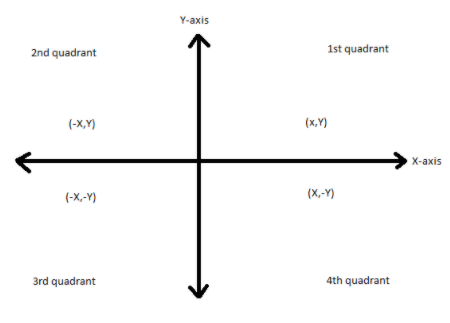
First we will take point \[\left( { - 3,5} \right)\]
By observing we found that the value of\[x\]is negative and the value of \[y\]is positive so this point will be placed in the 2nd quadrant.
Now, for \[\left( {4, - 1} \right)\]
Here, we see that the value of\[x\]is positive and the value of \[y\]is negative so this point will be placed in the 4th quadrant.
Now, for \[\left( {2,0} \right)\]
At this point the value of \[y\]is zero; it means this point lies on the \[x\]-axis.
Now, for \[\left( {2,2} \right)\]
At this point, the value of\[x\]is positive and the value of \[y\]is also positive, so this point will be placed in the 1st quadrant.
Now, for \[\left( { - 3, - 6} \right)\]
At this point, the value of\[x\]is negative and the value of \[y\]is also negative, so this point will be placed in the 3rd quadrant.
So, the \[\left( { - 3,5} \right)\]lies in the 2nd quadrant, \[\left( {4, - 1} \right)\]lies in the 4th quadrant, \[\left( {2,0} \right)\]lies on the \[x\]-axis, \[\left( {2,2} \right)\]lies in the 1st quadrant and \[\left( { - 3, - 6} \right)\]lies in the 3rd quadrant.
Therefore, the answer will be option B which is Ii, iv, \[x\]-axis, i, iii.
Note: If the value of \[x\]is zero it means the point is on the \[y\]axis and if the value of \[y\]is zero then it means the point is on the \[x\]-axis.
Complete step-by-step answer:
Given: we have given the points \[\left( { - 3,5} \right)\], \[\left( {4, - 1} \right)\], \[\left( {2,0} \right)\], \[\left( {2,2} \right)\], \[\left( { - 3, - 6} \right)\]. And we have to find the quadrant or axis where these points lie.
We will solve these points one by one,
First we will make a diagram of quadrants sharing all the conditions in different quadrants.
First we will take point \[\left( { - 3,5} \right)\]
By observing we found that the value of\[x\]is negative and the value of \[y\]is positive so this point will be placed in the 2nd quadrant.
Now, for \[\left( {4, - 1} \right)\]
Here, we see that the value of\[x\]is positive and the value of \[y\]is negative so this point will be placed in the 4th quadrant.
Now, for \[\left( {2,0} \right)\]
At this point the value of \[y\]is zero; it means this point lies on the \[x\]-axis.
Now, for \[\left( {2,2} \right)\]
At this point, the value of\[x\]is positive and the value of \[y\]is also positive, so this point will be placed in the 1st quadrant.
Now, for \[\left( { - 3, - 6} \right)\]
At this point, the value of\[x\]is negative and the value of \[y\]is also negative, so this point will be placed in the 3rd quadrant.
So, the \[\left( { - 3,5} \right)\]lies in the 2nd quadrant, \[\left( {4, - 1} \right)\]lies in the 4th quadrant, \[\left( {2,0} \right)\]lies on the \[x\]-axis, \[\left( {2,2} \right)\]lies in the 1st quadrant and \[\left( { - 3, - 6} \right)\]lies in the 3rd quadrant.
Therefore, the answer will be option B which is Ii, iv, \[x\]-axis, i, iii.
Note: If the value of \[x\]is zero it means the point is on the \[y\]axis and if the value of \[y\]is zero then it means the point is on the \[x\]-axis.
Recently Updated Pages
Find the greatest six digit number that is exactly class 8 maths CBSE

What is the time difference between India and Cana class 8 social science CBSE
Compare LPG and wood as fuels class 8 chemistry CBSE
In Indian rupees 1 trillion is equal to how many c class 8 maths CBSE
30 opposite words in English from a to z class 8 english CBSE
How many cubic feet equals to 1 unit sand class 8 maths CBSE
Trending doubts
What is BLO What is the full form of BLO class 8 social science CBSE
Citizens of India can vote at the age of A 18 years class 8 social science CBSE
Full form of STD, ISD and PCO
One cusec is equal to how many liters class 8 maths CBSE
What are the methods of reducing friction. Explain
What is the difference between rai and mustard see class 8 biology CBSE