




In an examination, 70% of the students passed in Paper I, and 60% of the students passed in Paper II. 15% of the students failed in both the papers while 270 students passed in both the papers. What is the total number of students?
A. 600
B. 580
C. 560
D. 540
Answer
 Verified
626.7k+ views
Hint: First of all, find the percentage of students failed in both the papers and hence the percentage of students failed in the examination. Then find the percentage of students passed in both the papers to obtain the required answer as the number of students passed in both the papers.
Complete step-by-step answer:
Let the total number of students attempted the examination \[n\left( U \right) = 100\% \]
And let the total number of students be \[x\].
The percentage of set of students passed in Paper I \[n\left( A \right) = 70\% \]
The percentage of set of students passed in Paper II \[n\left( B \right) = 60\% \]
We know that the complement of \[n\left( X \right)\] is given by \[n\left( {{X^c}} \right) = n\left( U \right) - n\left( X \right)\].
By using this formula, we get
The percentage of set of students failed in Paper I \[n\left( {{A^c}} \right) = n\left( U \right) - n\left( A \right) = 100\% - 70\% = 30\% \]
The percentage of set of students failed in Paper II \[n\left( {{B^c}} \right) = n\left( U \right) - n\left( B \right) = 100\% - 60\% = 40\% \]
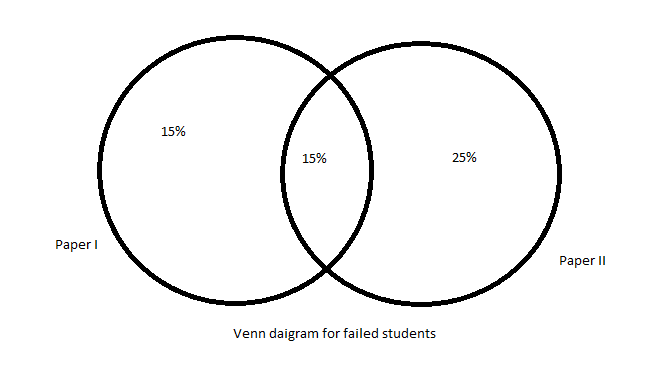
Given the percentage of students failed in both Papers I & II is 15%
The Venn diagram for failed students is shown as below:
Now, consider the percentage of students failed in the examination.
The percentage of set of the students failed in the examination = percentage of set of students failed in Paper I + percentage of set of students failed in paper II – set of the students failed in both Papers I & II
So, percentage of set of students failed in examination \[ = 30\% + 40\% - 15\% = 55\% \]
The percentage of students passed in both the papers = 100% - percentage of students failed in examination.
So, percentage of set of students passed in both papers \[ = 100\% - 55\% = 45\% \]
Given the number of students passed in both the papers is 270.
So, we have 45% of \[x\] = 270
\[
\Rightarrow \dfrac{{45}}{{100}} \times x = 270 \\
\Rightarrow 45x = 270 \times 100 \\
\Rightarrow x = \dfrac{{27000}}{{45}} \\
\therefore x = 600 \\
\]
Hence the total number of students is 600.
Thus, the correct option is A. 600
Note: The complement of \[n\left( X \right)\] is given by \[n\left( {{X^c}} \right) = n\left( U \right) - n\left( X \right)\]. In these types of problems try to solve the problem by drawing Venn diagrams and considering the set of objects in their respective areas or fields.
Complete step-by-step answer:
Let the total number of students attempted the examination \[n\left( U \right) = 100\% \]
And let the total number of students be \[x\].
The percentage of set of students passed in Paper I \[n\left( A \right) = 70\% \]
The percentage of set of students passed in Paper II \[n\left( B \right) = 60\% \]
We know that the complement of \[n\left( X \right)\] is given by \[n\left( {{X^c}} \right) = n\left( U \right) - n\left( X \right)\].
By using this formula, we get
The percentage of set of students failed in Paper I \[n\left( {{A^c}} \right) = n\left( U \right) - n\left( A \right) = 100\% - 70\% = 30\% \]
The percentage of set of students failed in Paper II \[n\left( {{B^c}} \right) = n\left( U \right) - n\left( B \right) = 100\% - 60\% = 40\% \]
Given the percentage of students failed in both Papers I & II is 15%
The Venn diagram for failed students is shown as below:
Now, consider the percentage of students failed in the examination.
The percentage of set of the students failed in the examination = percentage of set of students failed in Paper I + percentage of set of students failed in paper II – set of the students failed in both Papers I & II
So, percentage of set of students failed in examination \[ = 30\% + 40\% - 15\% = 55\% \]
The percentage of students passed in both the papers = 100% - percentage of students failed in examination.
So, percentage of set of students passed in both papers \[ = 100\% - 55\% = 45\% \]
Given the number of students passed in both the papers is 270.
So, we have 45% of \[x\] = 270
\[
\Rightarrow \dfrac{{45}}{{100}} \times x = 270 \\
\Rightarrow 45x = 270 \times 100 \\
\Rightarrow x = \dfrac{{27000}}{{45}} \\
\therefore x = 600 \\
\]
Hence the total number of students is 600.
Thus, the correct option is A. 600
Note: The complement of \[n\left( X \right)\] is given by \[n\left( {{X^c}} \right) = n\left( U \right) - n\left( X \right)\]. In these types of problems try to solve the problem by drawing Venn diagrams and considering the set of objects in their respective areas or fields.
Recently Updated Pages
Basicity of sulphurous acid and sulphuric acid are

Master Class 10 English: Engaging Questions & Answers for Success
Master Class 10 Social Science: Engaging Questions & Answers for Success
Master Class 10 Computer Science: Engaging Questions & Answers for Success
Class 10 Question and Answer - Your Ultimate Solutions Guide
Master Class 10 General Knowledge: Engaging Questions & Answers for Success
Trending doubts
Which country won the ICC Men's ODI World Cup in 2023?
In cricket, how many legal balls are there in a standard over?
Explain the Treaty of Vienna of 1815 class 10 social science CBSE
What does "powerplay" mean in limited-overs cricket?
What is the full form of PNG A Petrol Natural Gas B class 10 chemistry CBSE
What is the "Powerplay" in T20 cricket?