



Find the four angles of a cyclic quadrilateral ABCD in which $ \angle A=\left( 2x-1 \right){}^\circ $ , $ \angle B=\left( y+5 \right){}^\circ $ , $ \angle C=\left( 2y+15 \right){}^\circ $ and $ \angle D=\left( 4x-7 \right){}^\circ $ .
(a) $ \angle A=25{}^\circ ,\ \angle B=45{}^\circ ,\ \angle C=105{}^\circ ,\ \angle D=135{}^\circ $
(b) $ \angle A=35{}^\circ ,\ \angle B=75{}^\circ ,\ \angle C=95{}^\circ ,\ \angle D=135{}^\circ $
(c) $ \angle A=45{}^\circ ,\ \angle B=75{}^\circ ,\ \angle C=95{}^\circ ,\ \angle D=125{}^\circ $
(d) $ \angle A=65{}^\circ ,\ \angle B=55{}^\circ ,\ \angle C=115{}^\circ ,\ \angle D=125{}^\circ $
Answer
 Verified
660.6k+ views
Hint: In a quadrilateral sum of opposite angles is always equal to $ {{180}^{\circ }} $ , such as $ \angle A+\angle C={{180}^{\circ }} $ and $ \angle B+\angle D={{180}^{\circ }} $ . So, using this fact, we will equate all the expressions and from that we will find the value of x and y. Then by substituting the values of x and y in expressions of angles we will get our answer.
Complete step-by-step answer:
In question we are given equations of four angles of a quadrilateral and we are asked to find the value of angles. Now, we know that in a cyclic quadrilateral sum of opposite angles equal to $ {{180}^{\circ }} $ . So, first of all we will draw a figure for our simplicity,
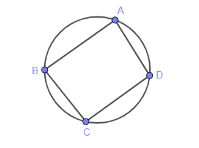
Now, from figure we can see that $ \angle A $ is an opposite angle to $ \angle C $ and in the same way $ \angle B $ is opposite angle to $ \angle D $, so using the fact that sum of opposite angles in a quadrilateral is $ {{180}^{\circ }} $ , we can see it mathematically as,
$ \angle A+\angle C={{180}^{\circ }} $ ………….(i)
$ \angle B+\angle D={{180}^{\circ }} $ ………….(ii)
Now, expressions of angles can be given as, $ \angle A=\left( 2x-1 \right){}^\circ $ , $ \angle B=\left( y+5 \right){}^\circ $ , $ \angle C=\left( 2y+15 \right){}^\circ $ and $ \angle D=\left( 4x-7 \right){}^\circ $ . So, on substituting these values in expression (i) and (ii), we will get,
$ 2x-1+2y+15={{180}^{\circ }} $ ………………(iii)
$ y+5+4x-7={{180}^{\circ }} $ …………………(iv)
Now, we can make one of the two expressions similar to another expression, such as on multiplying expression (i) with 2 on both the sides we will get,
$ 2\left( 2x+2y+15-1 \right)=2\left( {{180}^{\circ }} \right) $
$ 4x+4y+28=360 $
Now, making $ 4x $ as subject in above expression we will get,
$ 4x=360-28-4y\Rightarrow 4x=332-4y $ ………………(v)
Now, on substituting the value of $ 4x $ from expression (v) in expression (ii) we will get,
$ y+5+332-4y-7={{180}^{\circ }} $
On, solving further we will get,
$ 330-3y=180\Rightarrow -3y=180-330 $
$ \Rightarrow -3y=-150 $
$ \Rightarrow y=\dfrac{-150}{-3}=50 $ …………….(vi)
Now, on substituting value of y in expression (v) we will get,
$ 4x=332-4\left( 50 \right) $
$ \Rightarrow x=\dfrac{332-200}{4}=\dfrac{132}{4} $
$ \Rightarrow x=33 $ …………..(vi)
Now, on substituting the values of X and Y in expressions of angles we will get,
$ \angle A=\left( 2\left( 33 \right)-1 \right)=66-1={{65}^{\circ }} $
$ \angle B=\left( 50+5 \right){}^\circ ={{55}^{\circ }} $
$ \angle C=\left( 2\left( 50 \right)+15 \right){}^\circ =100+15={{115}^{\circ }} $
$ \angle D=\left( 4\left( 33 \right)-7 \right){}^\circ =132-7={{125}^{\circ }} $
Hence, values of angles can be given as, $ \angle A=65{}^\circ ,\ \angle B=55{}^\circ ,\ \angle C=115{}^\circ ,\ \angle D=125{}^\circ $ .
So, the correct answer is “Option D”.
Note: We know that the sum of opposite angles in quadrilateral is always equal to $ {{180}^{\circ }} $, so we solved by equating the expression and then solving them. But instead of that we can also solve this sum by using option methods, such as, we know that $ \angle A+\angle C={{180}^{\circ }} $ and $ \angle B+\angle D={{180}^{\circ }} $ . So, we will consider the values given in option for example (a) and then we will substitute in expression as, $ 25+105=145\ne 180 $ , in the same way we can find values of all options and at the end we will get option (d) as our correct answer because $ 65+115=180=180 $. So, one can also solve by this method as it consumes less time and it is easy also.
Complete step-by-step answer:
In question we are given equations of four angles of a quadrilateral and we are asked to find the value of angles. Now, we know that in a cyclic quadrilateral sum of opposite angles equal to $ {{180}^{\circ }} $ . So, first of all we will draw a figure for our simplicity,
Now, from figure we can see that $ \angle A $ is an opposite angle to $ \angle C $ and in the same way $ \angle B $ is opposite angle to $ \angle D $, so using the fact that sum of opposite angles in a quadrilateral is $ {{180}^{\circ }} $ , we can see it mathematically as,
$ \angle A+\angle C={{180}^{\circ }} $ ………….(i)
$ \angle B+\angle D={{180}^{\circ }} $ ………….(ii)
Now, expressions of angles can be given as, $ \angle A=\left( 2x-1 \right){}^\circ $ , $ \angle B=\left( y+5 \right){}^\circ $ , $ \angle C=\left( 2y+15 \right){}^\circ $ and $ \angle D=\left( 4x-7 \right){}^\circ $ . So, on substituting these values in expression (i) and (ii), we will get,
$ 2x-1+2y+15={{180}^{\circ }} $ ………………(iii)
$ y+5+4x-7={{180}^{\circ }} $ …………………(iv)
Now, we can make one of the two expressions similar to another expression, such as on multiplying expression (i) with 2 on both the sides we will get,
$ 2\left( 2x+2y+15-1 \right)=2\left( {{180}^{\circ }} \right) $
$ 4x+4y+28=360 $
Now, making $ 4x $ as subject in above expression we will get,
$ 4x=360-28-4y\Rightarrow 4x=332-4y $ ………………(v)
Now, on substituting the value of $ 4x $ from expression (v) in expression (ii) we will get,
$ y+5+332-4y-7={{180}^{\circ }} $
On, solving further we will get,
$ 330-3y=180\Rightarrow -3y=180-330 $
$ \Rightarrow -3y=-150 $
$ \Rightarrow y=\dfrac{-150}{-3}=50 $ …………….(vi)
Now, on substituting value of y in expression (v) we will get,
$ 4x=332-4\left( 50 \right) $
$ \Rightarrow x=\dfrac{332-200}{4}=\dfrac{132}{4} $
$ \Rightarrow x=33 $ …………..(vi)
Now, on substituting the values of X and Y in expressions of angles we will get,
$ \angle A=\left( 2\left( 33 \right)-1 \right)=66-1={{65}^{\circ }} $
$ \angle B=\left( 50+5 \right){}^\circ ={{55}^{\circ }} $
$ \angle C=\left( 2\left( 50 \right)+15 \right){}^\circ =100+15={{115}^{\circ }} $
$ \angle D=\left( 4\left( 33 \right)-7 \right){}^\circ =132-7={{125}^{\circ }} $
Hence, values of angles can be given as, $ \angle A=65{}^\circ ,\ \angle B=55{}^\circ ,\ \angle C=115{}^\circ ,\ \angle D=125{}^\circ $ .
So, the correct answer is “Option D”.
Note: We know that the sum of opposite angles in quadrilateral is always equal to $ {{180}^{\circ }} $, so we solved by equating the expression and then solving them. But instead of that we can also solve this sum by using option methods, such as, we know that $ \angle A+\angle C={{180}^{\circ }} $ and $ \angle B+\angle D={{180}^{\circ }} $ . So, we will consider the values given in option for example (a) and then we will substitute in expression as, $ 25+105=145\ne 180 $ , in the same way we can find values of all options and at the end we will get option (d) as our correct answer because $ 65+115=180=180 $. So, one can also solve by this method as it consumes less time and it is easy also.
Recently Updated Pages
What are the two major island groups in India class 9 social science CBSE

What is Jhum cultivation class 9 biology CBSE
Write an Article on Save Earth Save Life
Silk is obtained from of the silk moth APupa BLarva class 9 chemistry CBSE
Write chemical formulas of the following compounds class 9 chemistry CBSE
The Indo Gangetic Plains of India are fertile due to class 9 social science CBSE
Trending doubts
Fill the blanks with the suitable prepositions 1 The class 9 english CBSE
Who was referred to as Amitraghata by the Greeks AChandragupta class 9 social science CBSE
Difference Between Plant Cell and Animal Cell
Name 10 Living and Non living things class 9 biology CBSE
What is the full form of pH?
On an outline map of India show its neighbouring c class 9 social science CBSE