



How many areas do these stamps occupy?
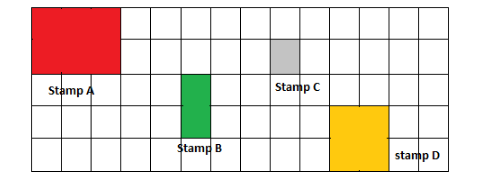
Stamp D covers 4 squares. Each square is 1cm. so the area of stamp D is 4 square cm.
Answer
 Verified
634.8k+ views
Hint: In this we have to find the area covered by each stamp and hence we have to find the total area occupied by the 4 stamps. To find the area we use the formula the area of a rectangle and the area of square. Then we total the areas occupied by each stamp and hence we find the solution.
Area of rectangle is $ l \times b $
Area of square is $ l \times l = {l^2} $
Complete step-by-step answer:
Given that each square is of length 1 cm. Now we will find the area occupied by each stamp and we total it. Now consider the stamp A, the stamp A has occupied the 5 squares and it is in the form of a rectangle. The stamp A has length 3 cm and breadth is 2cm. the area of the stamp A is calculated as follows.
The area of rectangle is defined as $ l \times b $
The area of stamp A is given by $ l \times b $
$ \Rightarrow 3cm \times 2cm $
$ \Rightarrow 6 $ square cm.
Now we have to find the area of stamp B. Now consider the stamp B, the stamp B has occupied the 2 squares and it is in the form of a rectangle. The stamp B has length 1 cm and breadth is 2cm. the area of the stamp B is calculated as follows.
The area of rectangle is defined as $ l \times b $
The area of stamp B is given by $ l \times b $
$ \Rightarrow 1cm \times 2cm $
$ \Rightarrow 2 $ square cm.
Now we have to find the area of stamp C. Now consider the stamp C, the stamp C has occupied the 1 square and it is in the form of square. The stamp C has length 1 cm and breadth is 1cm. the area of the stamp C is calculated as follows.
The area of square is defined as $ l \times l = {l^2} $
The area of stamp C is given by $ {l^2} $
$ \Rightarrow {(1cm)^2} $
$ \Rightarrow 1 $ square cm.
Now we have to find the area of stamp D. Now consider the stamp D, the stamp D has occupied the 4 squares and it is in the form of a square. The stamp D has length 2 cm and breadth is 2cm. the area of the stamp D is calculated as follows.
The area of square is defined as $ l \times l = {l^2} $
The area of stamp D is given by $ {l^2} $
$ \Rightarrow {(2cm)^2} $
$ \Rightarrow 4 $ square cm.
Now we have to find area of these stamps that is the sum of the area of each stamp
Total area = (stamp A + stamp B + stamp C +stamp D)
$ \Rightarrow $ Total area = (6+2+1+4) square cm.
$ \Rightarrow $ Total area = 13 square cm.
So, the correct answer is “13 square cm”.
Note: While finding the area of square and rectangle we should check the space or squares occupied by each stamp and then apply the formula to find the area. To find the total area we will add up all the areas and hence obtain the result. The unit of area should be mentioned compulsorily.
Area of rectangle is $ l \times b $
Area of square is $ l \times l = {l^2} $
Complete step-by-step answer:
Given that each square is of length 1 cm. Now we will find the area occupied by each stamp and we total it. Now consider the stamp A, the stamp A has occupied the 5 squares and it is in the form of a rectangle. The stamp A has length 3 cm and breadth is 2cm. the area of the stamp A is calculated as follows.
The area of rectangle is defined as $ l \times b $
The area of stamp A is given by $ l \times b $
$ \Rightarrow 3cm \times 2cm $
$ \Rightarrow 6 $ square cm.
Now we have to find the area of stamp B. Now consider the stamp B, the stamp B has occupied the 2 squares and it is in the form of a rectangle. The stamp B has length 1 cm and breadth is 2cm. the area of the stamp B is calculated as follows.
The area of rectangle is defined as $ l \times b $
The area of stamp B is given by $ l \times b $
$ \Rightarrow 1cm \times 2cm $
$ \Rightarrow 2 $ square cm.
Now we have to find the area of stamp C. Now consider the stamp C, the stamp C has occupied the 1 square and it is in the form of square. The stamp C has length 1 cm and breadth is 1cm. the area of the stamp C is calculated as follows.
The area of square is defined as $ l \times l = {l^2} $
The area of stamp C is given by $ {l^2} $
$ \Rightarrow {(1cm)^2} $
$ \Rightarrow 1 $ square cm.
Now we have to find the area of stamp D. Now consider the stamp D, the stamp D has occupied the 4 squares and it is in the form of a square. The stamp D has length 2 cm and breadth is 2cm. the area of the stamp D is calculated as follows.
The area of square is defined as $ l \times l = {l^2} $
The area of stamp D is given by $ {l^2} $
$ \Rightarrow {(2cm)^2} $
$ \Rightarrow 4 $ square cm.
Now we have to find area of these stamps that is the sum of the area of each stamp
Total area = (stamp A + stamp B + stamp C +stamp D)
$ \Rightarrow $ Total area = (6+2+1+4) square cm.
$ \Rightarrow $ Total area = 13 square cm.
So, the correct answer is “13 square cm”.
Note: While finding the area of square and rectangle we should check the space or squares occupied by each stamp and then apply the formula to find the area. To find the total area we will add up all the areas and hence obtain the result. The unit of area should be mentioned compulsorily.
Recently Updated Pages
Find the greatest six digit number that is exactly class 8 maths CBSE

What is the time difference between India and Cana class 8 social science CBSE
Compare LPG and wood as fuels class 8 chemistry CBSE
In Indian rupees 1 trillion is equal to how many c class 8 maths CBSE
30 opposite words in English from a to z class 8 english CBSE
How many cubic feet equals to 1 unit sand class 8 maths CBSE
Trending doubts
What is BLO What is the full form of BLO class 8 social science CBSE
Citizens of India can vote at the age of A 18 years class 8 social science CBSE
Full form of STD, ISD and PCO
One cusec is equal to how many liters class 8 maths CBSE
What are the methods of reducing friction. Explain
What is the difference between rai and mustard see class 8 biology CBSE