



A trapezium in which no parallel sides are equal is said to be
(a) Right Trapezium
(b) Equilateral Trapezium
(c) Isosceles Trapezium
(d) None of these
Answer
 Verified
626.4k+ views
Hint: First, before proceeding for this, we must know the various types of trapezium and also the basic definition of the trapezium. Then, trapezium is defined as quadrilateral with a pair of parallel sides or a parallelogram is called a trapezium if it has two parallel sides. Then, after checking all the conditions for the different types of trapezium, we get the correct answer.
Complete step-by-step answer:
In this question, we are supposed to find a trapezium in which no parallel sides are equal is called what kind of trapezium.
So, before proceeding for this, we must know the various types of trapezium and also the basic definition of the trapezium.
So, trapezium is defined as quadrilateral with a pair of parallel sides.
Also, a parallelogram is called a trapezium if it has two parallel sides.
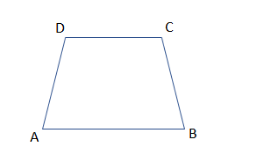
So, a trapezium ABCD is formed with parallel sides as AB and CD.
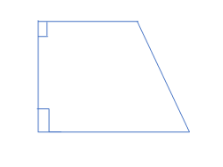
Now, the first type of trapezium is right trapezium which has at least two right angles as shown in the figure:
Then, the second type of trapezium is equilateral trapezium which is not possible as if it has all equal sides then it becomes a rhombus and contradicts the condition of the trapezium.
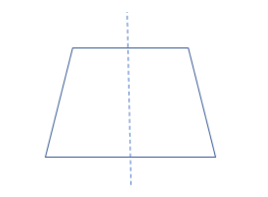
Then, the third type of trapezium is isosceles trapezium in which two sides are opposite and parallel but no parallel sides are equal. It has the property that there is a line bisecting one pair of opposite sides as:
So, from the above condition, a trapezium in which no parallel sides are equal is said to be isosceles trapezium.
So, the correct answer is “Option C”.
Note: Now, to solve these types of questions we need to be careful of the facts of the shapes in the geometry to get the correct answer to these types of questions. As sometimes some options are given for confusion only like the option as equilateral trapezium as it can’t exist in reality due to the property of trapezoid. So, be careful about the facts mentioned above.
Complete step-by-step answer:
In this question, we are supposed to find a trapezium in which no parallel sides are equal is called what kind of trapezium.
So, before proceeding for this, we must know the various types of trapezium and also the basic definition of the trapezium.
So, trapezium is defined as quadrilateral with a pair of parallel sides.
Also, a parallelogram is called a trapezium if it has two parallel sides.
So, a trapezium ABCD is formed with parallel sides as AB and CD.
Now, the first type of trapezium is right trapezium which has at least two right angles as shown in the figure:
Then, the second type of trapezium is equilateral trapezium which is not possible as if it has all equal sides then it becomes a rhombus and contradicts the condition of the trapezium.
Then, the third type of trapezium is isosceles trapezium in which two sides are opposite and parallel but no parallel sides are equal. It has the property that there is a line bisecting one pair of opposite sides as:
So, from the above condition, a trapezium in which no parallel sides are equal is said to be isosceles trapezium.
So, the correct answer is “Option C”.
Note: Now, to solve these types of questions we need to be careful of the facts of the shapes in the geometry to get the correct answer to these types of questions. As sometimes some options are given for confusion only like the option as equilateral trapezium as it can’t exist in reality due to the property of trapezoid. So, be careful about the facts mentioned above.
Recently Updated Pages
Master Class 12 Economics: Engaging Questions & Answers for Success

Master Class 12 English: Engaging Questions & Answers for Success
Master Class 12 Social Science: Engaging Questions & Answers for Success
Master Class 12 Maths: Engaging Questions & Answers for Success
Master Class 12 Physics: Engaging Questions & Answers for Success
Master Class 9 General Knowledge: Engaging Questions & Answers for Success
Trending doubts
Find the sum of series 1 + 2 + 3 + 4 + 5 + + 100 class 9 maths CBSE
Difference Between Plant Cell and Animal Cell
Fill the blanks with the suitable prepositions 1 The class 9 english CBSE
What is pollution? How many types of pollution? Define it
Name 10 Living and Non living things class 9 biology CBSE
What is the full form of pH?