









What Are the Types of Tissues in Biology for NEET?
The concept of Tissues forms the basis of understanding how living organisms, especially humans, are structured and how their bodies function. For NEET aspirants, mastering the topic of tissues is crucial because it builds a strong foundation for both structural and functional biology. This topic not only helps in answering direct NEET questions but also supports learning in other biological chapters. Understanding tissues will make it easier to grasp related chapters like anatomy, physiology, and diversity in the living world.
What are Tissues? Basic Definition and Meaning
Tissues are groups of similar cells that work together to perform a specific function in an organism. In multicellular organisms like humans and plants, tissues help organize cells efficiently to handle complex body tasks. For NEET, knowing the structure, types, and role of tissues is essential, as it connects cell biology to the organ and organ system level.
Core Ideas and Fundamentals of Tissues
Cellular Organization
Cells are the basic unit of life. In multicellular organisms, individual cells with similar functions group together to form tissues. This arrangement allows the body to perform specialized functions efficiently.
Definition of Tissue
A tissue is defined as: "A group of cells having similar origin, structure, and function." Tissues are more complex than cells but less complex than organs or organ systems.
Types of Tissues in the Human Body
There are four main types of tissues in animals, each carrying out a unique role. This can be illustrated with the following image:
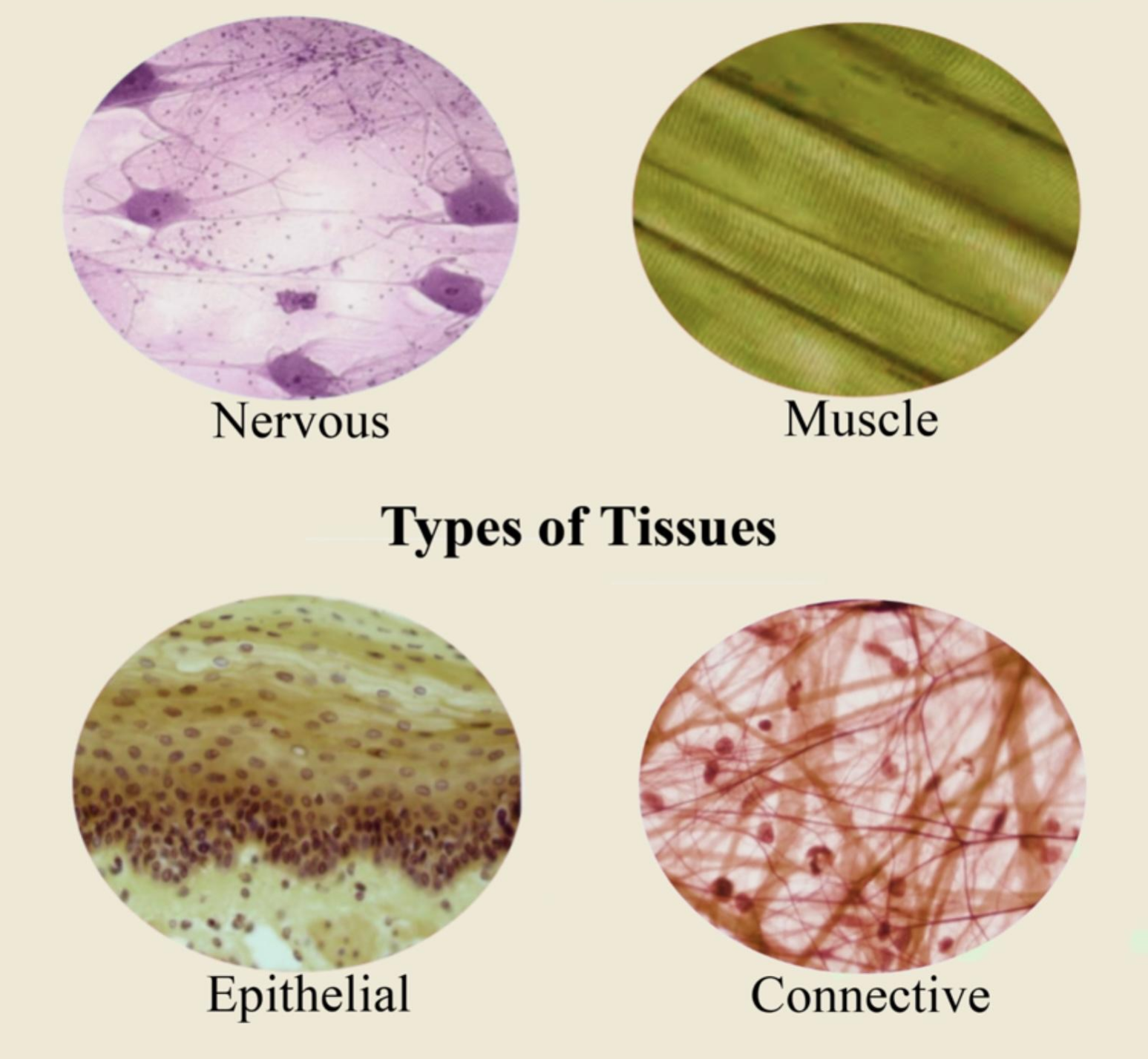
- Epithelial Tissue: Covers the body surface and lines internal cavities, providing protection, absorption, and secretion.
- Connective Tissue: Supports and binds other tissues, stores energy, and helps in transport. Examples include blood, bone, and adipose tissue.
- Muscular Tissue: Responsible for movement through contraction and relaxation. Includes skeletal, smooth, and cardiac muscles.
- Nervous Tissue: Helps in transmitting electrical impulses and coordinating bodily activities.
Important Sub-concepts Related to Tissues
Plant Tissues vs Animal Tissues
While this page focuses mainly on human (animal) tissues, it's important for NEET that you remember plants have their own tissue types: meristematic (growing) and permanent (supporting, conducting, protective). These plant tissues form the basics of plant anatomy.
Specialization and Differentiation
Tissue cells undergo differentiation, where they become specialized to perform distinct roles, e.g., muscle cells contract, nerve cells conduct signals, etc. This process supports the body's division of labor.
Organs and Organ Systems
Tissues combine to form organs (like the heart, skin, or kidney), which then work together in organ systems (such as the digestive or circulatory system). Understanding tissues helps you connect cellular structure to whole-body functions.
Functional Overview and Relationships Between Tissue Types
| Tissue Type | Main Function | Key Example |
|---|---|---|
| Epithelial | Protection, absorption, secretion | Skin epithelium, lining of gut |
| Connective | Support, binding, transport | Blood, bone, cartilage |
| Muscular | Movement | Skeletal muscles, heart |
| Nervous | Coordination, impulse transmission | Brain, spinal cord, nerves |
The table above summarizes the four basic animal tissue types, their primary functions, and key examples. This interconnected structure is essential for maintaining life and forms the basis of many NEET biology questions.
Characteristics and Features of Different Tissues
- Epithelial Tissue: Closely packed cells, with minimal intercellular space, resting on a basement membrane.
- Connective Tissue: Cells scattered within an extracellular matrix (can be liquid, gel, or solid).
- Muscular Tissue: Elongated, contractile cells capable of strong contractions.
- Nervous Tissue: Made up of neurons and supporting glial cells, specialized for electrical impulse conduction.
Why Tissues are Important for NEET
Understanding tissues provides a key link between cell biology and human anatomy, which is vital for the NEET exam. Questions are asked both directly from tissue structure-function and indirectly through their roles in organs and organ systems. A clear concept not only helps you score in direct questions but also aids in correlating with higher topics like physiology, biochemistry, and medical pathology. Many applied and clinical NEET biology questions are based on tissue types and their disorders.
How to Study Tissues Effectively for NEET
- Start by understanding definitions and differences between each tissue type from your NCERT.
- Use labeled diagrams (such as the types of tissues image above) for quick visualization and memory.
- Make tables of features, functions, and examples for each tissue type for comparison and revision.
- Solve previous year NEET MCQs related to tissues and carefully analyze why each option is correct or incorrect.
- Regularly revise summary points and attempt topic-wise mock tests.
- Discuss difficult parts with peers or teachers for conceptual clarity.
Common Mistakes Students Make in Tissues
- Confusing examples of tissue types, like mixing up connective and epithelial tissue examples.
- Not revising diagrams and hence forgetting structure details in the exam.
- Ignoring the small differences between subclasses of tissues (e.g., simple vs stratified epithelium, voluntary vs involuntary muscle).
- Not linking tissue function with the structure, leading to rote memorization without understanding.
- Overlooking importance of plant tissues (which are often asked in assertion-reason questions in NEET).
Quick Revision Points: Tissues for NEET
- Tissues are groups of similar cells performing a specific function.
- Four main animal tissues: epithelial, connective, muscular, nervous.
- Epithelial tissue lines and protects surfaces inside and outside the body.
- Connective tissue supports, joins, and protects body parts (includes bone and blood).
- Muscular tissue causes movement; major types are skeletal, cardiac, and smooth.
- Nervous tissue conducts impulses and coordinates body activity.
- Tissue study links cell biology to human anatomy and physiology in NEET.
- Use diagrams for revision - they simplify and clarify differences.


FAQs on Biology Tissues NEET Preparation: Types, Structure, and Functions
1. What are tissues in biology? (NEET)
Tissues in biology are groups of similar cells that perform specific functions together. In the NEET syllabus, understanding tissues helps students differentiate major categories and their roles in living organisms.
- Plant tissues: Meristematic and Permanent
- Animal tissues: Epithelial, Connective, Muscular, and Nervous
2. How are plant tissues classified in the NEET syllabus?
Plant tissues are classified mainly into meristematic tissues and permanent tissues for NEET and school exams.
- Meristematic tissues: Actively dividing cells (apical, lateral, intercalary)
- Permanent tissues: Non-dividing, differentiated cells (simple and complex types)
3. What are the main types of animal tissues for NEET?
Animal tissues are grouped into four main types in the NEET syllabus, each with distinct functions:
- Epithelial tissue: Covers body surfaces and lines cavities
- Connective tissue: Supports and connects body parts (including blood, bone, cartilage, adipose)
- Muscular tissue: Responsible for movement (skeletal, smooth, cardiac)
- Nervous tissue: Conducts impulses for coordination
4. What are meristematic tissues and their functions?
Meristematic tissues are groups of actively dividing plant cells responsible for growth and development.
- Located in apical (tips), lateral (sides), and intercalary (base of leaves/stems) regions
- Enable increase in length (primary growth) and thickness (secondary growth)
- Key for continuous plant tissue formation
5. What is the difference between simple and complex permanent tissues in plants?
Simple permanent tissues are made of similar cells, while complex permanent tissues consist of different cell types working together.
- Simple tissues: Parenchyma, Collenchyma, Sclerenchyma
- Complex tissues: Xylem (water transport), Phloem (food transport)
6. What are the four types of animal tissues?
The four types of animal tissues are epithelial, connective, muscular, and nervous tissue.
- Epithelial: Protection, absorption, secretion
- Connective: Support, binding, transport (blood, bone)
- Muscular: Movement (three types)
- Nervous: Control and coordination
7. What is the function of xylem and phloem tissues?
Xylem and phloem are complex permanent tissues in plants responsible for transport.
- Xylem: Conducts water and minerals from roots to all parts (one-way movement)
- Phloem: Transports food and nutrients (bidirectional)
8. What is parenchyma tissue and where is it found?
Parenchyma is a simple permanent plant tissue composed of living cells, usually with thin cell walls.
- Found in soft parts: cortex, pith, leaf mesophyll
- Functions: storage, photosynthesis, healing, and regeneration
- Important NEET keyword: chlorenchyma (parenchyma with chloroplast)
9. Why is the study of tissues important for NEET exam preparation?
Studying tissues is crucial for NEET because it forms the foundation for advanced topics in anatomy, physiology, and development.
- Clarifies structure-function relationships in plants and animals
- Helps in understanding diseases and support systems
- Direct application in higher biology chapters and medical science
10. What is connective tissue and what are its types?
Connective tissue binds, supports, and protects body structures in animals.
- Types include: Areolar (loose), adipose (fat), bone, cartilage, blood, ligaments, and tendons
- Key NEET concepts: matrix presence, cell diversity
11. What is the structural and functional unit of life?
The cell is known as the structural and functional unit of life in all living organisms.
- Cells group to form tissues, which carry out specific functions
- This concept underlines the tissue organization chapter in NEET syllabus
12. What is the difference between voluntary and involuntary muscles?
Voluntary muscles act under conscious control, while involuntary muscles work automatically.
- Voluntary: Skeletal muscles (movement, attached to bones)
- Involuntary: Smooth muscles (organs), cardiac muscle (heart)
13. What is the main function of epithelial tissue?
The main function of epithelial tissue is to protect, cover, and line all body surfaces and organs.
- Types: squamous, cuboidal, columnar, ciliated, glandular
- Roles: protection, absorption, secretion, sensation
