








Functions and Structure of the Male Reproductive System for NEET
The male reproductive system is a fundamental concept in Biology and frequently appears in NEET exams. It consists of organs and structures that enable the production, storage, and delivery of male gametes (sperms). Understanding how this system works is critical for grasping human reproduction, genetics, and developmental biology. Mastering this concept not only supports direct questions but also forms the basis for other related topics in the NEET Biology syllabus.
What is the Male Reproductive System?
The male reproductive system is a group of organs in males that work together to produce, maintain, and transport sperm and semen. It also plays a role in producing male sex hormones such as testosterone. This system includes both external organs like the penis and scrotum, and internal organs like testes, epididymis, vas deferens, seminal vesicles, prostate gland, and bulbourethral glands. All these parts function in a coordinated way to ensure successful reproduction in humans.
Core Ideas and Fundamentals of the Male Reproductive System
1. Main Functions
The male reproductive system has three primary functions: sperm production, sperm maturation and transport, and the secretion of male sex hormones. Understanding these functions sheds light on male fertility and reproductive health.
2. Key Organs and Their Roles
- Testes - produce sperm and testosterone.
- Epididymis - stores and matures sperm.
- Vas deferens - transports mature sperm from epididymis to urethra.
- Seminal vesicles - add seminal fluid to nourish sperm.
- Prostate gland - produces fluid that protects and activates sperm.
- Bulbourethral glands - secrete lubricating mucus.
- Penis - delivers sperm to the female reproductive tract.
- Scrotum - maintains temperature necessary for sperm production.
3. Structure and Flow
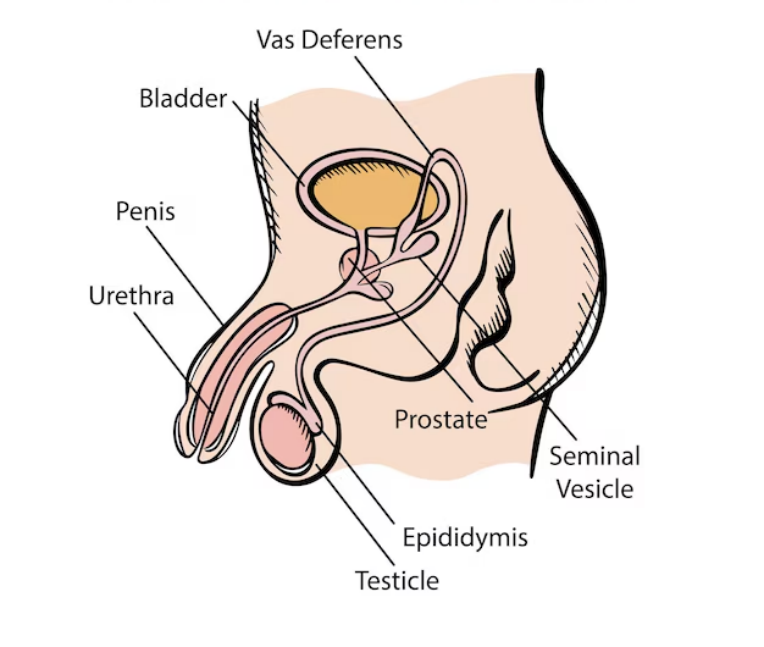
Sperms are produced in the testes and mature in the epididymis. During ejaculation, sperms pass through the vas deferens, get mixed with secretions from accessory glands (seminal vesicles, prostate, bulbourethral), and finally exit the body via the urethra within the penis.
Important Sub-Concepts Related to the Male Reproductive System
Spermatogenesis
Spermatogenesis is the process by which sperm cells are formed in the seminiferous tubules of the testes. This involves mitosis, meiosis, and a final step called spermiogenesis where spermatids transform into mature spermatozoa. Each stage relies on hormonal regulation, mainly by FSH, LH, and testosterone.
Hormonal Regulation
Male reproductive functions are tightly controlled by hormones. The hypothalamus releases GnRH, stimulating the pituitary to release FSH and LH. FSH stimulates Sertoli cells for sperm production, while LH stimulates Leydig cells in testes to produce testosterone.
Composition of Semen
Semen comprises sperm and fluids secreted by the seminal vesicles, prostate gland, and bulbourethral glands. Each component of semen has a role in sperm motility, nourishment, and protection inside the female reproductive tract.
Principles and Relationships in the Male Reproductive System
The male reproductive system relies on an interplay of anatomical structures and hormonal feedback mechanisms. The main principles involve:
- Spermatogenesis is regulated by pituitary and testicular hormones.
- Temperature regulation by the scrotum is crucial for normal sperm formation.
- Accessory glands contribute specific fluids for sperm survival and motility.
- Negative feedback by testosterone regulates hormone levels in a loop.
Key Features and Functions
- Continuous production of sperm from puberty onwards.
- Dual role in sperm delivery and hormone secretion.
- Anatomical design suited for temperature-sensitive spermogenesis.
- Specialized fluids for sperm nutrition, protection, and motility.
Why the Male Reproductive System is Important for NEET
The male reproductive system is a recurring topic in NEET Biology due to its central role in human physiology and reproduction. Questions frequently test basic structure, functions, related hormones, processes like spermatogenesis, and comparisons with the female reproductive system. A strong grasp on this topic helps in solving reproductive health, genetics, and endocrinology questions effectively. Understanding this system also builds the foundation for higher-level concepts in developmental biology and human health.
How to Study the Male Reproductive System Effectively for NEET
- Start by drawing and labeling diagrams - visual memory helps retain details of structures and their functions.
- Focus on understanding the flow of sperm and semen from production to ejaculation, relating each step with corresponding organs.
- Make summary notes or tables for hormones and their actions.
- Revise the steps and hormonal control of spermatogenesis carefully.
- Practice MCQs from past year NEET papers focused on this topic to understand question trends and patterns.
- Use reliable diagrams such as this one for accurate visualization (Male Reproductive System).
- Revisit quick points and revise difficult details regularly, especially hormonal pathways and functions of glands.
Common Mistakes Students Make in This Concept
- Confusing the function or structure of accessory glands (seminal vesicles, prostate, bulbourethral).
- Forgetting hormonal regulation details, especially the role of FSH, LH, and negative feedback.
- Mixing up the sequence of sperm transport or missing out on maturation steps.
- Neglecting diagram practice, which is crucial for NEET exams.
- Overlooking the importance of temperature regulation by the scrotum.
Quick Revision Points - Male Reproductive System
- Testes produce sperm and testosterone.
- Spermatogenesis occurs in seminiferous tubules - regulated by hormones.
- Sperm mature in the epididymis before transport via vas deferens.
- Accessory glands add fluids to semen for protection and motility.
- Scrotum provides lower temperature for efficient sperm production.
- LH stimulates Leydig cells - testosterone secretion.
- FSH stimulates Sertoli cells - sperm development.
- Practice diagram labeling and flowcharts for revision and recall.


FAQs on Biology Male Reproductive System NEET Overview
1. What is the structure of the male reproductive system in humans?
The male reproductive system in humans consists of primary and accessory organs essential for reproduction.
Main structures:
- Testes – produce sperm and testosterone
- Epididymis – stores and matures sperm
- Vas deferens – transports sperm
- Seminal vesicles – secrete seminal fluid
- Prostate gland – adds fluids to semen
- Penis – delivers semen
- Scrotum – houses and protects testes
2. What are the functions of the testes in the male reproductive system?
The testes have two main functions: sperm production (spermatogenesis) and hormone secretion.
Detailed functions:
- Production of sperms (spermatozoa) for sexual reproduction
- Secretion of testosterone, the main male sex hormone
- Regulating secondary sexual characteristics in males
3. Name the accessory glands of the male reproductive system and their functions.
The three main accessory glands are the seminal vesicles, prostate gland, and bulbourethral glands (Cowper’s glands).
Functions:
- Seminal vesicles: Produce seminal fluid rich in fructose for sperm nourishment
- Prostate gland: Secretes a milky fluid to activate sperm and neutralize vaginal acidity
- Bulbourethral glands: Secrete mucus to lubricate the urethra
4. What is spermatogenesis and where does it occur?
Spermatogenesis is the process of sperm formation that occurs in the seminiferous tubules of the testes.
Key stages:
- Multiplication of spermatogonia
- Formation of primary and secondary spermatocytes
- Development into spermatids and then sperms
5. Describe the pathway of sperm from production to ejaculation in the male reproductive system.
The pathway of sperm involves several organs from production to release.
Sequential steps:
- Sperms are produced in the seminiferous tubules (testes)
- Move to the epididymis for maturation
- Travel through the vas deferens
- Mix with fluids from seminal vesicles, prostate gland, and bulbourethral glands
- Enter the urethra and are expelled via the penis
6. What are the primary and secondary sex organs in males?
Primary sex organs in males are the testes, while secondary sex organs include all ducts and glands that assist reproduction.
Details:
- Primary sex organ: Testes (main reproductive organs)
- Secondary sex organs: Epididymis, vas deferens, urethra, penis, seminal vesicles, prostate gland, bulbourethral glands
7. What hormones are involved in regulating male reproductive functions?
Several hormones regulate male reproductive functions and spermatogenesis.
Key hormones:
- Testosterone – stimulates sperm production and secondary sex characteristics
- Follicle-stimulating hormone (FSH) – promotes spermatogenesis
- Luteinizing hormone (LH) – stimulates Leydig cells to produce testosterone
8. What is the role of the epididymis in the male reproductive system?
The epididymis is a long, coiled tube where sperms mature and are stored temporarily.
Main roles:
- Provides environment for maturation of sperm
- Stores sperm until ejaculation
- Transports sperm from the testes to the vas deferens
9. Which part of the male reproductive system produces seminal fluid?
Seminal fluid is produced mainly by the seminal vesicles, prostate gland, and bulbourethral glands.
- Seminal vesicles: Contribute about 60% of the total seminal fluid
- Prostate gland: Produces a milky, alkaline fluid (about 30%)
- Bulbourethral glands: Secrete mucus for lubrication
10. What is the significance of the scrotum in the male reproductive system?
The scrotum helps maintain optimal temperature for spermatogenesis in human males.
Functions:
- Houses and protects the testes
- Keeps testes cooler than body temperature for healthy sperm production
- Supports temperature regulation through contraction and relaxation
