









Human Skeletal System Functions and Diagram for NEET Preparation
The human skeletal system is a fundamental concept in biology that every NEET aspirant must understand thoroughly. It forms the supporting framework of the body, enables movement, protects vital organs, and helps in the production of blood cells. Mastery of the skeletal system is important not just for NEET exams but also for building a strong conceptual foundation for advanced topics in medicine and life sciences. This topic is often tested in NEET through direct questions, clinical applications, and diagram-based MCQs, making it crucial for high scoring.
What is the Human Skeletal System?
The human skeletal system is a structural framework made up of bones, cartilages, and joints. It provides shape and support to the body, protects internal organs like the brain and heart, enables movement with the help of muscles, and serves as a site for blood cell formation (hematopoiesis) and mineral storage. Understanding how the skeletal system works is essential for interpreting many physiological phenomena and for answering NEET questions accurately.
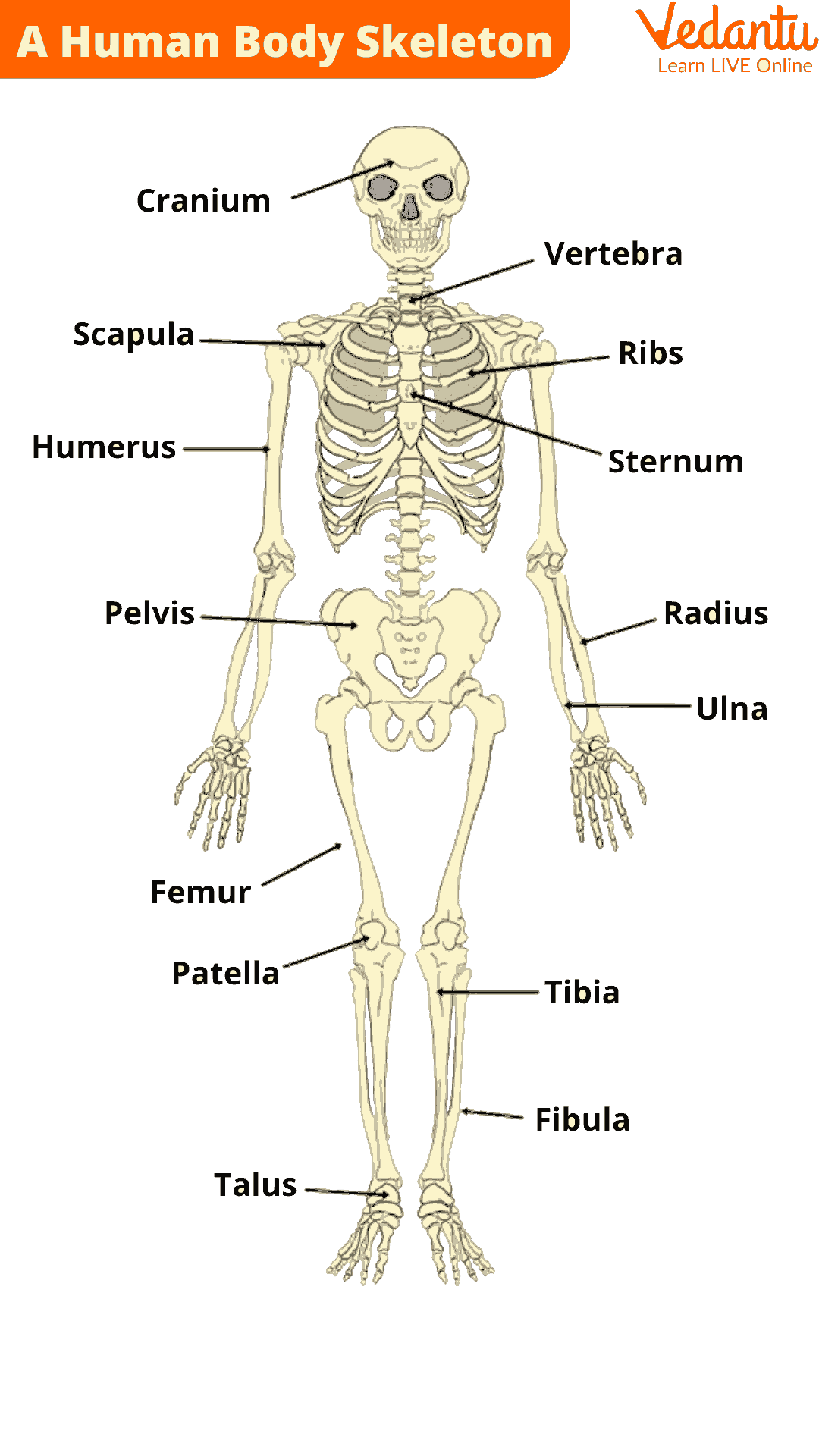
Core Ideas and Fundamentals of the Human Skeletal System
Structure of the Human Skeleton
The adult human skeleton typically comprises 206 bones. It is divided into two main parts: the axial skeleton and the appendicular skeleton. These together form the complete structure, provide support, and work in coordination with muscles for movement.
Axial Skeleton
The axial skeleton includes the skull, vertebral column, ribs, and sternum. It forms the central axis of the body and is responsible for protecting the brain, spinal cord, and thoracic organs.
Appendicular Skeleton
The appendicular skeleton consists of the girdles and limbs - the pectoral girdle (shoulders), pelvic girdle (hips), and the bones of the upper and lower limbs. It enables a wide range of movements, especially those involving the arms and legs.
Basic Functions of Bones
Bones provide rigidity and shape to the body, anchor muscles, facilitate movement, protect delicate organs, produce blood cells in the marrow, and act as a repository for minerals such as calcium and phosphate.
Key Sub-Concepts Related to the Human Skeletal System
Bone Types and Classification
Bones can be classified based on shape into long bones (e.g., humerus), short bones (e.g., carpals), flat bones (e.g., skull bones), irregular bones (e.g., vertebrae), and sesamoid bones (e.g., patella). Each type is specialized for specific functions such as support, protection, or movement.
Cartilage
Cartilage is a flexible, elastic connective tissue found at joints and in structures like the ear and nose. It prevents friction between bones and acts as a cushion, allowing smooth movement at the joints.
Joints and Their Types
Joints are the points where two or more bones meet. They allow movement and flexibility. Based on the degree of movement, joints are classified as fibrous (immovable), cartilaginous (slightly movable), and synovial (freely movable such as hinge, ball-and-socket joints, etc.).
Bone Marrow
Bone marrow is a soft tissue present within bones. Red bone marrow is involved in hematopoiesis (the formation of blood cells), an essential physiological process, while yellow bone marrow mainly stores fat.
Principles, Relationships, and Key Features in the Human Skeletal System
Bone Composition and Growth
Bones are composed of a matrix containing collagen fibers (for flexibility) and minerals like calcium and phosphate (for strength). The process of bone formation is called ossification, and it occurs in two main forms: endochondral (from cartilage) and intramembranous (from connective tissue). Growth plates (epiphyseal plates) are responsible for lengthwise growth in long bones during childhood and adolescence.
Ligaments and Tendons
Ligaments are strong, fibrous tissues that connect bone to bone, providing stability to joints. Tendons connect muscles to bones, transmitting the force needed for movement.
Key Features of the Human Skeletal System
- Provides structural support and defines body shape.
- Protects vital organs such as the brain (skull) and heart (rib cage).
- Facilitates movement with the help of muscles and joints.
- Produces blood cells in bone marrow (hematopoiesis).
- Stores and releases minerals, mainly calcium and phosphorus.
Why Is the Human Skeletal System Important for NEET?
A deep understanding of the human skeletal system is essential for NEET because this topic forms the core of several questions in biology sections. NEET tests your knowledge of anatomy, physiology, and the ability to understand clinical scenarios related to bones, joints, and movement. It is also interlinked with other topics, such as muscular system, nervous system, and the process of mineral homeostasis. Mastering the skeletal system helps build a holistic and interconnected view of human biology, enabling efficient problem-solving and better retention of related concepts.
How to Study the Human Skeletal System Effectively for NEET
- Start by learning the basic structure and function of the axial and appendicular skeleton.
- Practice labeling diagrams of the skeletal system regularly to improve recall for diagram-based MCQs.
- Understand and memorize the classification of bones, types of joints, and functional aspects of cartilage, ligaments, and bone marrow.
- Relate the functions of the skeletal system to real-life clinical examples and case-based NEET questions.
- Revise important terminologies, differences among bone types, and the process of ossification.
- Solve topic-specific MCQs to identify common traps and solidify your conceptual clarity.
- Make concise handwritten notes or flashcards for last-minute revision.
Common Mistakes Students Make in the Human Skeletal System
- Confusing bone names, positions, or numbers, especially in the axial and appendicular skeleton.
- Overlooking the functions and types of joints or mixing up terms like ligaments and tendons.
- Neglecting diagram practice, which leads to errors in identification- and structure-based questions.
- Ignoring the physiological importance of bone marrow and calcium metabolism.
- Forgetting key differences between cartilage and bone, or fibrous and synovial joints.
Quick Revision Points for the Human Skeletal System
- The adult human skeleton has 206 bones.
- Axial skeleton: skull, vertebral column, ribs, sternum.
- Appendicular skeleton: girdles (pectoral and pelvic) and limbs.
- Bones are classified as long, short, flat, irregular, and sesamoid.
- Cartilage provides flexibility; bones provide strength and rigidity.
- Joints are classified as fibrous, cartilaginous, and synovial (most movable).
- Ligaments connect bone to bone; tendons attach muscle to bone.
- Red bone marrow forms blood cells; yellow marrow stores fat.
- Ossification is the process of bone formation.
- Practice diagrams for better retention and quick identification in NEET.
FAQs on Human Skeletal System for NEET: Complete Overview and Key Concepts
1. What is the human skeletal system?
The human skeletal system is the internal framework of the body that provides shape, support, and protection for internal organs, all essential for NEET syllabus understanding. Key features include:
- 206 bones in adults, organized into axial and appendicular skeletons
- Cartilage and joints connecting and cushioning bones
- Functions: support, movement, protection, blood cell formation, mineral storage
2. What are the main functions of the human skeletal system?
The main functions of the human skeletal system are to support, protect, and enable movement for the body, all vital for NEET Biology.
- Support: Provides framework for the body
- Protection: Shields vital organs such as the brain and heart
- Movement: Works with muscles for locomotion
- Haemopoiesis: Blood cell production in bone marrow
- Mineral storage: Stores calcium and phosphorus
3. How many bones are there in the adult human body?
An adult human typically has 206 bones, which are organised into the axial and appendicular skeletons for NEET preparation:
- Axial skeleton: 80 bones
- Appendicular skeleton: 126 bones
4. What is the difference between axial and appendicular skeleton?
The axial skeleton forms the central core, while the appendicular skeleton includes limbs and girdles. For NEET, remember:
- Axial skeleton: Skull, vertebral column, ribs, sternum (80 bones)
- Appendicular skeleton: Pectoral and pelvic girdles, upper and lower limbs (126 bones)
5. Name the types of bones found in the human skeletal system.
Bones in the human skeleton are classified into types based on shape for NEET exam:
- Long bones (e.g., femur, humerus)
- Short bones (e.g., carpals, tarsals)
- Flat bones (e.g., skull, ribs)
- Irregular bones (e.g., vertebrae)
- Sesamoid bones (e.g., patella)
6. What is a joint? Name the types of joints in the human body.
A joint is a place where two or more bones meet, allowing movement and flexibility, important for NEET Biology.
- Fibrous (immovable): Skull sutures
- Cartilaginous (slightly movable): Intervertebral discs
- Synovial (freely movable): Ball and socket, hinge, pivot, gliding, saddle, condyloid
7. Which is the longest and strongest bone in the human body?
The femur, or thigh bone, is the longest and strongest bone in the human body, a key NEET fact. It:
- Extends from hip to knee
- Supports body weight during standing and movement
8. What is bone marrow and what is its function?
Bone marrow is soft, spongy tissue inside bones that plays a critical role in blood cell production (haemopoiesis) for the NEET exam.
- Red marrow: Produces RBCs, WBCs, and platelets
- Yellow marrow: Stores fat
9. List differences between male and female pelvis.
Male and female pelvises differ due to their functions, commonly asked in NEET:
- Female pelvis: Wider, circular pelvic inlet, broader pubic arch
- Male pelvis: Narrower, heart-shaped inlet, less broad arch
10. What disorders are related to the human skeletal system?
Skeletal system disorders affect bones, joints, or cartilage and are important for NEET Biology:
- Osteoporosis: Loss of bone density
- Arthritis: Joint inflammation
- Rickets: Vitamin D deficiency
- Fractures: Broken bones
11. Name the three types of muscle tissue associated with the skeletal system.
The three types of muscles associated with movement and the skeletal system, as per NEET syllabus, are:
- Skeletal muscle: Voluntary, attached to bones
- Cardiac muscle: Involuntary, heart
- Smooth muscle: Involuntary, walls of internal organs
12. What is the main function of the vertebral column in humans?
The vertebral column protects the spinal cord and supports the head and body, essential for NEET question practice. Functions include:
- Maintains upright posture
- Enables flexible movement
- Acts as axis for body
