








Re NEET Total Government MBBS Seats in India with State-wise Availability and Quota Details
Every year, medical aspirants appearing for Re NEET 2026 look for the total government MBBS seats in India before planning their counselling choices. Government MBBS seats are highly preferred because of lower fees, strong clinical exposure, and better admission value compared to many private colleges.
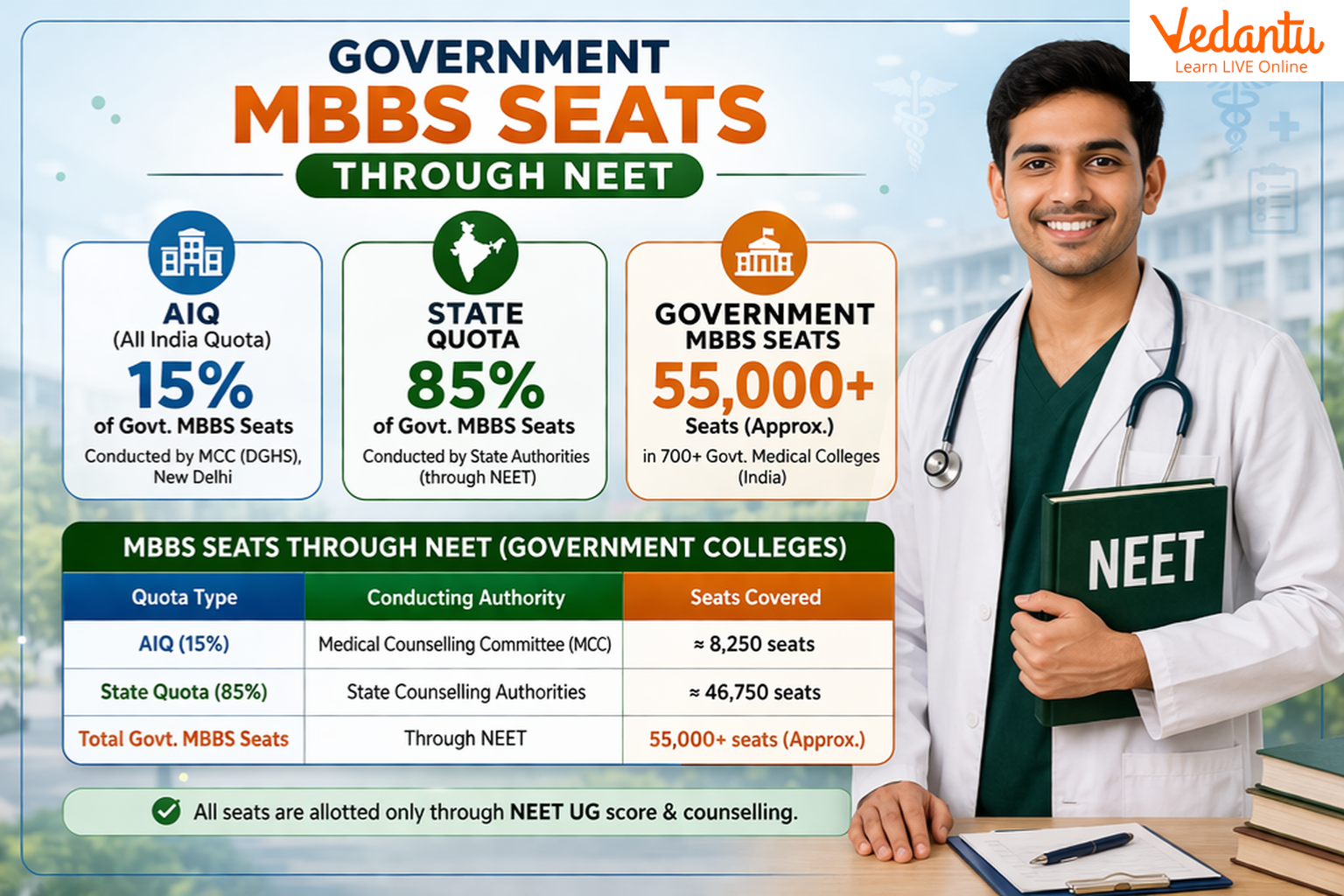
For Re NEET 2026, India is expected to have around 63,000+ government MBBS seats across government medical colleges, AIIMS, ESIC colleges, JIPMER, AFMC, and other central government institutions. These seats are allotted through the Re NEET UG 2026 counselling under 15% All India Quota and 85% State Quota rules.
Students should note that the final government MBBS seat count may change after the NMC and counselling authorities release the official 2026 seat matrix. Understanding the state-wise seat distribution, AIQ seats, State Quota seats, and reservation rules can help students make better choices during counselling.
Also Read: MBBS and BDS Seat Allotment in India
Re NEET 2026 Government MBBS Seats: Quick Highlights
Note: The above data is based on available NMC data and may change after the official Re NEET 2026 counselling seat matrix is released.
What is Included in Government MBBS Seats in India?
Government MBBS seats in India are not limited to only state government medical colleges. They may also include central government medical colleges, AIIMS, ESIC medical colleges, JIPMER, AFMC, AMU, BHU and other government-funded institutions.
These seats are filled through NEET UG counselling based on rank, category, quota, domicile rules, reservation policy and seat availability. Students should check the official MCC and state counselling seat matrix before filling college choices.
Re NEET 2026 Government MBBS Seats Availability State-wise in India
Understanding the Re NEET 2026 government MBBS seats availability is crucial for every aspirant aiming for a medical seat. The table below provides a clear picture of the total NEET government seats in MBBS in India, along with the number of government colleges in each state.
Note: The state-wise government MBBS seat data is based on available NMC/reference data and may change after the official Re NEET 2026 counselling seat matrix is released.
Re NEET 2026 Reservation in Government MBBS Seats in India State-wise Quota and EWS Details
Reservation plays a key role in the distribution of government MBBS seats through the Re NEET 2026. As per the Ministry of Health and Family Welfare (MoHFW), 10% of the total MBBS seats in government medical colleges are reserved for the Economically Weaker Section (EWS) under the All India Quota and state quota policies. States like Maharashtra, Gujarat, Karnataka, Tamil Nadu, Andhra Pradesh, and Telangana have a higher number of government MBBS seats, which directly improves the chances of admission for aspirants from these regions. With the addition of 5200+ new government MBBS seats in recent years, the overall seat availability has increased, giving more opportunities to NEET aspirants. However, due to rising competition, understanding state-wise reservation policies and seat distribution is essential for making the right choices during counselling.
Also Check: NEET UG Accepted Medical College
NEET Government MBBS Seats in India: Year-wise Growth and Trends
The number of government MBBS seats in NEET 2026 has steadily increased over the years, reflecting the expansion of medical education infrastructure. This growth has improved NEET 2026 government MBBS seats availability, giving more opportunities to aspirants across the country.
Total Government MBBS Seats in India 2026
As per available NMC/reference data, India is expected to have around 63,780 government MBBS seats across nearly 456 government medical colleges for Re NEET 2026. These seats include state government medical colleges, AIIMS, ESIC, JIPMER, AFMC and other central government institutions.
The final seat count may change after NMC and counselling authorities release the official Re NEET 2026 seat matrix. The table below gives a state-wise overview of major government MBBS seat availability in India.
Note: The 2026 government MBBS seat data is based on available NMC/reference sources and may change after the official Re NEET 2026 counselling seat matrix is released.
All India Quota (AIQ) vs State Quota Government MBBS Seats
For Re NEET 2026, government MBBS seats in India are generally filled through two major counselling routes:
15% of seats are filled via All India Quota (AIQ) counselling conducted by the MCC.
85% of seats are reserved for state quota candidates, allotted through respective state counselling authorities.
For example, if a college in Uttar Pradesh has 200 government seats, 30 are filled through AIQ and 170 through the UP state quota. Non-domicile candidates can contest only for AIQ seats in other states.
Reservation Policy for Government MBBS Seats
Reservation in government MBBS seats is as per central and state government policies:
27% of AIQ MBBS seats are reserved for OBC-NCL.
15% for SC, 7.5% for ST, and 10% for EWS candidates under AIQ.
5% horizontal reservation for PwD (Persons with Disabilities) across all categories.
State quota reservations follow respective state rules. Always check the latest guidelines during applications.
For a detailed reservation category matrix, refer to our guide on NEET Reservation Criteria 2026.
Previous Year NEET Cut Off for MBBS Admission: 2025 Category-wise Data
The official Re NEET 2026 cutoff has not been released yet. The Re NEET 2026 cutoff is expected in July 2026 after the result announcement. Until then, students can refer to the NEET 2025 cutoff to understand the previous-year qualifying marks, category-wise percentile, and competition level for MBBS admission.
NTA released the NEET 2025 cutoff for MBBS on 14 June 2025 on its official website. It is important to understand that qualifying the NEET cutoff does not guarantee admission. Candidates must also participate in counselling and complete the seat allotment process to secure a seat in a medical or dental college.
Compared to 2024, there has been a slight decrease in cutoff marks. For the General category, the cutoff range dropped from 720–162 in 2024 to 686–144 in 2025, indicating a shift in exam difficulty and competition.
Below is the detailed category-wise NEET 2025 cutoff data:
Note: The above cutoff is based on NEET 2025 qualifying data. The official Re NEET 2026 cutoff will be updated after NTA releases the 2026 result and cutoff marks.
Re NEET 2026 Counselling and Government MBBS Seat Allotment
Government MBBS seats through Re NEET 2026 are allotted through an online counselling process under both AIQ and State Quota.
Students must register for Re NEET 2026 counselling on the official MCC portal for AIQ seats or the respective state counselling authority portal for State Quota seats.
Candidates need to fill and lock their preferred government medical colleges during the choice-filling process.
Document verification is done using the NEET scorecard, admit card, Class 10 and 12 marksheets, category certificate, domicile certificate, and other required documents.
Seat allotment is based on the Re NEET rank, category, quota, seat availability, reservation rules, and choices filled by the candidate.
After allotment, candidates must download the allotment letter, report to the allotted college, complete admission formalities, and pay the required fee.
For counselling dates and steps, see the complete process guide on MBBS Admission 2026.
Tips to Maximise Your Chances for a Government MBBS Seat
Aim for a score higher than the previous year’s state and AIQ cut-offs.
Use the reservation category benefits wherever applicable (EWS, OBC, SC, ST, PwD).
Apply for both AIQ and your state quota to widen your reach.
Stay updated on the addition of new government colleges for increased seat chances.
Participate in all counselling rounds, including mop-up, as vacancies can arise.
Find more tips and insights at MBBS/BDS Admission through NEET 2026.
Conclusion
Government MBBS seats through Re NEET 2026 are highly competitive but achievable with proper strategy and information. Track latest updates on seat matrix, reservation changes, and state counselling on our Re NEET 2026 pages. Prepare thoroughly, match your preferences to cut-offs, and do not miss out on any step of the admission process. For full details and live seat updates, access our comprehensive Government Medical Colleges List.
FAQs on Re NEET 2026 Government MBBS Seats Availability: State-wise Distribution in India
1. How many government MBBS seats are there through the Re NEET 2026?
As per available NMC data, India is expected to have around 63,780 government MBBS seats across nearly 456 government medical colleges for Re NEET 2026. The final seat count may change after the official counselling seat matrix is released by MCC and state counselling authorities.
2. What is the minimum Re NEET score required for a government MBBS seat?
The minimum score required for a government MBBS seat depends on the candidate’s category, state, quota, college preference, and cutoff trend. General category students usually need a higher score for top government colleges, while OBC, SC, ST, EWS, and PwD candidates may have different cutoff ranges as per reservation rules.
3. How do AIQ and State Quota seats differ in Re NEET 2026?
AIQ, or All India Quota, includes 15% of government MBBS seats and is open to eligible students across India through MCC counselling. State Quota includes 85% of government MBBS seats and is usually reserved for eligible domicile candidates through the respective state counselling authorities.
Learn more about quota rules and reservation here.
4. Will government MBBS seats increase in 2026?
Government MBBS seats may increase in 2026 if new medical colleges are approved or existing colleges receive additional seat approvals from the NMC. Students should check the official NMC, MCC, and state counselling updates for the final seat matrix.
5. What documents are needed for the Re NEET 2026 counselling for government MBBS seats?
Candidates usually need their NEET admit card, NEET scorecard, Class 10 and 12 marksheets, ID proof, category certificate if applicable, domicile certificate for state quota, passport-size photographs, and other documents required by MCC or state counselling authorities.
Keep originals and photocopies ready. See the full checklist in the detailed NEET admission guide.
6. Can I get a government MBBS seat in another state without a domicile certificate?
Yes, students can compete for government MBBS seats in another state through the 15% All India Quota. However, 85% State Quota seats are usually available only for candidates who meet that state’s domicile or eligibility rules.
7. How does reservation work in government MBBS seats through Re NEET?
Reservation in government MBBS seats is followed as per central and state government rules. Under AIQ, seats are reserved for OBC-NCL, SC, ST, EWS, and PwD candidates as per the applicable counselling norms. State quota reservation rules may vary from one state to another.
8. What is the Re NEET seat allotment process for government MBBS colleges?
The seat allotment process includes counselling registration, choice filling, choice locking, seat allotment based on rank and category, document verification, fee payment, and reporting to the allotted medical college. AIQ counselling is conducted by MCC, while State Quota counselling is conducted by the respective state authorities.
9. Does EWS/Category reservation apply to both AIQ and State Quota seats?
Yes, EWS, OBC, SC, and ST reservations apply in both AIQ and state quota seats, following the guidelines of MCC and respective state authorities. Always check the latest notification for any state-specific reservation changes. For full reservation matrix, see NEET reservation rules.
10. What is the government MBBS seat matrix for the top states in Re NEET 2026?
As per available reference data, Maharashtra has around 6,050 government MBBS seats, Tamil Nadu has around 5,250, Uttar Pradesh has around 5,925, Karnataka has around 4,100, Gujarat has around 4,300, and Telangana has around 4,390 government MBBS seats. Final numbers may change after the official 2026 seat matrix is released.
11. If I fail to secure a government MBBS seat, is my Re NEET score valid for next year?
No, the Re NEET score is valid only for the admission year in which the exam is conducted. If a candidate wants to apply again next year, they must appear for the next NEET exam and qualify as per that year’s cutoff and counselling rules.
12. Where can I find the official MBBS government seat matrix PDF for Re NEET 2026?
The official government MBBS seat matrix for Re NEET 2026 will be available on MCC and respective state counselling authority websites during counselling. Students can also check NMC updates for recognised medical colleges and approved MBBS seats.
13. How many total MBBS seats are there in the Re NEET 2026?
India is expected to have around 1.29 lakh MBBS seats across government, private, deemed, AIIMS, JIPMER, ESIC, and other medical institutions. Out of these, around 63,000+ seats are expected to be available in government medical colleges.
14. Which states have the highest number of government MBBS seats in India?
States such as Maharashtra, Uttar Pradesh, Tamil Nadu, Rajasthan, Gujarat, Telangana, West Bengal, and Karnataka have some of the highest numbers of government MBBS seats in India. These states usually offer more options during AIQ and State Quota counselling.
