


NCERT Solutions for Class 8 Social Science Chapter 2
Big Questions
1. How did a land of diverse geographies, languages, and religions come together to challenge and finally end nearly two centuries of British rule?
Answer:
Despite differences in geography, language, religion and customs, people across India gradually developed a shared sense of belonging and opposition to British colonial rule. Newspapers, literature, education, public meetings and political organisations helped spread national awareness and connected people from different regions.
Different groups followed different methods to oppose British rule. Some demanded reforms through constitutional means, while others supported Swadeshi, boycott, revolutionary activities, satyagraha, non-cooperation and civil disobedience. Peasants, workers, students, women, tribal communities and political leaders all participated in different ways. Their collective efforts and sacrifices over several decades eventually contributed to India achieving independence in 1947.
2. What were the main developments and who were some important figures in India’s struggle for freedom?
Answer:
India’s freedom struggle developed through several important phases. The formation of the Indian National Congress in 1885 created an important platform for political activity. The Partition of Bengal in 1905 led to the Swadeshi and Boycott movements and strengthened nationalist feelings. Revolutionary groups also emerged and challenged colonial rule through different forms of resistance.
Later, Mahatma Gandhi helped turn the freedom struggle into a mass movement through satyagraha, non-violence, non-cooperation, and Civil Disobedience. Events such as the Jallianwala Bagh massacre, the Dandi March, the Civil Disobedience Movement and the Quit India Movement became major landmarks. Subhas Chandra Bose and the Indian National Army also played an important role during the final phase of British rule.
Important figures included Dadabhai Naoroji, Bal Gangadhar Tilak, Lala Lajpat Rai, Bipin Chandra Pal, Aurobindo Ghose, Mahatma Gandhi, Rabindranath Tagore, Sarojini Naidu, Bhagat Singh, Chandrashekhar Azad, Subhas Chandra Bose, Jawaharlal Nehru, Sardar Vallabhbhai Patel, Maulana Abul Kalam Azad and Annie Besant, among many others.
3. What issues did the leading freedom fighters agree or disagree upon?
Answer:
The leading freedom fighters broadly agreed that British colonial rule had to end and that Indians should have the right to govern themselves. However, they did not always agree on how this goal should be achieved.
Some leaders preferred constitutional reforms and gradual political change, while Nationalists such as Bal Gangadhar Tilak demanded Swaraj and wider public participation. Revolutionaries believed stronger or armed resistance was necessary, whereas Mahatma Gandhi promoted ahimsa, satyagraha and civil disobedience.
There were also differences over participation in legislative councils, the Khilafat Movement, separate electorates, Hindu-Muslim political relations and the future political structure of India. Despite these disagreements, the struggle brought together many individuals and groups around the larger goal of ending colonial rule.
LET’S EXPLORE
Talk to your grandparents or elderly family members and find out what they remember or heard about India’s freedom struggle. Note which leaders or methods people supported. Discuss in class how, despite sharing the same goal of freedom, people followed different paths.
Answer:
This is an activity-based question, so answers may vary depending on the family member interviewed. A sample response could be:
After speaking with elderly family members, I learnt that people supported different leaders and methods during the freedom struggle. Many admired Mahatma Gandhi and supported non-violence, satyagraha and peaceful protest. Others admired revolutionaries such as Bhagat Singh or supported Subhas Chandra Bose and the Indian National Army.
Although their methods differed, these groups shared the larger objective of ending British rule. This shows that people can follow different paths while working towards a common goal.
LET’S EXPLORE
Below are the first two stanzas of the song. Can you make out some of their meaning?
Vande mātaram!
sujalām suphalām malayajaśhītalām
śhasyaśhyāmalām, mātaram!
Vande mātaram!
Śubhrajyotsnām pulakitayāminīm
phullakusumita drumadalaśhobhinīm
suhāsinīm sumadhura bhāṣhiṇīm
sukhadām varadām, mātaram!
Vande mātaram!
Answer:
These lines praise India as the Motherland and describe her natural beauty and abundance. The land is shown as rich in water, fertile, covered with crops and refreshed by pleasant breezes. The verses also describe beautiful moonlit nights, flowering trees and the richness of nature.
Mother India is presented as smiling, sweet-speaking, happiness-giving and generous. Overall, the stanzas express deep love, respect and devotion towards the motherland.
LET’S EXPLORE
How are the values expressed by Swami Vivekananda above relevant in the 21st century? Can some of them help you achieve your goals? Share your thoughts with your classmates.
Answer:
Values such as self-confidence, courage, inner strength, good character, service to others and respect for India’s cultural heritage remain relevant in the 21st century. They encourage young people to face difficulties confidently, work hard and contribute positively to society.
These values can also help me achieve my goals. Self-confidence can help me believe in my abilities, while discipline and determination can help me continue working even when I face difficulties. A sense of responsibility and service can also help me become a better and more responsible citizen.
LET’S EXPLORE
1. Why do you think the Bande Mataram daily avoided using the word ‘independence’?
Answer:
The Bande Mataram daily may have avoided directly using the word ‘independence’ because openly demanding complete freedom from British rule could invite censorship and action from the colonial government. Expressions such as ‘national autonomy’ could communicate the demand for self-government while avoiding a direct declaration that might lead to immediate suppression.
2 . Comment on the phrase ‘absolute national autonomy’ in the above quotation from a Bande Mataram article.
Answer:
The phrase ‘absolute national autonomy’ suggests complete self-government and the ability of Indians to manage their own affairs without foreign control. It reflected the growing nationalist belief that India should determine its own political, social and economic future.
3. Looking at the two boxes on either side of the daily’s title in Fig. 2.12, what do you observe?
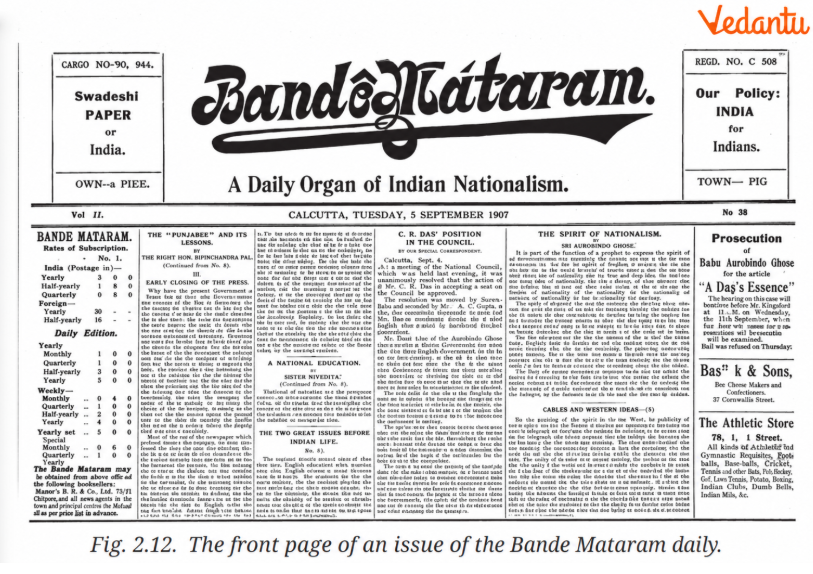
Answer:
The boxes contain messages associated with patriotism, national awakening and devotion to the motherland. Their placement around the newspaper’s title shows that the publication was not merely reporting events but was also being used to spread nationalist ideas and encourage people to think about self-rule and the country’s future.
LET’S EXPLORE
1. In what ways are these two representations of Mother India similar or different?
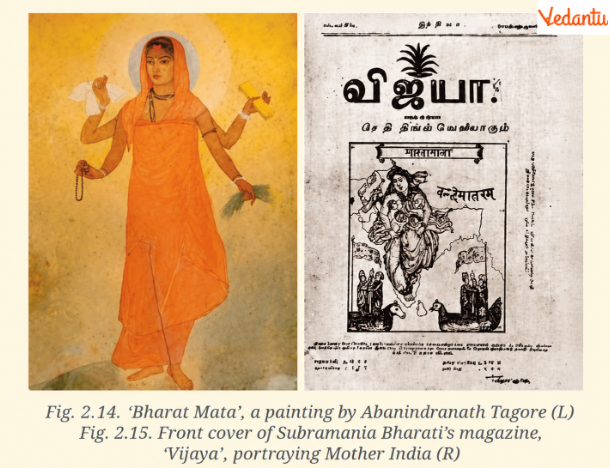
Answer:
Both representations present India as a mother figure and use her image to express patriotism and devotion to the nation. They encourage people to see the country not simply as a geographical territory but as a mother worthy of love and respect.
However, the style and symbolism of the representations differ. One presents Mother India in a more spiritual and serene form, while the other uses imagery connected with nationalist awakening and the freedom struggle. Thus, both communicate patriotism but do so in different visual ways.
2. What details can you discern in the front cover of Subramania Bharati’s Vijaya?
Answer:
The front cover of Vijaya uses the image of Mother India as an important symbol of the nation. Its design reflects nationalist ideas and the growing sense of patriotism during the freedom struggle. The visual elements seek to create feelings of national unity, pride and devotion towards India.
LET’S EXPLORE
You may explore further and find out more about the freedom struggle in the North-East and known and lesser-known freedom fighters from this area.
Answer:
The North-East also made important contributions to resistance against British rule. Different communities and leaders challenged colonial authority at various stages.
For example, U Tirot Sing led resistance against British expansion in the Khasi Hills. Maniram Dewan and Piyali Barua were associated with resistance to British rule in Assam during the period of the Revolt of 1857. Rani Gaidinliu resisted British authority at a young age and became an important figure in the freedom struggle.
During the Quit India Movement, Kanaklata Barua became known for her courage and sacrifice in Assam. Such examples show that India’s struggle for independence included contributions from many regions and communities, including the North-East.
LET’S EXPLORE
When the judge asked Tilak if he had anything to say after being sentenced, Tilak replied, “There are higher powers that rule the destinies of men and nations; and I think, it may be the will of Providence that the cause I represent may be benefited more by my suffering than by my pen and tongue.”
What message do you think he was trying to convey? On another occasion, Tilak famously declared, “Swaraj is my birthright, and I shall have it.” What does this reveal about Tilak’s character?
Answer:
Tilak was conveying that his imprisonment and personal suffering could strengthen the cause of freedom rather than weaken it. He believed that sacrifice for a larger national cause could inspire others and make the movement stronger. He was therefore willing to accept personal hardship for what he believed was right.
His declaration, “Swaraj is my birthright, and I shall have it,” reflects his courage, determination and strong commitment to self-rule. It shows that Tilak regarded Swaraj as a right of the Indian people rather than something to be granted as a favour by colonial rulers.
LET’S EXPLORE
Rabindranath Tagore sent a strong letter of protest to the then Viceroy. “The accounts of the insults and sufferings by our brothers in Punjab,” wrote Tagore, “have trickled through the gagged silence, reaching every corner of India, and the universal agony of indignation roused in the hearts of our people has been ignored by our rulers—possibly congratulating themselves for what they imagine as salutary lessons.” In the same letter, Tagore returned the knighthood he had received from the British.
What does Tagore mean when he assumes that the colonial rulers ‘congratulated themselves’ after the Jallianwala Bagh massacre?
Answer:
Tagore was criticising the colonial rulers for believing that their harsh actions in Punjab had successfully frightened Indians and strengthened British authority. By saying that they may have ‘congratulated themselves’, he was pointing to their apparent belief that such repression had taught Indians a lesson.
Tagore strongly rejected this attitude. He believed that the suffering and humiliation inflicted on Indians were grave injustices. His decision to return his knighthood was therefore a powerful act of protest against British actions following the Jallianwala Bagh massacre.
LET’S EXPLORE
Form groups to analyse, compare and discuss the various elements or demands contained in the above resolution.
Answer:
The resolution presented freedom as an inalienable right of the Indian people. It argued that people should be able to enjoy the fruits of their labour, meet the necessities of life and have development opportunities.
It also stated that if a government deprived people of these rights and oppressed them, people had the right to change or abolish that government. The resolution accused British rule of harming India economically, politically, culturally and spiritually. Its central demand was therefore Purna Swaraj, or complete independence, and the end of India’s colonial connection with Britain.
Questions and activities
The following are suggested activities to choose from.
True or False. Find out whether the following statements are true or false:
1. Right from its inception, the Indian National Congress called for India’s independence.
Answer: False.
The Indian National Congress did not demand complete independence from its very beginning. Its early leaders initially sought political and administrative reforms within the existing system. The demand for complete independence developed later.
2. Bal Gangadhar Tilak turned a Shivaji festival into a popular event.
Answer: True.
Tilak helped popularise public celebrations associated with Shivaji as a means of bringing people together and encouraging political and national awareness.
3. The Ghadar Movement of 1914–15 aimed to start a mutiny within the British Indian Army while British troops were busy with World War I.
Answer: True.
The Ghadar revolutionaries attempted to organise an uprising against British rule during World War I and hoped to encourage Indian soldiers to revolt.
4. Vallabhbhai Patel earned the title ‘Sardar’ for his leadership during the Satyagraha agitation in Gujarat.
Answer: True.
Vallabhbhai Patel became widely known as ‘Sardar’ following his leadership in the Bardoli Satyagraha in Gujarat.
5. The Kakori train robbery of 1925 was carried out to fund the activities of the Hindustan Republican Association.
Answer: True.
The Kakori action was carried out by revolutionaries associated with the Hindustan Republican Association to obtain government funds for revolutionary activities.
6. The ‘Do or Die’ call was given by Mahatma Gandhi during the Non-Cooperation Movement in 1920.
Answer: False.
Mahatma Gandhi gave the ‘Do or Die’ call during the Quit India Movement in 1942, not during the Non-Cooperation Movement of 1920.
7. B.R. Ambedkar and Gandhi were in total agreement regarding the issue of ‘separate electorates’ for Dalits.
Answer: False.
B.R. Ambedkar and Mahatma Gandhi had significant differences over the question of separate electorates for the Depressed Classes. Their disagreement eventually led to negotiations associated with the Poona Pact of 1932.
8. Sir Stafford Cripps was sent to India in 1942 because Winston Churchill supported immediate independence for India.
Answer: False.
The Cripps Mission was sent to India during World War II to seek Indian political cooperation and present constitutional proposals. It did not offer immediate independence to India.
9. Subhas Chandra Bose raised an army during his stay in Germany.
Answer: True.
During his stay in Germany, Subhas Chandra Bose organised an armed force of Indian soldiers known as the Indian Legion. He later went to Southeast Asia and took leadership of the Indian National Army.
10. The Radcliffe Line, which divided India and Pakistan, was announced a few weeks before Independence Day.
Answer: False.
The Radcliffe Award defining the boundaries was officially published on 17 August 1947, two days after India became independent.
Who Am I? Can you identify these figures?
1. Known as the ‘Lion of Punjab’, I was severely injured during a brutal lathi charge while protesting against the Simon Commission.
Answer: Lala Lajpat Rai
2. I famously declared, ‘Swaraj is my birthright, and I shall have it!’ I used the Kesari newspaper and festivals like Ganesh Chaturthi to unite people against British rule.
Answer: Bal Gangadhar Tilak
3. I was a leader of the Nationalist faction of the Congress. In the daily Bande Mataram, I wrote on the need for India to attain absolute autonomy.
Answer: Aurobindo Ghose
4. I earned my nickname ‘Bagha’ after wrestling a tiger with my bare hands. I was a revolutionary leader who died in a gunfight while waiting for a shipment of German arms to start an uprising.
Answer: Jatindranath Mukherjee (Bagha Jatin)
5. I organised the daring attempt to throw a bomb at the Viceroy in 1912. I later escaped to Japan, where I spent years working to organise a movement from there.
Answer: Rash Behari Bose
6. I was martyred at a young age after an attempt on the life of a British judge.
Answer: Khudiram Bose
7. I was martyred at a young age after throwing nonlethal bombs in Delhi’s Central Legislative Assembly.
Answer: Bhagat Singh
8. I turned the freedom struggle into a mass movement through the principles of ahimsa and satyagraha, leading campaigns such as the Dandi March.
Answer: Mahatma Gandhi
9. I sought help from the Axis powers during World War II to organise the Indian National Army.
Answer: Subhas Chandra Bose
10. A British lawyer, I was given just five weeks to draw the boundary line that would partition the Indian subcontinent into two separate nations.
Answer: Cyril Radcliffe
What kinds of sacrifices are needed to achieve freedom? Think about the lives of Indian soldiers during wars, families suffering during famines, leaders and ordinary people who were arrested, and countless others who lost their homes and safety while participating in protests. If you were living during India’s freedom struggle, would you have chosen to participate in it? What comforts, opportunities, or personal goals might you have been willing to give up for a cause you strongly believed in?
Answer:
Achieving freedom often requires people to make serious personal sacrifices. During India’s freedom struggle, many people faced imprisonment, loss of livelihood, physical hardship and separation from their families. Some even sacrificed their lives. Ordinary citizens also risked their safety by joining protests, boycotts and movements against colonial rule.
If I had lived during the freedom struggle, I would have wanted to contribute to the movement in a peaceful and meaningful way. I might have been willing to give up personal comfort, leisure, educational or career opportunities, and accept the possibility of hardship for the larger goal of freedom. The sacrifices made by people during this period show how strongly they valued independence.
What values does Tilak’s statement, “Swaraj is my birthright, and I shall have it,” reflect? Can these values be meaningful for young people today?
Answer:
Tilak’s statement reflects courage, determination, self-respect, patriotism and a strong belief in freedom. By calling Swaraj his birthright, he expressed the idea that people have a natural right to govern themselves.
These values can still be meaningful for young people today. Determination helps students continue working towards their goals, while courage helps them face challenges. Self-respect, responsibility and perseverance can also encourage young people to stand up for what is right and contribute positively to society.
How did peasants, workers, tribals, and students contribute to the national movement in ways different from political leaders?
Answer:
Political leaders often provided direction, organised movements, negotiated with authorities and communicated national demands. Peasants, workers, tribal communities and students strengthened the movement through participation at the local and mass levels.
Peasants joined protests against unfair taxes and oppressive policies. Workers participated in strikes and demonstrations. Tribal communities resisted colonial interference with their lands, forests and traditional ways of life. Students joined processions, boycotts and nationalist campaigns and helped spread political ideas.
Their participation transformed the freedom struggle from the work of political organisations and leaders into a much broader people’s movement.
Discuss in class this extract from Nehru’s speech on 15 August 1947:
“Long years ago we made a tryst with destiny, and now the time comes when we shall redeem our pledge, not wholly or in full measure, but very substantially. At the stroke of the midnight hour, when the world sleeps, India will awake to life and freedom. A moment comes, which comes but rarely in history, when we step out from the old to the new, when an age ends, and when the soul of a nation, long suppressed, finds utterance…”
What is meant by “redeem our pledge”? How would you define the ‘soul of a nation’?
Answer:
In this speech, “redeem our pledge” means fulfilling the long-standing promise and commitment to achieve freedom for India. Generations of Indians had struggled and sacrificed for independence, and 15 August 1947 marked the fulfilment of that historic goal, although Nehru acknowledged that much work remained.
The ‘soul of a nation’ can be understood as the shared identity, aspirations, values, memories and hopes that connect its people. Nehru’s words suggest that after a long period of colonial rule, independent India could finally express its own voice and determine its future.
Imagine you are a freedom fighter.
a) Explain the method you support to achieve freedom.
Answer:
I would support satyagraha and non-violent resistance. Through peaceful protests, non-cooperation, civil disobedience and boycotts, people could challenge unjust colonial laws while avoiding violence. Large-scale peaceful participation could also bring people from different backgrounds together.
b) Discuss with your classmates any other method they would support. Be respectful in your debate.
Answer:
Some classmates might support revolutionary resistance, believing stronger action was necessary against colonial rule. Others might favour constitutional negotiations and gradual reforms. Each method emerged from different ideas about how British rule could most effectively be challenged.
A respectful discussion should focus on understanding why people supported different methods rather than dismissing their views.
c) What does this debate teach us about unity and disagreement?
Answer:
The debate shows that people can disagree about methods while still sharing a common goal. During India’s freedom struggle, leaders and groups often differed over strategies, yet many remained committed to ending colonial rule.
It teaches us that unity does not always require complete agreement. Differences can be discussed respectfully while people continue working towards a shared objective.
Write a news report based on an important event in the Freedom Movement (Swadeshi, boycott, satyagraha, Non-Cooperation, Quit India, or Partition).
a) Write a headline.
Answer:
Headline: Gandhi’s Salt March Challenges British Salt Law
News Report:
Dandi, 6 April 1930: Mahatma Gandhi completed the historic Salt March from Sabarmati Ashram to Dandi and challenged the British salt law by making salt from seawater. The march attracted widespread attention and encouraged people in different parts of India to participate in the Civil Disobedience Movement.
b) Include one interview or public reaction.
Answer:
A participant in the movement might have said:
“We are peacefully opposing an unjust law and joining the struggle for Swaraj.”
c) Explain why this event was important.
Answer:
The Salt March turned an everyday item such as salt into a powerful symbol of resistance against colonial rule. It encouraged wider participation in the Civil Disobedience Movement and demonstrated how satyagraha and non-violent action could be used to challenge British authority.
Imagine you are part of a team creating a small museum exhibition on India’s freedom struggle for students of your age.
a) Choose a title for your exhibit.
Answer:
Journey to Freedom: India’s Struggle for Independence
b) Select three objects (for example: a letter, a photograph, a newspaper, a prison diary — you can add to these examples) and explain what each object represents.
Answer:
A copy of the Bande Mataram newspaper: It represents the role of newspapers and writings in spreading nationalist ideas and encouraging political awareness.
Salt associated with the Dandi March: It represents Mahatma Gandhi’s challenge to the British salt laws and the use of non-violent civil disobedience.
A photograph of the Indian National Army: It represents Subhas Chandra Bose and the INA’s efforts to challenge British rule during World War II.
c)Write a short note on what visitors should learn or feel after seeing this exhibit.
Answer:
Visitors should understand that India’s independence resulted from the efforts and sacrifices of many people who came from different regions and backgrounds and sometimes followed different methods. The exhibition should encourage visitors to appreciate the values of courage, unity, sacrifice and freedom and respect those who contributed to India’s struggle for independence.
As a class activity, write and stage a small play or skit based on the Freedom Movement.
Answer:
Students can prepare a short skit based on an important episode from the Freedom Movement, such as the Dandi March, Non-Cooperation Movement or Quit India Movement.
For example, a Dandi March skit can include a narrator, Mahatma Gandhi, volunteers, ordinary citizens and representatives of the colonial administration. The scenes can show why the salt law was opposed, how Gandhi and his followers marched to Dandi, and how ordinary people joined the Civil Disobedience Movement.
The skit should conclude by explaining how peaceful resistance and mass participation became important parts of India’s freedom struggle.
India achieved freedom after great sacrifice. What responsibilities do citizens have today to protect and strengthen this freedom? Write 5 to 10 lines.
Answer:
India achieved independence through the efforts and sacrifices of countless people. Citizens today have a responsibility to value and protect this freedom. They should respect the rights and dignity of others and follow democratic values. People should promote unity despite differences in religion, language, region and culture. Citizens should oppose injustice and discrimination and contribute to peace and harmony. They should participate responsibly in democratic processes and work towards the country’s progress. Protecting public resources and fulfilling civic duties are also important. By acting responsibly, citizens can strengthen India’s freedom and honour the sacrifices made during the independence struggle.
Revise India’s Long Road to Independence with NCERT Solutions
Understand the important events, movements, people and ideas covered in India’s Long Road to Independence instead of simply memorising dates.
Use the NCERT Class 8 Social Science Chapter 2 Solutions alongside Exploring Society: India and Beyond, Part 2 to check textbook answers and revise important points.
Follow the sequence of historical developments to understand how India’s struggle for independence evolved.
Practise writing answers in your own words while keeping important historical facts, events and names accurate.
Download the NCERT Class 8 Social Science Chapter 2 Solutions PDF for convenient revision and exam preparation.
Related Study Materials for CBSE Class 8 Social Science Chapter 2
Explore Chapter-Wise NCERT Solutions for Class 8 Social Science Part 2
Related Study Material for Class 8 Social Science
FAQs on Class 8 Social Science Chapter 2: India’s Long Road to Independence Solutions
1. What is Class 8 Social Science Chapter 2 India’s Long Road to Independence about?
The chapter focuses on India’s struggle against British rule and explains how different events, movements, leaders and sections of society contributed to the journey towards independence.
2. How should I study India’s Long Road to Independence in Class 8?
Read the chapter in chronological order and note important events, people and developments. Try to understand why an event happened and what followed from it rather than memorising isolated dates.
3. How can NCERT Solutions for Class 8 Social Science Chapter 2 help students?
The solutions help students check their responses to textbook questions and understand how important historical points can be organised into clear answers. They are most useful after students have read the chapter and attempted the questions themselves.
4. Is India’s Long Road to Independence an important chapter for Class 8 exams?
Students should prepare the chapter carefully because it covers important historical developments related to India’s freedom struggle. Focus on the sequence of events, their causes and consequences, and the roles played by different people and movements.
5. How can I remember the events covered in India’s Long Road to Independence?
Create a simple timeline while reading the chapter. Connect each important event with its causes, major participants and outcomes. This makes the sequence easier to understand and revise.
6. Can I download NCERT Class 8 Social Science Chapter 2 Solutions as a PDF?
Yes. Students can download the chapter solutions as a PDF and use them to revise the textbook questions whenever required.
7. Should I memorise every date in Class 8 Social Science Chapter 2?
Focus first on understanding the sequence and significance of the events discussed in the chapter. Remember important dates that are specifically relevant to the chapter, but avoid learning dates without understanding what happened and why.