









Exact Values And Table Of Trigonometric Ratios For 0 30 45 60 And 90 Degrees
Trigonometry is a discipline of mathematics that examines the sides and angles of a right triangle. Sine (sin), cosine (cos), and tangent (tan) are the three fundamental trigonometric functions. The cosecant (cosec), secant (sec), and cotangent (cot) are additional trigonometric functions that are derived from the fundamental trigonometric functions. We will discover how to calculate the trigonometric ratios of a few particular angles in this article, along with a thorough explanation.
Trigonometric Ratios: Definition
A right-angle triangle's side ratio with regard to any of its sharp angles is referred to as a trigonometric ratio of that angle. Trigonometric ratios of the values for the angles $0^{o}, 30^{o}, 45^{o}, 60^{o}$, and $90^{o}$ are known. Let's now look at how to precisely calculate the trigonometric ratios of these angles.
What are Trigonometric Ratios
Sine, Cosine, Tangent, Cotangent, Secant, and Cosecant are all trigonometric ratios. Trigonometric ratios, which contain the values of all trigonometric functions, are based on the ratio of sides of a right-angled triangle. The ratios of a right-angled triangle's sides about a certain acute angle are known as trigonometric ratios.
The right triangle's three sides are as follows:
Hypotenuse (the longest side)
Perpendicular (opposite side to the angle)
Base (Adjacent side to the angle)
Standard Trigonometric Angles
These trigonometric ratios have standard angles of $0^{o}, 30^{o}, 45^{o}, 60^{o}, and 90^{o}$. These angles can be expressed as radians, using values like $\pi, 2\pi$ etc. In trigonometry, these angles are employed most regularly and frequently. To answer various problems, it is necessary to learn the values of certain trigonometric angles.
Trigonometric Ratios Formulas
Essentially, the right-angled triangle expresses each of the six trigonometric ratios.
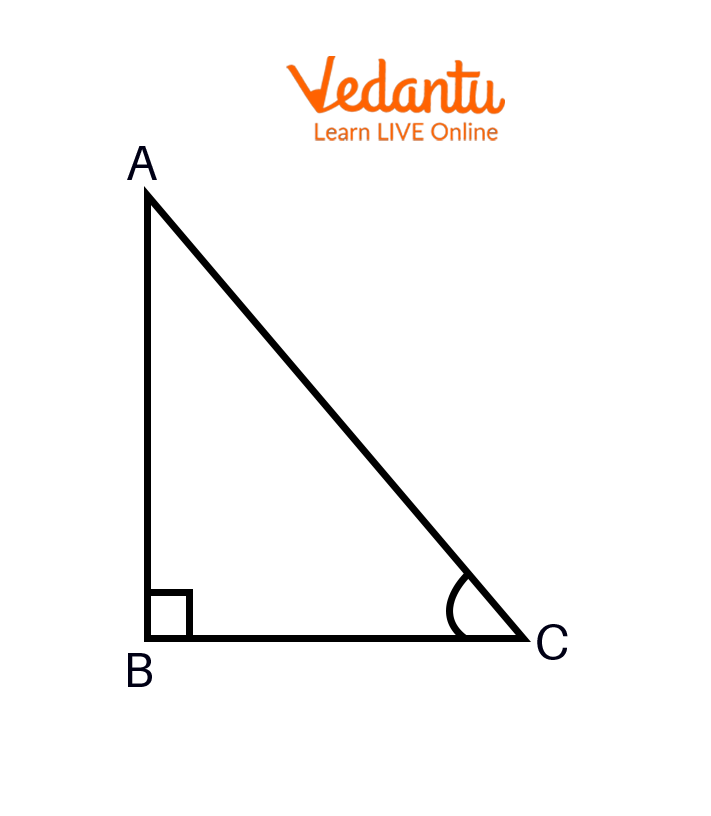
Triangle ABC
A triangle with a right angle at B is ABC. The following are the six trigonometric ratios for C:
$\sin C = \frac{AB}{AC}$
$\csc C = \frac{AC}{AB}$
$\cos C = \frac{BC}{AC}$
$\sec C = \frac{AC}{BC}$
$\tan C = \frac{AB}{BC}$
$\cot C = \frac{BC}{AB}$
Trigonometric Ratios Table
The values of trigonometric ratios such as sine, cosine, tangent, cotangent, cosecant, and secant from $0$ to $360^{o}$ are included in the trigonometry table. We can obtain the following values from these trigonometric ratios, which are listed in the trigonometry ratio table, by applying values ranging from $0$ to $360^{o}$:
$\angle A$ | $o^{o}$ | $30^{o}$ | $45^{o}$ | $60^{o}$ | $90^{0}$ |
$\sin A$ | $0$ | $\dfrac{1}{2}$ | $\dfrac{1}{\sqrt{2}}$ | $\dfrac{\sqrt{3}}{2}$ | $1$ |
$\cos A$ | $1$ | $\dfrac{\sqrt{3}}{2}$ | \dfrac{1}{\sqrt{2}} | $\dfrac{1}{2}$ | $0$ |
$\tan A$ | $0$ | $\dfrac{1}{\sqrt{3}}$ | $1$ | $\sqrt{3}$ | Not defined |
$\cot A$ | Not defined | $\sqrt{3}$ | $1$ | $\dfrac{1}{\sqrt{3}}$ | $0$ |
$\sec A$ | $1$ | $\dfrac{2}{\sqrt{3}}$ | $\sqrt{2}$ | $2$ | Not defined |
$\csc A$ | Not defined | $2$ | $\sqrt{2}$ | $\dfrac{2}{\sqrt{3}}$ | $1$ |
Trigonometric Ratios of Some Specific Angles
Geometry can be used to find the trigonometric ratios for some specific angles, such as $30^{o}, 45^{o}, and 60^{o}$, which are frequently encountered in applications.
Trigonometric Ratios of $30^{o} and 60^{o}$
Consider $ABC$ to be an equilateral triangle with length a.
Draw $AD$ perpendicular to $BC$, after which $D$ cuts the side $BC$ in half.
Then,
$ BD = DC = $\frac{a}{2}$
$\angle{BAD} = \angle{DAC } = 30^{o}$
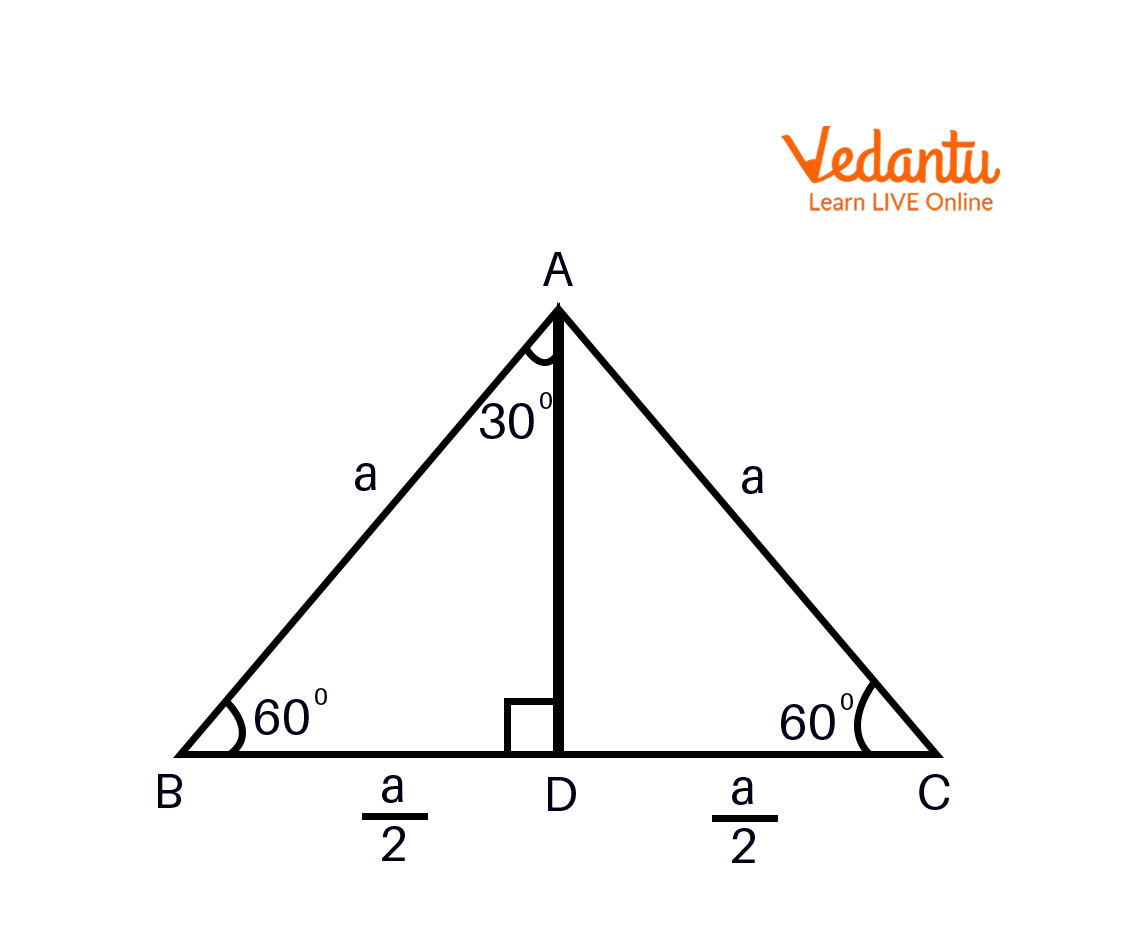
Equilateral triangle ABC
Now, in right triangle $ADB, \angle{BAD} = 30^{o}$ and $BD = \dfrac{a}{2}$.
In right triangle ADB, using the Pythagorean theorem,
$AB^2 = AD^2+ BD^2$
$a^2= AD^2 + (\frac{a}{2})^{2}$
$a^2- \frac{a^2}{4} = AD^2$
$\frac{3a^2}{4} = AD^2$
$\sqrt{\frac{3a^2}{4}} = AD$
$\sqrt{3} ⋅ \frac{a}{2} = AD$
As a result, using the right triangle ADB, we can obtain the trigonometric ratios of the angle of $30^{o}$.
$\sin 30^{o}=\frac{BD}{AB}=\frac{\frac{a}{2}}{{a}}=\frac{1}{2}$
$\cos 30^{o}=\frac{AD}{AB}=\frac{\frac{\sqrt{3}}{2 }a}{a} = \frac{\sqrt{3}}{2}$
$Tan 30^{o}=\frac{BD}{AD}=\frac{\frac{a}{2 }}{\frac{\sqrt{3}}{2} a}=\frac{1}{\sqrt{3}}$
$Cot 30^{o}=\sqrt{3}$
$Sec 30^{o}=\frac{2}{\sqrt{3}}$
$\csc 30^{o}=2$
angle ABD = $60^{o}$ in the right triangle ADB.
The trigonometric ratios of the angle of $60^{o}$ can thus be found.
$\sin 60^{o}=\frac{AD}{AB}= \frac{\frac{\sqrt{3}}{2}a}{a}=\frac{\sqrt{3}} {2}$
$\cos 60^{o}=\frac{BD}{AB}=\frac{(\frac{a}{2})}{a}=\frac{1}{2}$
$\tan 60^{o}=\frac{AD}{BD}=\frac{\frac{\sqrt{3}}{2} a }{(\frac{a}{2})}=\sqrt{3}$
$\cot 60^{o}=\frac{1}{\sqrt{3}}$
$\sec 60^{o}=2$
$\csc 60^{o}=\frac{2} {\sqrt{3}}$
Trigonometric Ratio of $45^{o}$
A right triangle's other acute angle is $45$ degrees if the acute angle in the triangle is $45$ degrees.
The triangle is, therefore, isosceles. Think about the triangle $ABC$ with
$\angle {B} = 90^{o}$
$\angle {A} = \angle {C} = 45^{o}$
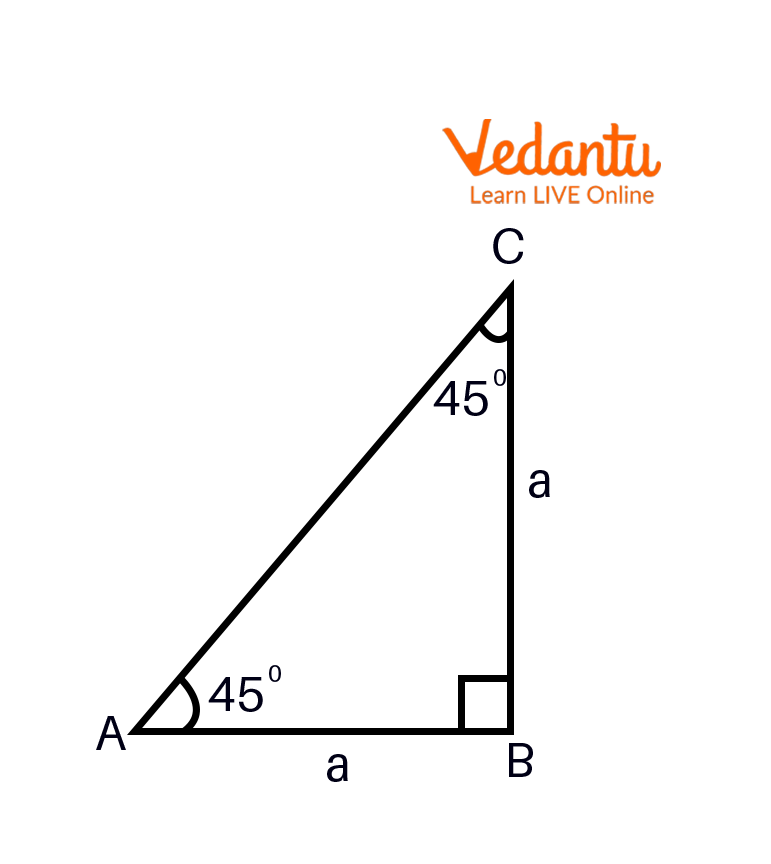
Triangle ABC with specified angles
Then $AB = BC$.
Let $AB = BC = a$.
Using the Pythagorean theorem,
$AC^2 = AB^2 + BC^2$
$AC^2 = a^2+ a^2$
$AC^2 = 2a^2$
Take square roots on each side.
$AC = a\sqrt{2}$
As a result, using the right triangle ABC, we can obtain the trigonometric ratios of angle $45^{o}$.
$\sin 45^{o}=\frac{BC}{AC} =\frac{a}{a \sqrt{2}} = \frac{\sqrt{2}}{2}$
$\cos 45^{o}=\frac{AB}{AC} =\frac{a}{a \sqrt{2}}= \frac{\sqrt{2}}{2}$
$\tan 45^{o}=\frac{BC}{AB} = \frac{a}{a}=1$
$\cot 45^{o}=1$
$\sec 45^{o}=\sqrt{2}$
$csc 45^{o}= \sqrt{2}$
Trigonometric Ratios of $0^{o} and 90^{o}$
Take a look at the illustration below, which displays a circle with a radius of $1$ unit centered at the origin.
Give P the coordinates of a point on the circle in the first quadrant $(x, y)$.
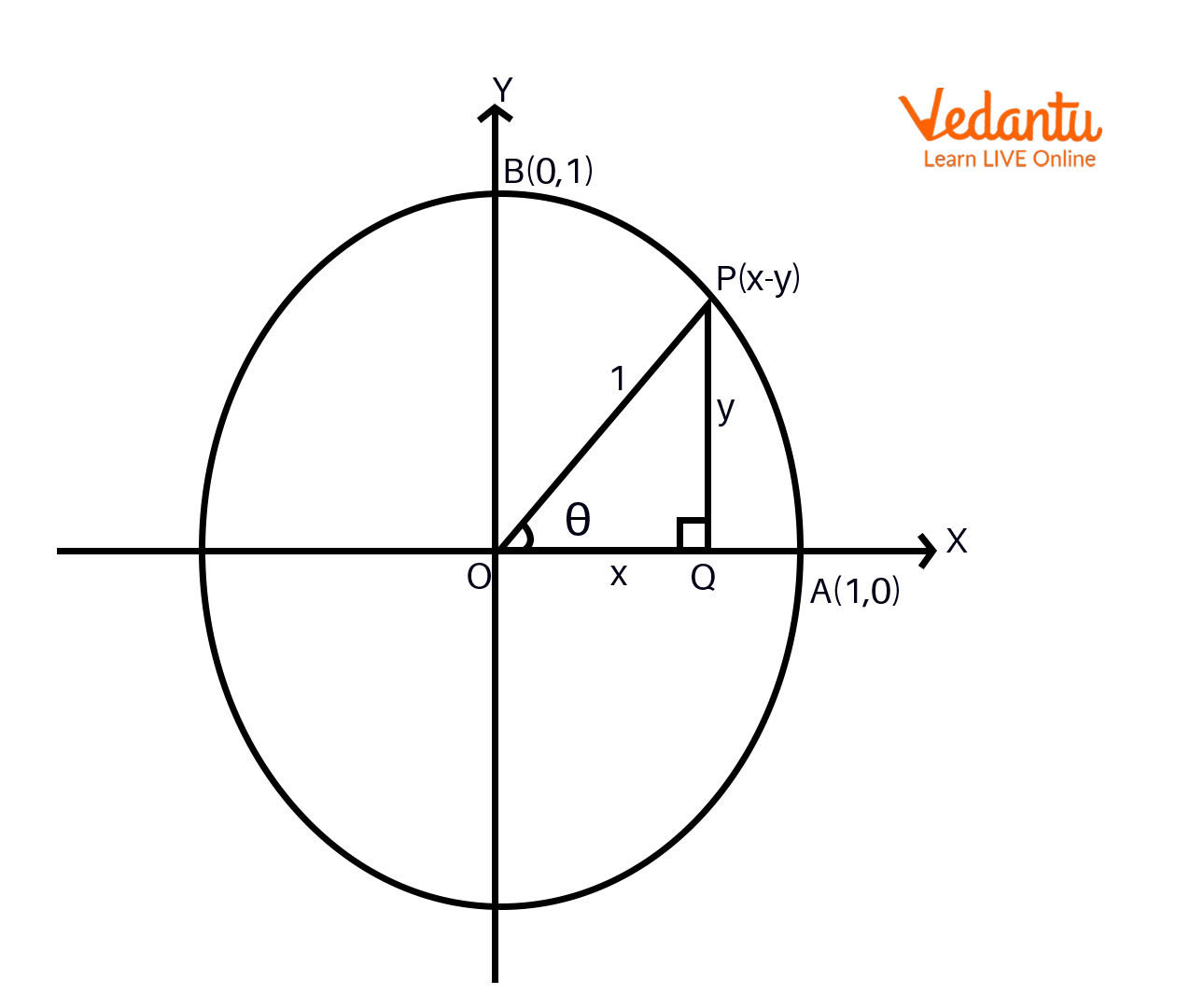
Triangle POQ
To create the right triangle $OPQ$, we drop a perpendicular $PQ$ from $P$ to the x-axis.
Let $\angle{POQ} = \theta$, then
$\sin \theta = \frac{PQ }{OP} = \frac{ y}{1} = y (y coordinate of P)$
$\cos \theta = \frac{OQ}{OP} = \frac{x}{1} = x (x coordinate of P)$
$\tan \theta = \frac{PQ}{OQ}= \frac{y}{x}$
If OP coincides with OA, then angle $\theta = 0^{o}$.
A's coordinates are (1, 0), so we have;
$\sin 0^{o}=0$
$\cos 0^{o}=1$
$\tan 0^{o}=\frac{0}{1}=0$
$\cot 0^{o}=not defined$
$\Sec 0^{o}=1$
$\csc 0^{o}= not defined$
If $OP$ and $OB$ coincide, then the angle is equal to $90^{o}$.
$B$'s coordinates are $(0, 1)$, so we have;
$\sin 90^{o}=1$
$\cos 90^{o}=0$
$\tan 90^{o}=\frac{1}{0}=not defined$
$\cot 90^{o}=0$
$\sec 90^{o}=not defined$
$\csc 90^{o}= 1$
Solved Examples
Example 1: Evaluate $sin 60^{o} cos 30^{o} + cos 60^{o} sin 30^{o}$
Solution: We have given a trigonometric expression $sin 60^{o} cos 30^{o} + cos 60^{o} sin 30^{o}$
Substituting the values we get,
$sin 60^{o} cos 30^{o} + cos 60^{o} sin 30^{o}$
$=\frac{\sqrt{3}}{2}\times \frac{\sqrt{3}}{2}+\frac{1}{2}\times \frac{1}{2}$
Simplifying the expression;
$=\frac{3}{4}+\frac{1}{4}$
$=1$
Example 2: Simplify $4\cot^2 45^{o} – \sec^2 60^{o} + \sin^2 60^{o} + \cos^2 90^{o}$.
Solution: We have $4\cot^2 45^{o} – \sec^2 60^{o} + \sin^2 60^{o} + \cos^2 90^{o}$
Substituting the values we get;
$= 4(\cot 45^{o})^2 – (\sec 60^{o})^2 + (\sin 60^{o})^2 + (\cos 90^{o})^2$
$= 4 × (1)^2 – (2)^2 + (\frac{\sqrt{3}}{2})^2 + 0$
$= 4 – 4 + \frac{3}{4} + 0 $
$= \frac{3}{4}$
Conclusion
As we have discussed above the six standard trigonometric angles. Sine, Cosine, Tangent, Cotangent, Secant, and Cosecant are all trigonometric ratios. These trigonometric ratios have standard angles of $0^{o}, 30^{o}, 45^{o}, 60^{o}, and 90^{o}$. The values of the ratios for these angles can be found in the trigonometric ratios table. The ratio of a right-angle triangle's sides to any of its acute angles is known as a trigonometric ratio for a given angle. Geometry can be used to find the trigonometric ratios for some specific. angles, such as $30^{o}, 45^{o}, and 60^{o}$, which are frequently encountered in applications.
Related Topics
FAQs on Trigonometric Ratios Of Some Specific Angles
1. What are the trigonometric ratios of some specific angles?
The trigonometric ratios of specific angles like 0°, 30°, 45°, 60°, and 90° have fixed standard values used in solving problems in trigonometry.
The most commonly used ratios are:
- sin 0° = 0, cos 0° = 1, tan 0° = 0
- sin 30° = 1/2, cos 30° = √3/2, tan 30° = 1/√3
- sin 45° = 1/√2, cos 45° = 1/√2, tan 45° = 1
- sin 60° = √3/2, cos 60° = 1/2, tan 60° = √3
- sin 90° = 1, cos 90° = 0, tan 90° is not defined
2. How do you remember the trigonometric values of 0°, 30°, 45°, 60°, and 90°?
The easiest way to remember trigonometric ratios of standard angles is by using the square root pattern method for sine and cosine.
For sin θ (θ = 0°, 30°, 45°, 60°, 90°):
- Write numbers 0, 1, 2, 3, 4
- Take square roots: √0, √1, √2, √3, √4
- Divide each by 2
0, 1/2, 1/√2, √3/2, 1
For cos θ, reverse the order:
1, √3/2, 1/√2, 1/2, 0
Then use tan θ = sin θ / cos θ to find tangent values.
3. Why is tan 90° not defined?
The value of tan 90° is not defined because it involves division by zero.
We know that:
tan θ = sin θ / cos θ
At 90°:
- sin 90° = 1
- cos 90° = 0
tan 90° = 1 / 0
Division by zero is undefined in mathematics, so tan 90° does not exist.
4. What is the value of sin 45° and cos 45°?
The value of sin 45° and cos 45° is 1/√2 (or √2/2).
This comes from an isosceles right-angled triangle with sides 1, 1, and √2.
- sin 45° = Perpendicular / Hypotenuse = 1/√2
- cos 45° = Base / Hypotenuse = 1/√2
5. What is the exact value of tan 30° and tan 60°?
The exact values are tan 30° = 1/√3 and tan 60° = √3.
Using the identity tan θ = sin θ / cos θ:
- tan 30° = (1/2) / (√3/2) = 1/√3
- tan 60° = (√3/2) / (1/2) = √3
6. How are trigonometric ratios of specific angles derived?
The trigonometric ratios of specific angles are derived using special right-angled triangles like the 30°–60°–90° and 45°–45°–90° triangles.
For 45°–45°–90° triangle:
- Sides are in ratio 1 : 1 : √2
For 30°–60°–90° triangle:
- Sides are in ratio 1 : √3 : 2
Using these side ratios and definitions of sin, cos, and tan, we obtain all standard trigonometric values.
7. What are the values of sin 0° and cos 90°?
The values are sin 0° = 0 and cos 90° = 0.
From the unit circle or right triangle perspective:
- At 0°, the vertical side is 0, so sine is 0.
- At 90°, the horizontal side is 0, so cosine is 0.
8. What is the relationship between sin and cos of complementary angles?
The sine of an angle equals the cosine of its complement, expressed as sin (90° − θ) = cos θ.
Similarly:
- cos (90° − θ) = sin θ
- tan (90° − θ) = cot θ
sin 30° = cos 60° = 1/2
This is known as the complementary angle identity.
9. Can you give a worked example using trigonometric ratios of specific angles?
Yes, you can solve right triangle problems easily using standard trigonometric ratios.
Example: If a right triangle has one angle 30° and hypotenuse 10 cm, find the opposite side.
Step 1: Use sin 30° = Opposite / Hypotenuse
Step 2: Substitute value → 1/2 = Opposite / 10
Step 3: Opposite = 10 × 1/2 = 5 cm
Thus, the opposite side is 5 cm.
10. What are common mistakes students make with trigonometric ratios of specific angles?
Common mistakes include mixing up sine and cosine values and forgetting that tan 90° is undefined.
Some frequent errors are:
- Writing sin 30° = √3/2 instead of 1/2
- Forgetting tan 90° is not defined
- Confusing radians and degrees
- Not rationalizing 1/√3 when required
