









Proof Formula and Solved Examples of the Exterior Angle Theorem in a Cyclic Quadrilateral
The theorem on the exterior angle of a cyclic quadrilateral is used to state the property of cyclic quadrilaterals and helps us in solving complex problems related to exterior angles in an easy and efficient manner. Cyclic quadrilaterals are the quadrilaterals that are formed when all the vertices of the quadrilateral lie on the circumference of the circle. In this article, we will discuss the detailed proof of the theorem related to exterior angles of the cyclic quadrilateral along with the application of the cyclic quadrilateral in our real life.
History of Euclid

Euclid
Name: Euclid
Born: Mid-4th century BC
Died: Mid-3rd century BC
Field: Mathematics
Nationality: Greek
Statement of Theorem on the Exterior Angle of a Cyclic Quadrilateral
The theorem on the exterior angle of a cyclic quadrilateral states that an exterior angle of a cyclic quadrilateral is equal to the interior angle at the opposite vertex.
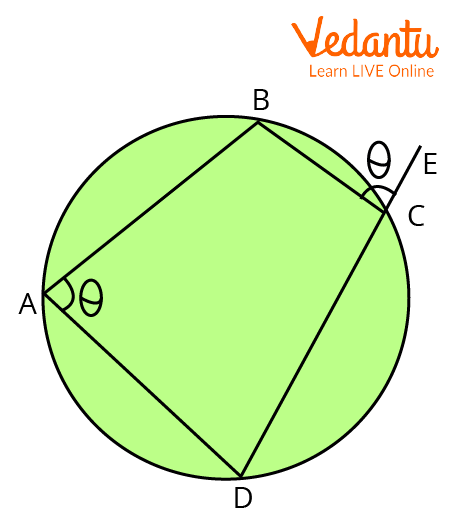
Cyclic Quadrilateral ABCD
Proof of Theorem on the Exterior Angle of a Cyclic Quadrilateral
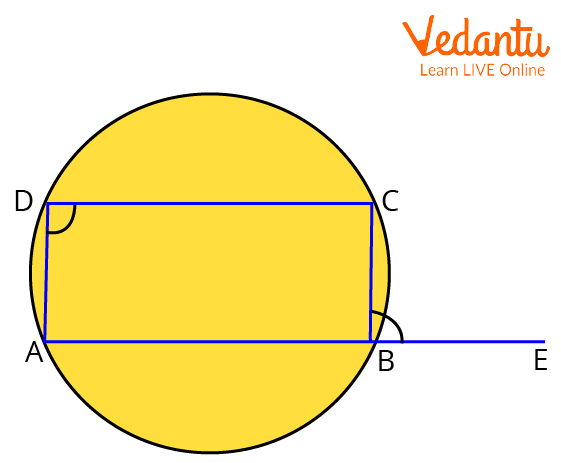
Proof of the Exterior Angle of a Cyclic Quadrilateral
Given: In a cyclic quadrilateral $A B C D$, side $A B$ is produced to a point $E$.
To prove: External $\angle C B E=\angle A D C$
Proof:
$\angle A B C+\angle C B E=180^{\circ}$ (Linear pair)
$\angle A B C+\angle A D C=180^{\circ}$ (Opposite angles of a cyclic quadrilateral)
Equating above both cases, we get
$\angle A B C+\angle C B E=\angle A B C+\angle A D C$
$\angle C B E=\angle A D C$
Hence proved.
Limitations of Theorem on the Exterior Angle of a Cyclic Quadrilateral
The theorem is applicable only in the case of cyclic quadrilaterals.
Applications of Theorem on the Exterior Angle of a Cyclic Quadrilateral
It is used in making paintings, sculptures, etc.
The Cyclic Quadrilateral Theorem is used in computer programming.
It is used in graphic arts, logos, and packaging.
Solved Examples of Exterior Angles of Cyclic Quadrilateral
1. In the cyclic quadrilateral, side $\mathrm{BD}$ is produced to $\mathrm{E}$ and $\angle B A C=75^{\circ}$. What is the value of $\angle C D E$?
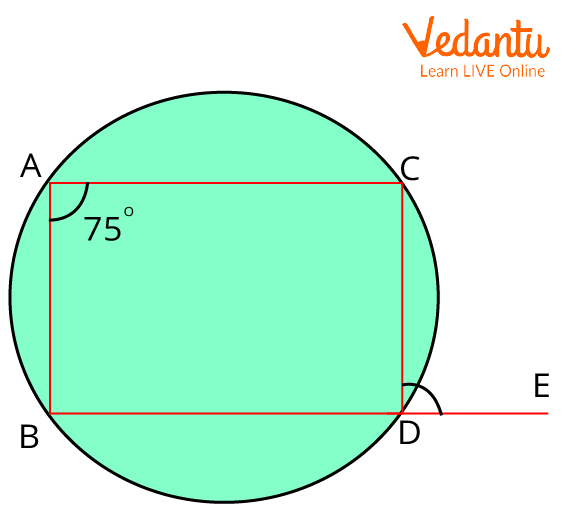
Angle A is given in ABCD is a Cyclic Quadrilateral
Ans:
$\angle B A C=\angle C D E$ (exterior angle of a cyclic quadrilateral is equal to the interior angle at the opposite vertex)
And we are given that $\angle B A C=75^{\circ}$
$\angle B A C=\angle C D E$
Therefore, $\angle C D E=75^{\circ}$
2. In the cyclic quadrilateral, side $\mathrm{BD}$ is produced to $\mathrm{E}$ and $\angle B A C=75^{\circ}$. What is the value of $\angle C D B$?
To Find Angle CDB in the Quad. ABCD
Ans:
$\angle B A C=\angle C D E$ (exterior angle of a cyclic quadrilateral is equal to the interior angle at the opposite vertex)
And we are given that $\angle B A C=75^0$
and $\angle B A C=\angle C D E$
Therefore, $\angle C D E=75^{\circ}$
$\angle C D B+\angle C B E=180^{\circ} \text { (Linear pair) } \\$
$\angle C D B+75^{\circ}=180^{\circ} \\$
$\angle C D B=105^{\circ}$
3. In the cyclic quadrilateral, side $\mathrm{BC}$ is produced to $\mathrm{E}$ and $\angle D C E=95^{\circ}$. What is the value of $\angle D A B$?
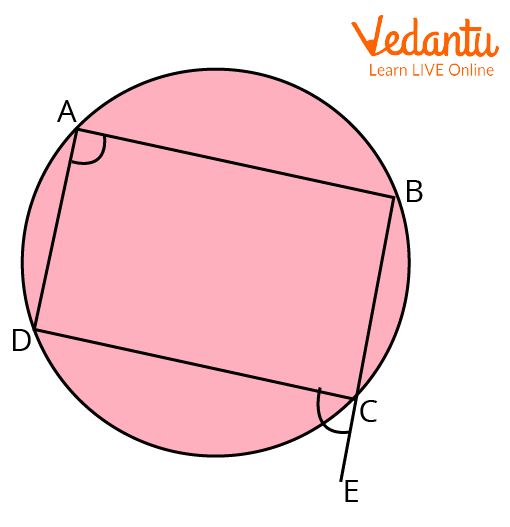
To Find Angle DAB
Ans:
$\angle B A D=\angle D C E$ (exterior angle of a cyclic quadrilateral is equal to the interior angle at the opposite vertex)
And we are given that $\angle D C E=95^{\circ}$
and $\angle B A C=\angle C D E$
Therefore, $\angle B A D=95^0$
Important Points to Remember
The exterior angle of a cyclic quadrilateral is equal to the interior angle at the opposite vertex.
Important Formulas to Remember
In a cyclic quadrilateral ABCD, side AB is produced to point E.
Then, External $\angle C B E = \angle A D C$
Conclusion
Cyclic Quadrilaterals are connecting links between polygons and circles. In the article, we have discussed the detailed proof of the exterior angles of the Cyclic Quadrilateral Theorem. Applications of the Cyclic Quadrilaterals are also discussed in this article. And we can conclude that the theorem is a fundamental tool of Euclidean Geometry and is of great significance in solving problems related to Cyclic Quadrilaterals.


FAQs on Theorem on the Exterior Angle in a Cyclic Quadrilateral
1. What is the theorem on the exterior angle of a cyclic quadrilateral?
The exterior angle of a cyclic quadrilateral is equal to the interior opposite angle. In a quadrilateral inscribed in a circle, if one side is extended to form an exterior angle, then that exterior angle equals the angle at the opposite vertex.
- If ABCD is a cyclic quadrilateral and side BC is extended,
- Then exterior angle at C = interior angle at A.
2. How do you prove the exterior angle theorem of a cyclic quadrilateral?
The exterior angle theorem of a cyclic quadrilateral is proved using the fact that opposite angles of a cyclic quadrilateral are supplementary.
- In cyclic quadrilateral ABCD, ∠A + ∠C = 180°.
- If BC is extended, the exterior angle at C forms a linear pair with ∠C.
- So exterior angle at C = 180° − ∠C.
- Since ∠A + ∠C = 180°, we get 180° − ∠C = ∠A.
3. What is the formula for the exterior angle of a cyclic quadrilateral?
The formula for the exterior angle of a cyclic quadrilateral is: Exterior angle = Opposite interior angle.
- If ABCD is cyclic and BC is extended,
- Exterior ∠C = ∠A
4. Why is the exterior angle equal to the opposite interior angle in a cyclic quadrilateral?
The exterior angle equals the opposite interior angle because opposite angles of a cyclic quadrilateral are supplementary.
- Opposite angles satisfy ∠A + ∠C = 180°.
- The exterior angle at C forms a linear pair with ∠C.
- Exterior angle = 180° − ∠C.
- Since ∠A = 180° − ∠C, exterior angle = ∠A.
5. Can you give an example of the exterior angle theorem of a cyclic quadrilateral?
Yes, in a cyclic quadrilateral, the exterior angle equals the opposite interior angle.
- Suppose ∠A = 70°.
- Then ∠C = 180° − 70° = 110°.
- If side BC is extended, exterior angle at C = 180° − 110° = 70°.
6. What are the key properties of a cyclic quadrilateral related to exterior angles?
The key properties linking cyclic quadrilaterals and exterior angles are based on angle relationships in a circle.
- Opposite angles are supplementary: sum = 180°.
- An exterior angle equals the interior opposite angle.
- All vertices lie on a single circle.
7. How do you find a missing angle using the exterior angle theorem in a cyclic quadrilateral?
To find a missing angle, use the rule that the exterior angle equals the opposite interior angle.
- Step 1: Identify the exterior angle formed by extending a side.
- Step 2: Locate the opposite interior angle.
- Step 3: Set them equal and solve.
8. What is the difference between the exterior angle theorem of a triangle and a cyclic quadrilateral?
The triangle exterior angle theorem states that an exterior angle equals the sum of the two remote interior angles, while in a cyclic quadrilateral the exterior angle equals the single opposite interior angle.
- Triangle: Exterior angle = sum of two opposite interior angles.
- Cyclic quadrilateral: Exterior angle = one opposite interior angle.
9. Does the exterior angle theorem apply to all quadrilaterals?
No, the exterior angle theorem applies only to a cyclic quadrilateral, not to all quadrilaterals.
- The quadrilateral must have all four vertices on a circle.
- Opposite angles must sum to 180°.
10. What is the converse of the exterior angle theorem of a cyclic quadrilateral?
The converse states that if an exterior angle of a quadrilateral equals its opposite interior angle, then the quadrilateral is cyclic.
- If exterior ∠C = interior ∠A,
- Then ∠A + ∠C = 180°.
- This proves the quadrilateral can be inscribed in a circle.
