








What Is Place Value For 5 Year Students With Fun Examples
Introduction to Place Value and Numbers
Kids are introduced to numbers at an early age; kids starting in Grade 2 are familiarised with the use of place value charts and their importance in writing the numbers in words. The concept of numbers and place value for Year 5 students is one of the important basics of Mathematics. The article provides an overview of the topics that are taught in fifth grade. It particularly focuses on the methods that can help teachers in teaching place value to kids in Year 5 students. Teaching place value to Year 5 students will be much easier once you go through the following.
Fun Ways of Teaching Place Value in Year 5
Teaching new concepts is always a pleasant experience. Kids at a growing age are very curious to learn things. Mentioned below are some tips that can help teachers in teaching the new concepts like place value in year 5.
Engaging with Kids
Learning can be a fun experience. Students and parents or teachers are equally involved in the learning process, and learning new things through activity is one of the most effective methods of engaging with the students.
One such activity can be planned using the Dienes blocks. Dienes blocks of different values can be used for place value representation. Kids can be asked to represent any number like 174 with the help of dienes. For number 174 kids would need to organise one set of 100, 7 sets of 10 and four single cubes. This can be fun and can help kids to better understand the place value chart.
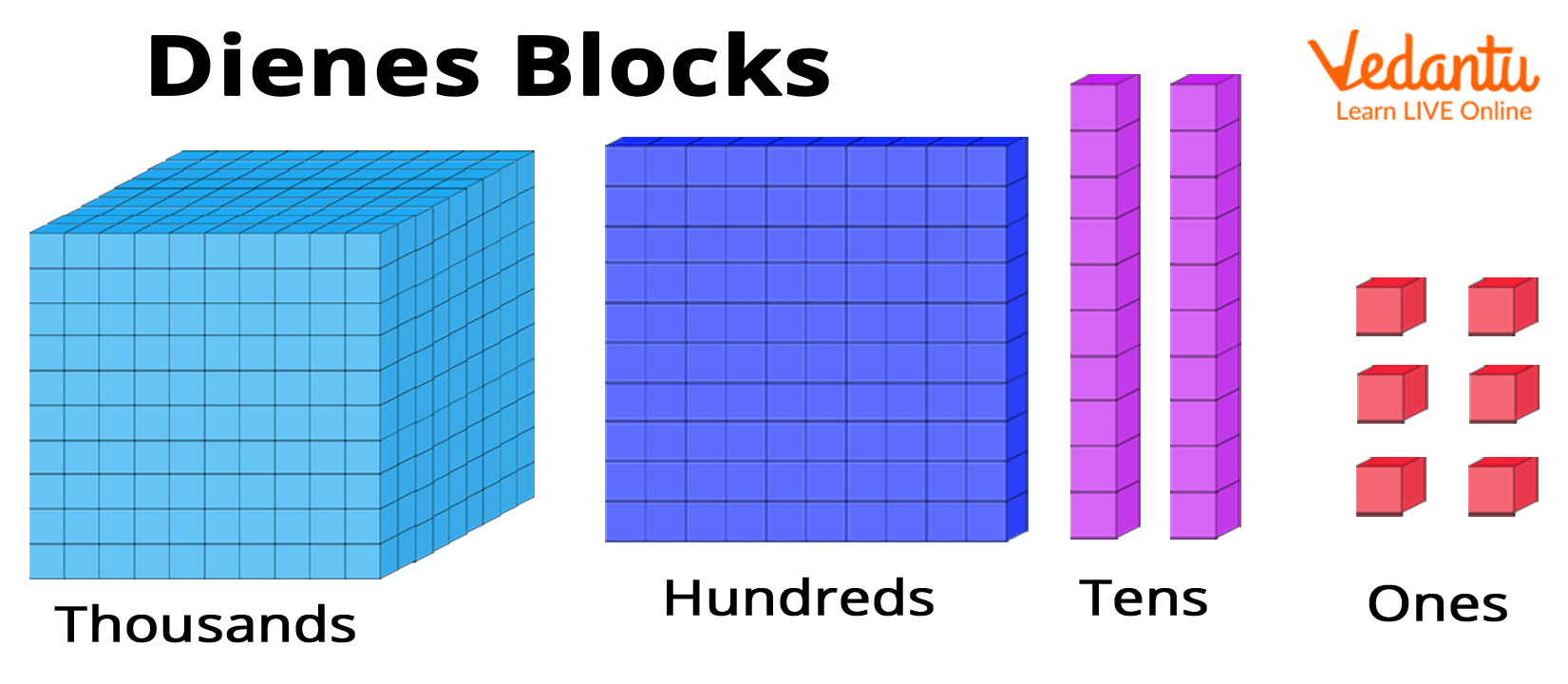
Dienes block used to learn place value in Year 5
Using the Knowledge of Place Value
Parents and teachers must encourage kids to correlate the concepts of place value to other mathematical operations. This can help kids to excel academically and also improve their understanding of the concept.
In the case of place value, kids can learn about the pattern for example 4 + 3 = 7, and 0.4 + 0.3 = 0.7. The pattern that emerged here can be represented as the numbers in the calculation being ten times smaller and the total is also ten times smaller.
Teaching Kids to Calculate Place Value in Year 5
Lastly, we must learn to calculate the place value of the numbers. We can learn it from the following examples.
Example 1. Calculate the place value of the number 24
The digit 2 in the number 24 is in the tens place, and it has a place value of 2 × 10 = 20
The digit 4 is in the one’s place, and it has the place value of 4 × 1 = 4
Example 2. Calculate the place value of 657
The place value of the digit 6 is 6 x 100 = 600
The place value of 5 in number 657 is 5 x 10 = 50
The place value of the one’s digit is 7 x 1 =7.
This was the complete discussion on methods to teach kids about place value in Year 5. We hope to have provided a better insight into the topic. An important point to note here is that it is through regular practice that a kid can enhance their skills.
FAQs on Teaching Place Value to 5 Year Old Students
1. What is place value for 5 year students?
Place value is the value of a digit based on its position in a number. For 5 year students, place value usually means understanding ones and tens.
- The right digit shows ones (single units).
- The next digit to the left shows tens (groups of 10).
- Example: In 14, the 1 means 1 ten and the 4 means 4 ones.
2. How do you explain place value to a child?
You explain place value by showing that digits change value depending on where they sit in a number. Use simple objects to model this idea.
- Bundle 10 straws to make 1 ten.
- Leave single straws as ones.
- Show 23 as 2 bundles of ten and 3 single straws.
3. What are tens and ones in place value?
Tens and ones are the first two place value positions in two-digit numbers.
- Ones represent single units from 0 to 9.
- Tens represent groups of 10.
- Example: In 36, 3 means 3 tens (30) and 6 means 6 ones.
4. How do you teach place value with base ten blocks?
You teach place value with base ten blocks by using rods for tens and small cubes for ones.
- A long rod equals 10 ones (1 ten).
- A small cube equals 1 one.
- Example: 27 is shown as 2 rods and 7 cubes.
5. Why is place value important in early maths?
Place value is important because it helps children understand how numbers are built and how to add and subtract correctly.
- It supports counting beyond 10.
- It prepares students for addition and subtraction with regrouping.
- It strengthens number sense up to 100 and beyond.
6. Can you give an example of place value for kindergarten?
An example of place value for kindergarten is breaking 18 into tens and ones.
- 18 = 1 ten + 8 ones.
- The digit 1 stands for 10.
- The digit 8 stands for 8.
7. How do you teach place value in a fun way?
You can teach place value in a fun way by using games, songs, and hands-on grouping activities.
- Play a matching game with number cards and tens/ones blocks.
- Use place value charts to build numbers.
- Sing counting songs that group numbers into tens.
8. What is a place value chart for kids?
A place value chart is a table that shows where each digit belongs in a number.
- Common columns are Tens and Ones.
- Example for 45:
- 4 goes in the Tens column.
- 5 goes in the Ones column.
9. How do you write a two-digit number in expanded form?
A two-digit number in expanded form is written as the sum of its tens and ones.
- Example: 32 = 30 + 2.
- 30 represents 3 tens.
- 2 represents 2 ones.
10. What are common mistakes children make with place value?
A common mistake in place value is confusing the position of digits in two-digit numbers.
- Reading 41 as 14.
- Thinking the digit 3 in 34 means just 3 instead of 30.
- Not grouping 10 ones into 1 ten.
