








How to Do Subtraction With Regrouping Step by Step with Examples
What is Subtraction?
The concept of the difference in maths is finding the difference between the numbers. Here, the number we are subtracting is subtrahend, the number from which we are subtracting is minuend, and the result we are obtaining is the difference.
The subtraction can be between two one-digit numbers, two-digit numbers, three-digit numbers, four-digit numbers, and so on.
Now, let us understand what subtraction with regrouping is. Well, this concept says that the subtraction process is done by exchanging one ten’s into ten one’s.
Here, we will use the concept of subtraction with regrouping for three to four-digit numbers.
How to do Subtraction with Regrouping?
Suppose we wish to find the difference between 785 and 468. Both are three-digit numbers, therefore placing one number below the other in order of their place values, we get –
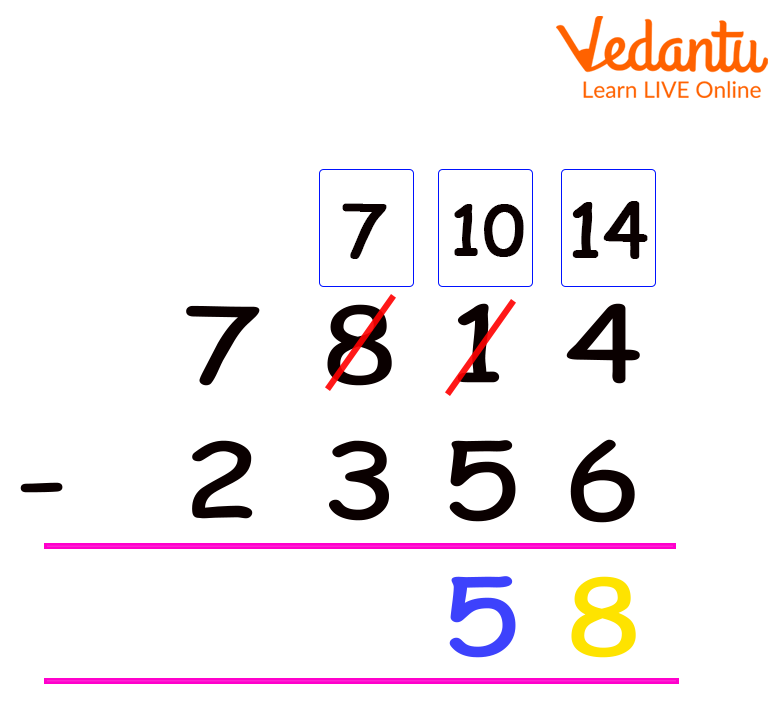
Subtraction of two three-digit numbers
In the above case, we conclude that each digit of the subtrahend was less than the given digit in the minuend. So, how do we subtract a subtrahend that is greater at a certain place value than the corresponding value of the minuend? Well, for this, we will understand it using an example.
Now, here if we desire to determine the difference between 2356 and 7814, we will first compare the digits of both the subtrahend and the minuend.
Secondly, we notice that the value of subtrahend is greater than the value of the minuend at a few places.
A question arises: how do we subtract 6 from 4? Here, we use the concept of taking away a digit from the next place value or borrowing a value in such cases. By borrowing, we mean that we borrow 1 from the next number in the place value, like one’s digit taking ‘1’ from the ten’s place value. This is known as regrouping.
Let us solve this step by step.
Step 1: Firstly, subtract 6 from 4. Since we cannot subtract larger numbers from smaller ones, we borrow 1 from the digit that is at the ten’s place in the minuend to make the one’s digit larger.
Like here, in this case, the number is 1, so we borrow 1 from 1, and the 1 at the ten’s place in the minuend turns to 0.
Therefore, the number at the one’s place of the minuend, after borrowing 1 becomes 14. Now, it is easier for us to subtract 6 from 14, and hence, we get 8 at the one’s place as the answer.
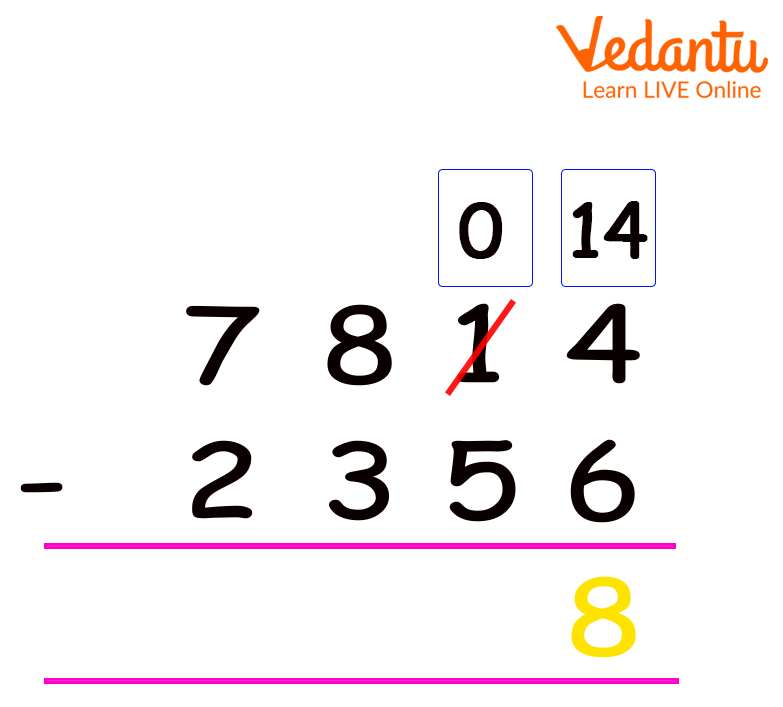
Step 1 of subtraction with regrouping
Step 2: In the next step, we move to subtract the digits at the ten’s place. Please note that the digit at the ten’s place is now 0, instead of the 1 that we had earlier.
Now, what we do is, we have to subtract 5 from 0, which again is impossible.
However, we repeat the steps again that we did for subtracting the digits at the one’s place.
Now, here, we will borrow 1 from the digit at the hundred’s place, and give it to 0 at the ten’s place. So, now ‘8’ at the hundred’s place of the minuend turns to 7 and the 0 at the ten’s place of the minuend becomes 10. Now, it is easier for us to subtract 5 from 10 and hence we get 5 as the answer at the ten’s place.
Step 2 of subtraction with regrouping
Step 3: Now, let us have a look at the values at the hundred’s place. We can see ‘3’ as the subtrahend and 7 as the minuend, which can be subtracted now. Therefore, we get 4 as the answer at the hundred’s place.
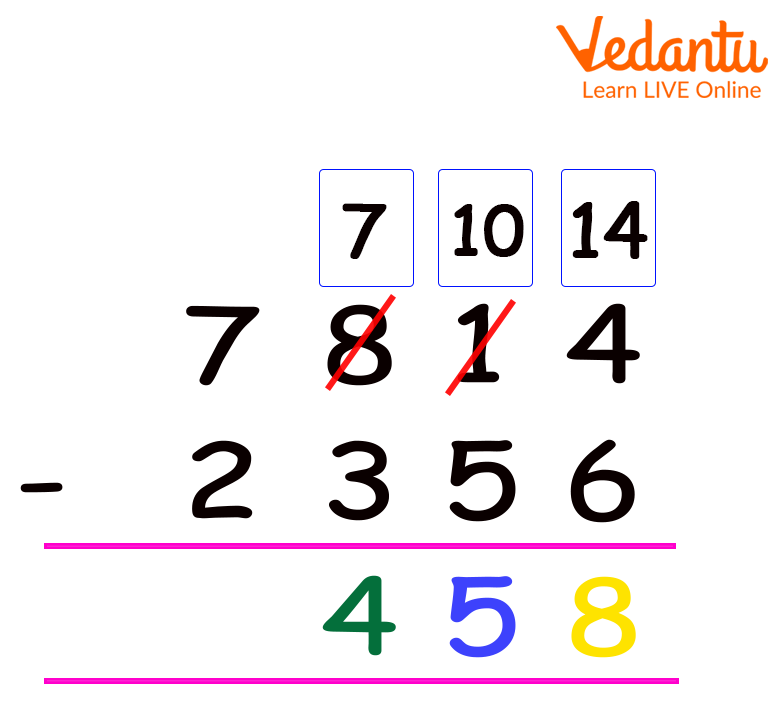
Step 3 of subtraction with regrouping
Step 4: Lastly, we go next to values at the thousand’s place. Here, we find 2 as the subtrahend and 7 as the minuend. Hence, easily we get 5 as the answer at the thousand’s place.
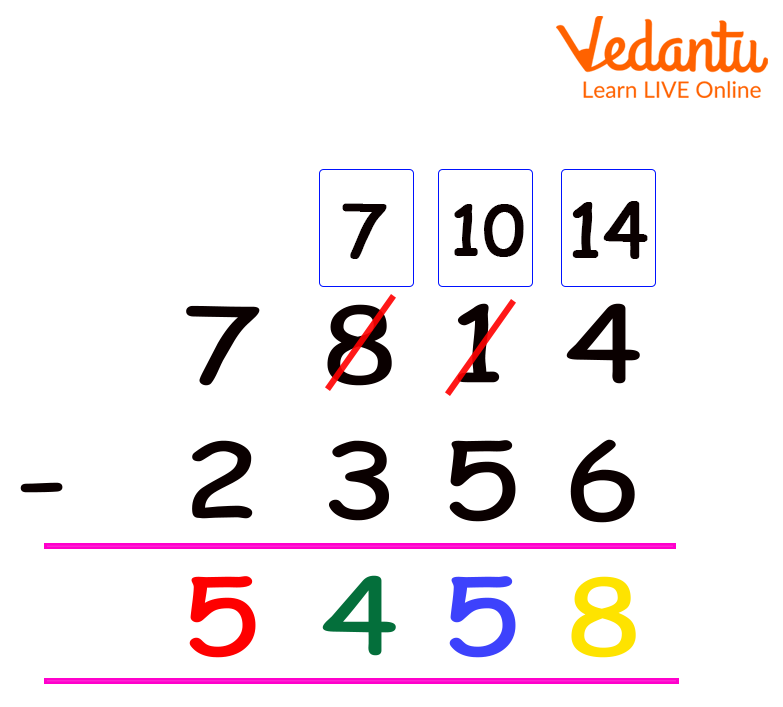
Step 4 of subtraction with regrouping
Hence, using the formula Minuend - Subtrahend = Difference, we get,
7814 – 2356 = 5458 as the answer.
So, this is how we do subtraction with regrouping for two three-digit and two four-digit numbers by using the concept of borrowing.
FAQs on Subtraction With Regrouping Explained for Students
1. What is subtraction with regrouping?
Subtraction with regrouping is a method of subtracting numbers where you borrow from the next higher place value when the top digit is smaller than the bottom digit. It is also called borrowing in subtraction.
- Used in multi-digit subtraction (2-digit, 3-digit, or more).
- Required when the digit in the minuend is less than the digit in the subtrahend.
- Example: In 52 − 38, regroup 5 tens into 4 tens and 12 ones before subtracting.
2. How do you do subtraction with regrouping step by step?
To do subtraction with regrouping, you borrow from the next place value when needed and subtract column by column from right to left.
- Step 1: Line up numbers by place value.
- Step 2: Start from the ones place.
- Step 3: If the top digit is smaller, regroup (borrow 1 from the next column).
- Step 4: Subtract each column.
- Step 5: Write the final difference.
3. Why do we regroup in subtraction?
We regroup in subtraction because you cannot subtract a larger digit from a smaller digit within the same place value. Regrouping converts one unit of a higher place value into smaller units.
- 1 ten = 10 ones
- 1 hundred = 10 tens
- Ensures subtraction follows place value rules
4. What is an example of subtraction with regrouping?
An example of subtraction with regrouping is 52 − 38 = 14. Here is how it works:
- 2 is smaller than 8, so regroup 5 tens into 4 tens and 12 ones.
- 12 − 8 = 4
- 4 − 3 = 1
5. What is the difference between subtraction with regrouping and without regrouping?
The difference is that subtraction with regrouping requires borrowing, while subtraction without regrouping does not.
- Without regrouping: Each top digit is greater than or equal to the bottom digit (e.g., 75 − 23).
- With regrouping: At least one top digit is smaller and needs borrowing (e.g., 52 − 38).
6. How do you subtract 3-digit numbers with regrouping?
To subtract 3-digit numbers with regrouping, subtract from right to left and borrow across place values when needed.
- Line up hundreds, tens, and ones.
- Regroup if a digit is smaller than the digit below it.
- Subtract each column carefully.
7. How do you subtract across zeros with regrouping?
To subtract across zeros, borrow from the nearest non-zero digit to the left and regroup step by step.
- Example: 300 − 125
- Borrow from 3 hundreds → becomes 2 hundreds.
- Regroup through tens to make 10 tens, then 10 ones.
- Final subtraction gives 175.
8. What are common mistakes in subtraction with regrouping?
Common mistakes in subtraction with regrouping include incorrect borrowing and place value errors.
- Forgetting to reduce the digit you borrowed from.
- Misaligning place values.
- Subtracting larger from smaller without regrouping.
- Errors when subtracting across zeros.
9. Can you use a number line for subtraction with regrouping?
Yes, you can use a number line to model subtraction with regrouping by counting backward in parts.
- Start at the larger number.
- Jump back in tens and ones.
- Combine jumps to find the difference.
10. How can I check subtraction with regrouping?
You can check subtraction with regrouping by using addition to verify the answer.
- Add the difference to the subtrahend.
- If the sum equals the minuend, the subtraction is correct.
