








Number 3 worksheets tracing counting and recognition practice
Overview of the Number 3
Are you stabbed worrying about how to teach your children to identify number 3? If yes, then you have come across the right platform. This article will aid you in teaching 3 to the children by using number 3 activities. Here, we have discussed the number 3, its different writing forms, its representation on the number line, and many more. This writing helps in making the learning process simple and interesting. Now, are you ready to start memorizing this interesting topic?
What is the Number 3?
A number, numeral, and digit, 3 is defined as the natural number that comes after 2 and before 4. It is the smallest possible prime number which is an odd number. Divisors of 3 are 1, and 3 itself. In many societies and cultures, the number 3 is considered religious and it also possesses certain cultural implications.
Writing Number 3 in different Formats
The number 3 can be written in different forms such as:
In Number Names
In terms of number names, 3 is written as three
In Ordinal Form
In terms of ordinal form, the number 3 is written as third
In roman numeral form, the number 3 is depicted by writing it as lll
In Square Form
It can not be expressed in terms of the square of a number
Number 3 with Objects
Number 3 is the counting number, which is represented by using the objects, in the below-given images. The use of graphics helps the parents and teachers to teach number 3 to the children easily.

Showing number 3 with objects
How to write Number 3?
To learn the number 3, one should practice writing it again and again by counting. Some worksheets are given below that are based on the concept of the dotted phenomenon which aids the children in learning how to write the number 3 easily.
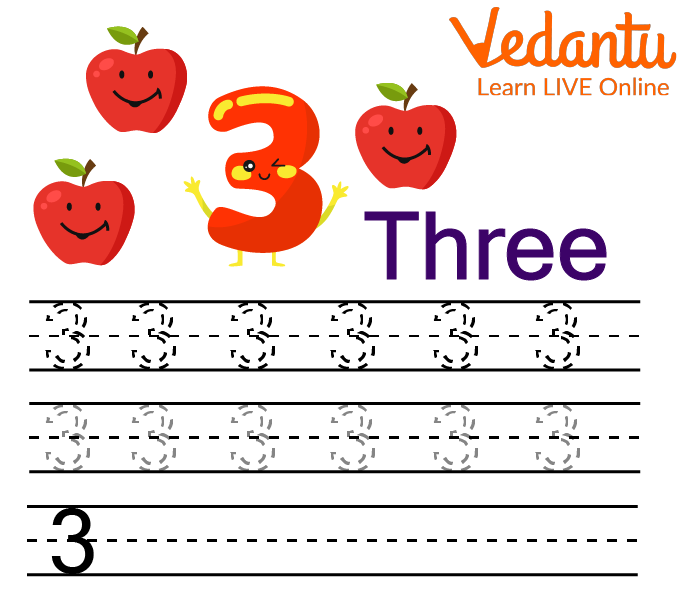
How to write Number 3
Solved Examples
Q1. Can the number 9 be expressed in terms of 3?
Ans. Yes, the number 9 can be expressed in terms of 3 because it is the square root of the number 9 I.e. multiplying 3 with 3 , we get 9.
Thus, the number 3 is the square root of the number 9.
Q2. How to represent the number 3 on the number line?
Ans. To represent the number 3 on the number line, follow the given steps:
Draw a straight line of any length using the scale
Represent the integers on the number line
Mark the point where you get the number 3
Thus, the number 3 is represented on the number line.
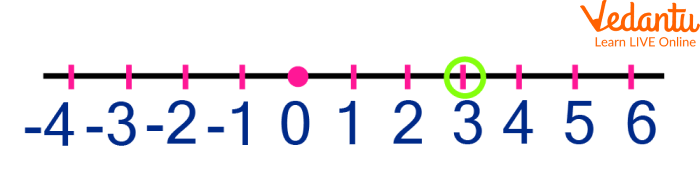
Number 3 on number line
Practice Problems
Till now, the children would gain a clear picture of the number 3 in their mind which would help them to identify it easily. Some number 3 worksheets for nursery are given below along with graphics that help the tutors in evaluating how much the kids have gained and whether they can identify the number 3 or not.
Q1. Write the number of objects in the circle shown in each box:
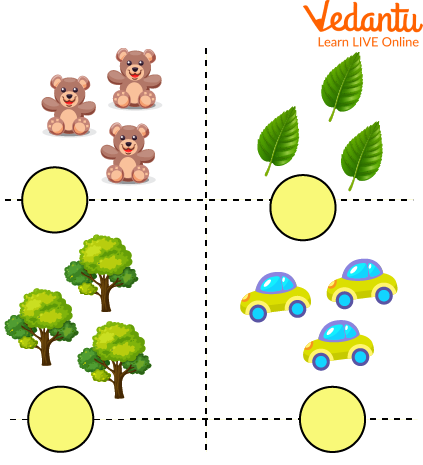
Number 3 worksheet for nursery, based on count and write
Q2. How many 3’s are there in the below image?
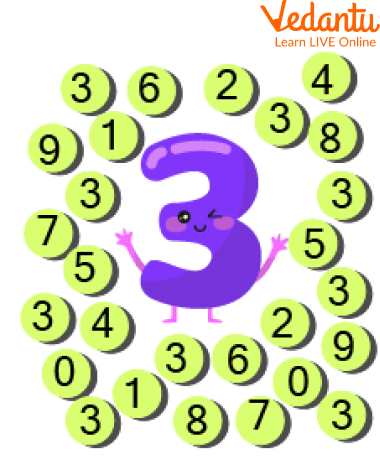
Number 3 worksheet for nursery, based on the concept of circling
Summary
To wrap up here with the topic of learning the number 3. It serves as the fundamental block in memorizing mathematics. It is useful not only in mathematics but also in real life. This article covers every topic related to number 3 by using number 3 activities and graphics so that children would easily grab the topic. The language used in the above writing is kept simple and fascinating to make the understanding of the concepts deeper. I Hope you find the article useful and enjoy reading it.
FAQs on Fun Number 3 Activities for Early Learners
1. What are Number 3 activities in Maths?
Number 3 activities are learning exercises that help children understand the number 3, including counting, writing, and recognizing three objects. These activities usually focus on:
- Counting up to 3
- Recognizing the numeral 3
- Matching number 3 with three objects
- Tracing and writing the number 3
2. How do you teach a child to count to 3?
You can teach a child to count to 3 by using real objects and counting them one by one aloud. Follow these steps:
- Place 3 objects (e.g., blocks) in front of the child.
- Point to each object and say: 1, 2, 3.
- Repeat and encourage the child to count independently.
- Practice with different objects like toys, fruits, or fingers.
3. How do you write the number 3 correctly?
The number 3 is written by drawing two curved lines, one on top of the other. Follow these steps:
- Start at the top.
- Draw a small curve to the right.
- Without lifting the pencil, draw another curve below it.
4. What are some fun activities to learn the number 3?
Fun Number 3 activities include counting games, coloring, and matching exercises that focus on the quantity three. Examples include:
- Coloring exactly 3 objects in a picture
- Clapping hands 3 times
- Finding groups of three items in the classroom
- Using flashcards with the numeral 3
5. What does the number 3 represent in Maths?
In Maths, the number 3 represents a quantity of three units or objects. It means:
- One more than 2
- One less than 4
- A set containing exactly three items
6. How do you show the number 3 using objects?
You can show the number 3 by grouping exactly three objects together. For example:
- 🍎🍎🍎 (3 apples)
- ✏️✏️✏️ (3 pencils)
- 3 fingers held up
7. What is an example of a simple addition activity with number 3?
A simple addition activity with number 3 is adding numbers that make a total of 3. For example:
- 1 + 2 = 3
- 2 + 1 = 3
- 0 + 3 = 3
8. What is the difference between the numeral 3 and three objects?
The numeral 3 is the written symbol, while three objects represent the actual quantity. For example:
- 3 → the digit or symbol
- 🍪🍪🍪 → a group showing the quantity three
9. Why is learning the number 3 important in early Maths?
Learning the number 3 is important because it builds foundational counting and number recognition skills. It helps children:
- Understand number order (1, 2, 3)
- Develop basic addition and subtraction skills
- Recognize small quantities quickly
10. What are common mistakes children make when learning number 3?
Common mistakes when learning the number 3 include miscounting objects and reversing the numeral. These mistakes include:
- Counting the same object twice
- Stopping at 2 instead of 3
- Writing the numeral 3 backwards
