









How To Find The Nth Term Of An AP Using The Formula With Examples
The term in the nth position from the first (left side) of an arithmetic progression is known as the $n^{th}$ term of AP. An arithmetic progression is a sequence where the differences between two subsequent terms are the same.
$n^{th}$ Term Formula:
Suppose that an equation reference goes here. $a_{1}, a_{2}, a_{3},...$be an arithmetic progression (AP), in which the first term $a_1$ is equal to “a” and the common difference is taken as "d.", then the second term, third term and so on can be determined as shown below:
Second term,
\[{{a}_{2}}~=\text{ }a+d\]
Third term, \[{{a}_{3}}~=\text{ }\left( a+d \right)+d\text{ }=\text{ }a+2d,\]
Fourth term, \[{{a}_{4}}~=\text{ }\left( a+2d \right)+d\text{ }=\text{ }a+3d\], and so on.
As a result, the nth term of an AP ($a_n$) with the first term “a” and common difference “d” is given by the formula:
$n^{th}$ term of an AP, \[{{a}_{n}}~=\text{ }a+\left( n-1 \right)d.\]
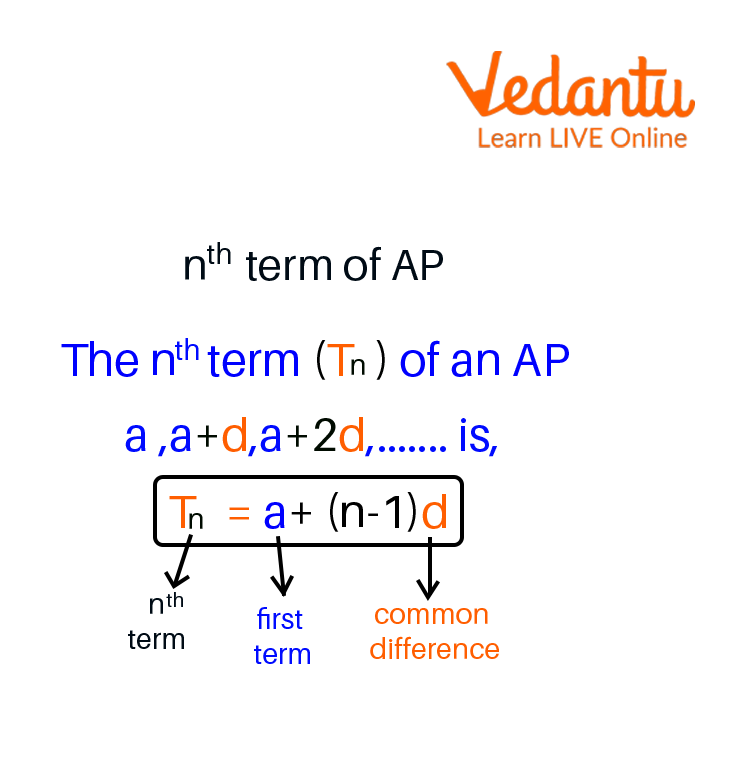
$n^{th}$ term of AP
General term of AP:
Formula for the nth term of the A.P. with first term ‘a’ and common difference ‘d’ is ${{a}_{n}}=\text{ }a\text{ }+\text{ }\left( n-1 \right)\text{ }d. n^{th}$ term (${{a}_{n}}$) is also termed as the general term of the AP.
As a result , the General Term of an $a_{n}=a+(n-1)d$. If there are ‘\[n\]’ terms in the AP, then \[{{a}_{n}}\] symbolizes the last term which is sometimes also indicated by ‘\[l\]’.
Sum of n Terms in an A.P:
A Math lesson for grade \[10\] was held in Germany in the nineteenth century. The teacher instructed her students to add all of the numbers from \[1to100\]. The students were having difficulty calculating the sum of all these numbers. While the other pupils were still calculating the amount, one youngster screamed out the answer \[5050\]. Carl Friedrich Gauss, the brilliant German mathematician, was this youngster. How did he come up with the figure so quickly?
He noticed that terms equidistant from the start and end of the series had a constant sum of \[101\].
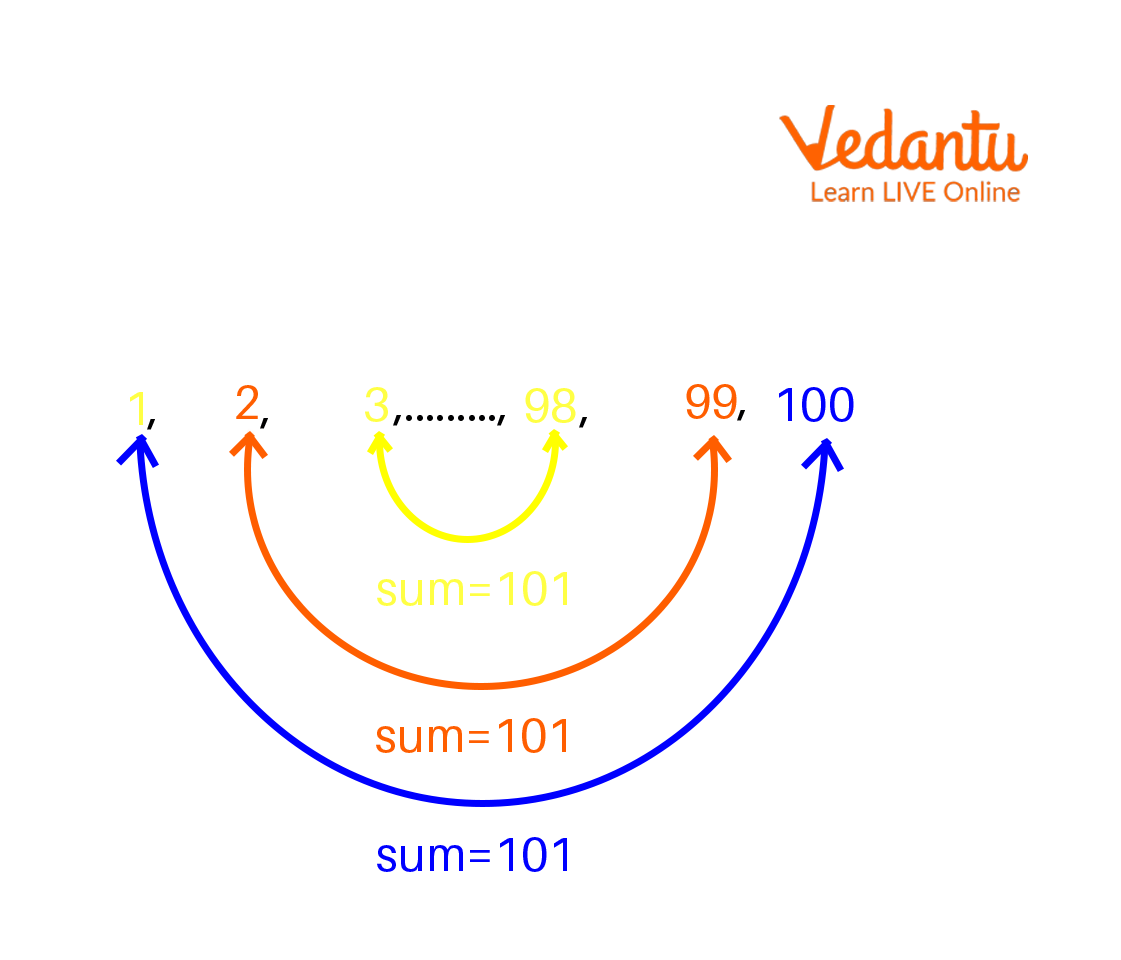
Constant Sum of the series
We can recognize that there are \[50\]such pairs whose sum is \[101\] in the series \[1,\text{ }2,\text{ }3,...,\text{ }100.\] As a result, the sum of all terms in this series is \[50\times 101\] =\[5050\].
Sum of n Terms of AP Formula:
The sum of n terms of an AP can be simply calculated using a simple formula that states that if the first term of the AP is a and the common difference is d, the formula for the sum of n terms of the AP is
\[{{S}_{n}}=\text{ }\dfrac{n}{2}\left[ 2a\text{ }+\text{ }\left( n-1 \right)d \right]\]
Example: Calculate the sum of the first 20 terms of the following AP: $S=190+167+144+121+...$
Solution: Using the sum of n terms of an AP formula,
\[{{S}_{n}}=\text{ }\dfrac{n}{2}\left[ 2a\text{ }+\text{ }\left( n-1 \right)d \right]\]
Here, we have \[a\text{ }=\text{ }190,\text{ }d\text{ }=\text{ }-23,\text{ }and\text{ }n\text{ }=\text{ }20\]. Putting all these values in the above formula,
$S=\dfrac{20}{2}(2(190)+(20-1)(-23))$
$=10(380-437)$
$10(-57)$
$-570$
As a result, the sum of the first 20 terms of the given AP is -570.
How to Find the nth Term in AP?
Procedure for determining the nth term:
Step 1: First, find the first and second terms, $a_{1}$ and $a_{2}$
Step 2: Next, calculate the common difference between them, which is $[d=a_{2}-a_{1}]$.
Step 3: Now, by adding the difference d to the second term, we get the third term, and so on. That is the second term, $a_2=a_1+d$ ($a_1$ is first term)
$a_3=a_2+d=\left( a_1+d \right)+d=a_1+2d$ is the third term.
$a_4=a_3+d=\left( a_1+2d \right)+d=a_1+3d$ is the fourth term.
As a result, the coefficient of d is one less than the number of words. That is to say,
The coefficient of d in $a_2$ is 1 $\left[ \left( 2-1 \right)=1 \right]$.
The coefficient of d in $a_3$ is 2, $\left[ \left( 3-1 \right)=2 \right]$.
The coefficient of d in $a_4$ is 3, $\left[ \left( 4-1 \right)=3 \right]$.
Likewise, the number of d for the $N^{th}$ term should be $\left( N-1 \right)$ times.
As a result, $a = a_1 + \left( N-1 \right)d \left[ \text{First term}+ \left( \text{Last term}-1 \right)\text{common difference} \right]$.
Example : Determine the 9th term of the following series: \[1,\text{ }4,\text{ }7,\text{ }10,\text{ }13,\text{ }16,....\]
Solution:
Here,first term,$a_1 = 1$, second term, $a_2 = 4$, third term, $a_3 = 7$, forth term, $a_4=10$.
$d=a_2 - a_1 = 4 - 1=3$ is the common difference.
Check if d is true or not.
$a_1+ d = 1+3 =4 =a_2$
$a_2+d = 4+3=7=a_3$
$a_3+d=7+3=10=a_4$
$a_4+d=10+3=13=a_5$
$a_5+d=13+3 =16=a_6 $
So the common difference is right here.
Now the $9^{th}$ term,
$a_9=a_1+\left( N-1 \right)d$
$=1+\left( 9-1 \right) \times 3$
$ =1+8 \times 3$
$=1+24$
$=25$
As a result, the $9^{th}$ term is 25.
How Do You Determine the Number of Terms in an Arithmetic Sequence?
Calculating the number of terms in an arithmetic sequence may appear to be a difficult problem, but it is quite simple. Simply enter the above numbers into the formula \[{{t}_{n}}=\text{ }a\text{ }+\text{ }\left( n\text{ }-\text{ }1 \right)\]d and solve for n, the number of terms. It's worth noting that tn is the last number in the sequence, a is the first term, and d is a common difference.
Tips: The common difference will always divide the difference between the last and first terms.
Solved Questions:
Q.1: An AP's third term is 5 and its seventh term is 9. Determine the arithmetic progression (AP).
Solution: As a result, the third term of AP = 5.
AP's seventh term = 9
$\left( i.e \right) a_3 = a+\left( 3-1 \right)~ $
$d = a+2d = 5 \ldots \left( 1 \right)~ $
$a_7 =a+\left( 7-1 \right)~ $
$d= a+6d = 9 \ldots \left( 2 \right)~ $
When we solve equations $\left( 1 \right)$ and $\left( 2 \right)$, we get
a=3 and d = 1.
As a result, the first term is 3, and the common difference is 1.
The arithmetic progression $\left( AP \right)$ is thus $3, 4, 5, 6, 7, 8, 9,...$
Q.2: Given \[a\text{ }=\text{ }5,\text{ }d\text{ }=\text{ }3,\text{ }and\text{ }{{a}_{n}}~=\text{ }50\], find the value of \[{{S}_{n}}\].
Solution: The given values are $a =5=a_{1}, d=3$, and ${{a}_{n}}=50$.
We know that the $n^{th}$ term of AP is given by the formula ${{a}_{n}}=a+\left( n-1 \right)d$.
$\Rightarrow 50=5+\left( n-1 \right)3 $
$50=5+3n-3$
$50=3n+2$
$48=3n$
$16=n$
By using the sum of AP formula,
${{S}_{n}}~=\dfrac{n}{2}\left( {{a}_{1}}+{{a}_{n}} \right)$
${{S}_{n}}~=\dfrac{16}{2}\left( 5+50 \right)$
${{S}_{n}}~=8\left( 55 \right)$
${{S}_{n}}~=440 $
Thus, the value of $S_{n}$ is 440.
Q.3 Find the value of m if the total of an A.P.'s “n” terms is $3n^{2}+5n$ and its $m^{th}$ term is 164.
Solution: Let $S_n$ denote the sum of n terms and $a_n$ be the $n^{th}$ term of the given AP. Then,
$S_{n}=3n^{2}+5n$
$S_{n-1}=3(n-1)^{2}+5(n-1)=3n^{2}-n-2$
Now,$a_{n}=S_{n}-S_{n-1}$
$a_{n}=3n^{2}+5n-3n^{2}+n+2$
$a_{n}=6n+2$
Now, $a_m=164$
$6m+2=164$
$6m=162$
$m=27$
Related Articles:
Conclusion:
The common difference does not always have to be positive.
An AP's common difference is the difference between any term and its prior term, in this order.
The first term of AP can be calculated using the formula a = \[T_{n}\text{ }-\text{ }\left( n\text{ }-\text{ }1 \right)d.\]
FAQs on Nth Term Of An Arithmetic Progression Explained
1. What is the nth term of an AP?
The nth term of an AP (Arithmetic Progression) is the formula used to find any term in the sequence without listing all previous terms. The formula is aₙ = a + (n − 1)d, where:
- a = first term
- d = common difference
- n = term number
2. What is the formula for the nth term of an arithmetic progression?
The formula for the nth term of an arithmetic progression is aₙ = a + (n − 1)d. Here:
- a is the first term
- d is the common difference (difference between consecutive terms)
- n is the position of the term
3. How do you find the nth term of an AP step by step?
To find the nth term of an AP, use the formula aₙ = a + (n − 1)d and substitute the given values. Follow these steps:
- Step 1: Identify the first term (a).
- Step 2: Find the common difference (d).
- Step 3: Substitute the value of n.
- Step 4: Simplify to get the final answer.
4. How do you find the common difference in an AP?
The common difference (d) in an AP is found by subtracting a term from the next term. The formula is d = a₂ − a₁. For example, in 7, 10, 13, 16:
- d = 10 − 7 = 3
5. Can you give an example of finding the nth term of an AP?
Yes, the nth term can be found using aₙ = a + (n − 1)d. Example: Find the 10th term of 3, 7, 11, 15...
- a = 3
- d = 4
- n = 10
6. How do you find the nth term when the first term and last term are given?
If the first term, last term, and number of terms are given, first find the common difference using d = (l − a)/(n − 1). Then use aₙ = a + (n − 1)d. Here:
- a = first term
- l = last term
- n = total number of terms
7. What is the difference between the nth term and the sum of n terms in an AP?
The nth term gives a specific term in the sequence, while the sum of n terms (Sₙ) gives the total of the first n terms. Formulas:
- aₙ = a + (n − 1)d
- Sₙ = n/2 [2a + (n − 1)d]
8. How do you find n if the nth term of an AP is given?
To find n, substitute the given term into aₙ = a + (n − 1)d and solve for n. Example: If the 25th term of 4, 7, 10... is asked:
- a = 4
- d = 3
- aₙ = 25
9. Can the nth term of an AP be negative?
Yes, the nth term of an AP can be negative if the common difference is negative or large enough to reduce the term value. Example: In 10, 7, 4, 1, −2... the 5th term is −2. A negative common difference makes the arithmetic progression decreasing.
10. Why is the nth term formula important in arithmetic progression?
The nth term formula is important because it allows you to find any term directly without writing the entire sequence. It helps in:
- Solving algebraic and board exam problems
- Finding unknown terms quickly
- Modeling real-life patterns like savings or seating arrangements
