









How To Find The Incircle Of A Triangle Formula And Steps
A triangle in geometry is a three-sided polygon with three edges and three vertices. The fact that a triangle's interior angles add up to 180 degrees is its most crucial characteristic. This characteristic is known as the triangle's angle sum property. If ABC is a triangle, it is written as ABC, where A, B, and C represent the triangle's vertices.
In Euclidean geometry, a triangle is a two-dimensional shape that is represented by three non-collinear points in a single plane. A triangle is a form of a polygon with three sides; the intersection of the two longest sides is known as the triangle's vertex.
Have a look at Incircle of a Triangle
The greatest circle that may fit within a triangle in geometry is known as the incircle or inscribed circle, which touches (or is tangent to) all three sides of the triangle. The triangle's incenter, also known as the triangle's centre, sits at the centre of the incircle. The intersection of the three internal angle bisectors, or the incenter, marks the location of the incircle's centre.
Properties of Incentre
There are several characteristics of a triangle's incenter; let's examine the image below and list each one one by one.
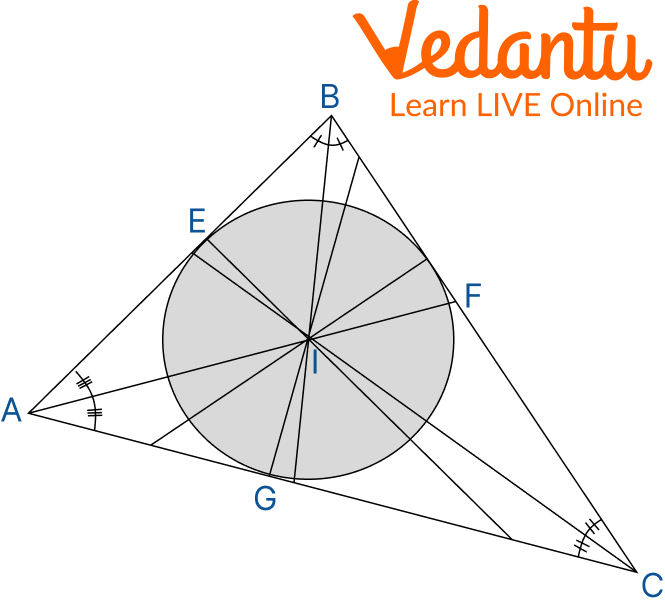
Incentre
Property 1: Line segments AE and AG, CG and CF, BF and BE are equal in length if I is the triangle's incenter.
Proof: As triangles, AEI and AGI are congruent triangles according to the rule of congruence.
Here AI = AI is common
The radius of the circle is IE = IGAnd $90^{\circ}$ angles are $\angle A E I=\angle A G I=90^{\circ}$
Thus, $\Delta AEI\cong \Delta AGI$
So, By CPCT we have AE = AG similarly which implies CG = CF AND BF = BE
Property 2: $\angle \text{BAl}=\angle \text{CAl},\angle \text{ABI}=\angle \text{CBI, }\angle \text{BCl}=\angle \text{ACl}$ if I is the triangle’s incentre.
Proof: According to the rule of congruence by RHS we have AEI and AGI congruent triangles.
Thus, by CPCT, angle BAI is equal to angle CAI.
Property 3: The triangle's sides are tangents to the circle and are referred to as the circle's inradii. Here, OE = OF = OG = r are the inradii.
Property 4: We have $s=\dfrac{a+b+c}{2}$ where ‘s’ is semi perimeter, ‘r’ is inradius then area is A = sr
Property 5: A triangle's incenter, as opposed to an orthocenter, always resides within the triangle.
Incircle of Triangle Formula
Here let E, F, and G be the angle bisectors of C, A, and B which cross the sides AB, AC, and BC respectively.
Now, use the angle sum property for calculating the incentre of a triangle angle.
Thus, we have $\angle AIB=180{}^\circ -\left( \dfrac{\angle A+\angle B}{2} \right)$ where ‘I’ is the incentive.
If we want to calculate it by using three coordinates. Coordinates are
$A{{(x)}_{1}},{{(y)}_{1}},B{{(x)}_{2}},{{(y)}_{2}},C{{(x)}_{3}},{{(y)}_{3}}$ for sides a, b, c.
Thus, incentre formula be $\left( \dfrac{a{{x}_{1}}+b{{x}_{2}}+c{{x}_{3}}}{a+b+c},\dfrac{a{{y}_{1}}+b{{y}_{2}}+c{{y}_{3}}}{a+b+c} \right)$
Solved Examples
Q 1. ‘I’ be the incentre of the triangle in ABC triangle, find the value of ‘x’
Ans. Given that ‘I’ is the incenter.
According to the figure, we have AI, BI, and CI as angle bisectors.
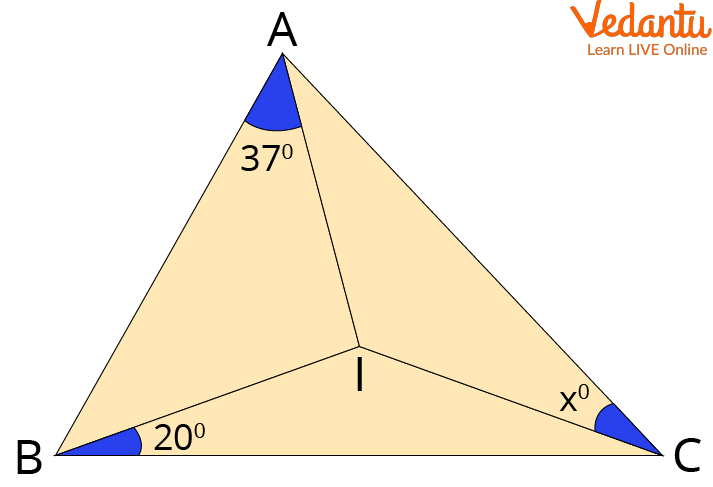
Triangle Showing Incentre
$\angle \text{BAl}+\angle \text{CBI}+\angle \text{ACl }=\dfrac{{{180}^{{}^\circ }}}{2}$
${{37}^{{}^\circ }}+{{20}^{{}^\circ }}+{{x}^{{}^\circ }}={{90}^{{}^\circ }}$
${{57}^{{}^\circ }}+{{x}^{{}^\circ }}={{90}^{{}^\circ }}$
${{x}^{{}^\circ }}={{90}^{{}^\circ }}-{{57}^{{}^\circ }}$
${{x}^{{}^\circ }}={{33}^{{}^\circ }}$
Q 2. Sandeep determined that a triangular sheet has a surface area of 50 feet square. The sheet has a 10-foot radius. Please assist Ram with determining the triangle's semiperimeter if a circle is drawn inside the triangle, touching each side.
Ans. We have given that the area is 50 feet square and the radius is 10 feet.
Area = semiperimeter which is multiplied by the inradius of the triangle.
$50=s\times 10$
$s=\dfrac{50}{10}$
$s=5$
Practice Problems
Q 1. The triangle ABC constructed by the points A(3, 1), B(0, 3), and C(-3, 1) has the following coordinates for its incenter: (p, q). Find (p, q).
Ans: Coordinates = $\left( 0,\dfrac{2\sqrt{13}+18}{6+2\sqrt{13}} \right)$
Q 2. ‘I’ be the incentre of the triangle in PQR triangle, solve for the value of ‘x’ where $P=40{}^\circ , Q=20{}^\circ$
Ans: $x{}^\circ =30{}^\circ$
Q 3. Whichever of the following is true for the triangle's incenter.
The place where the triangle's perpendicular bisectors intersect is known as the incenter.
One of a triangle's sides may be where the triangle's incenter is located.
A triangle's incenter is located at equal distances from its vertices.
None of the above
Ans: Option D i.e. none of the above
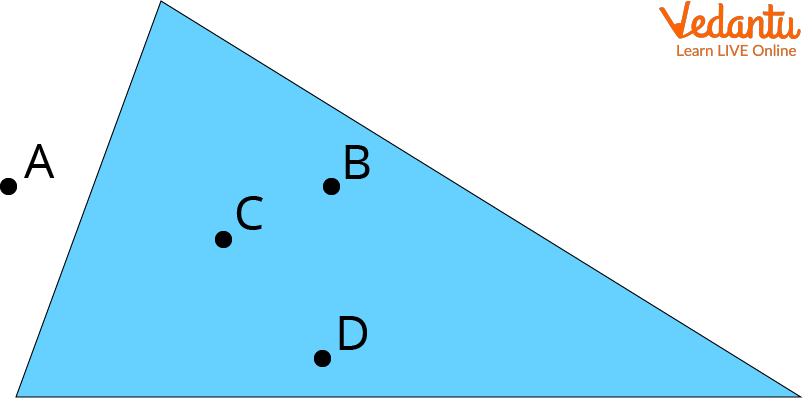
Q 4. What is the incentre in the given figure
Incentre
Ans: Here, ‘C’ is the incentre in the above figure.
Summary
This article summarizes that a triangle in geometry is a three-sided closed polygon with three edges and three vertices and the greatest circle that may fit within a triangle in geometry is known as the incircle or inscribed circle, which touches (or is tangent to) all three sides of the triangle. The incenter of a triangle is defined as the point at which all three interior angle bisectors intersect. The properties of the Incenter and some solved examples on incenter are also discussed in this article which helps you to get a better understanding of the concept of Incircle.


FAQs on Incircle Of A Triangle Explained With Inradius And Properties
1. What is the incircle of a triangle?
The incircle of a triangle is the circle drawn inside a triangle that touches all three sides at exactly one point each. It is also called the inscribed circle.
- The center of the incircle is called the incenter.
- The incenter is the point where the three angle bisectors meet.
- The radius of the incircle is called the inradius.
2. How do you find the incenter of a triangle?
The incenter of a triangle is found by intersecting the three angle bisectors.
- Step 1: Draw the angle bisector of any two angles of the triangle.
- Step 2: Mark their intersection point.
- Step 3: This intersection point is the incenter.
3. What is the formula for the radius of the incircle?
The radius of the incircle (inradius) is given by the formula r = A / s, where A is the area of the triangle and s is the semi-perimeter.
- A = Area of the triangle
- s = (a + b + c) / 2
- a, b, c are the side lengths
4. How do you calculate the incircle radius with an example?
The incircle radius is calculated using r = A / s.
- Suppose a triangle has sides 3 cm, 4 cm, and 5 cm.
- Semi-perimeter: s = (3 + 4 + 5)/2 = 6
- Area (right triangle): A = (1/2) × 3 × 4 = 6
- Inradius: r = 6 / 6 = 1 cm
5. Why does the incircle touch all three sides of a triangle?
The incircle touches all three sides because its center (the incenter) is equidistant from each side of the triangle.
- The incenter lies on all three angle bisectors.
- Any point on an angle bisector is equidistant from the sides of that angle.
- This equal distance becomes the radius of the incircle.
6. What is the difference between incircle and circumcircle?
The incircle is inside the triangle touching all sides, while the circumcircle passes through all three vertices.
- Incircle center: Incenter (intersection of angle bisectors)
- Circumcircle center: Circumcenter (intersection of perpendicular bisectors)
- Incircle radius: r = A/s
- Circumcircle radius: R = abc / 4A
7. Does every triangle have an incircle?
Yes, every triangle has exactly one incircle.
- The three angle bisectors of any triangle always intersect at one point.
- This intersection point forms the incenter.
- A circle drawn with this center and perpendicular distance to a side as radius will touch all three sides.
8. How is the area of a triangle related to its incircle?
The area of a triangle can be expressed using the incircle as A = r × s, where r is the inradius and s is the semi-perimeter.
- r = inradius
- s = (a + b + c)/2
9. What are the properties of the incircle of a triangle?
The incircle has several important geometric properties.
- Its center is the incenter.
- The incenter lies inside the triangle.
- The incircle is tangent to all three sides.
- The incenter is equidistant from each side.
- The radius is calculated using r = A/s.
10. How do you construct the incircle of a triangle step by step?
The incircle is constructed by locating the incenter and drawing a perpendicular radius to a side.
- Step 1: Draw a triangle.
- Step 2: Construct the angle bisectors of any two angles.
- Step 3: Mark their intersection point (incenter).
- Step 4: Draw a perpendicular from the incenter to any side to get the radius.
- Step 5: With this radius, draw a circle centered at the incenter.
