









How to Find HCF Using Long Division Method with Steps and Solved Examples
As we all know, the Highest Common Factor (HCF) as the name itself says, it's the method of finding the highest common factors of two or more than two numbers. It's the highest common number that can divide the given two or more two positive numbers equally.
There are different methods through which we can find out the HCF of given numbers. Of Course, it can be used to find the HCF of small numbers but when it comes to large numbers, then the most suitable method is the Long Division Method. Come on, let us understand HCF by the long division method step by step with a few examples along the way.
What is H.C.F?
HCF stands for Highest Common Factor. HCF of 2 numbers is the highest factor that can divide the two numbers easily. The highest common factor (HCF) can be evaluated for 2 or more than 2 numbers. It is the greatest divisor for any two or more numbers that can equally or completely divide the given numbers.
For Example, the HCF of 60 and 75 is 15 because 15 is the largest number which can divide both 60 and 75 exactly.
Methods for Finding H.C.F
HCF of two or more number can be found by using two methods:
By prime factorization method
By division method
We will discuss the division method in this article.
Steps of HCF by Long Division Method
Step 1: Divide the larger number by the smaller number.
HCF of 18 and 30
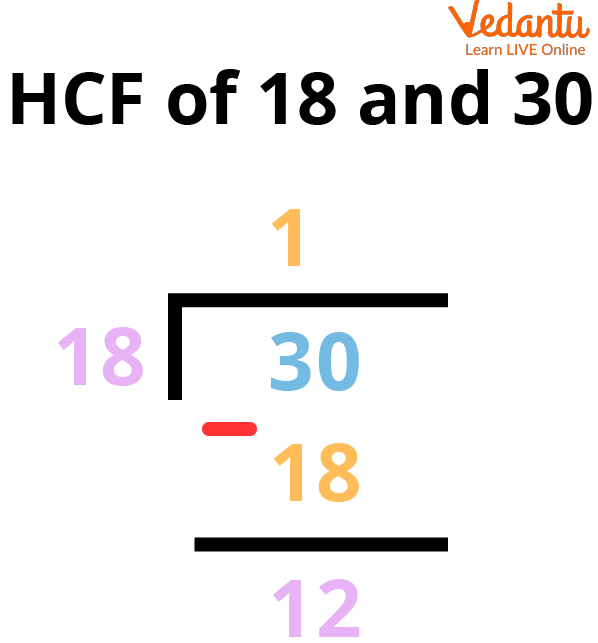
The Long Division Method
Step 2: The remainder becomes the divisor and the divisor becomes the dividend. Therefore, divide the first divisor by the first remainder.
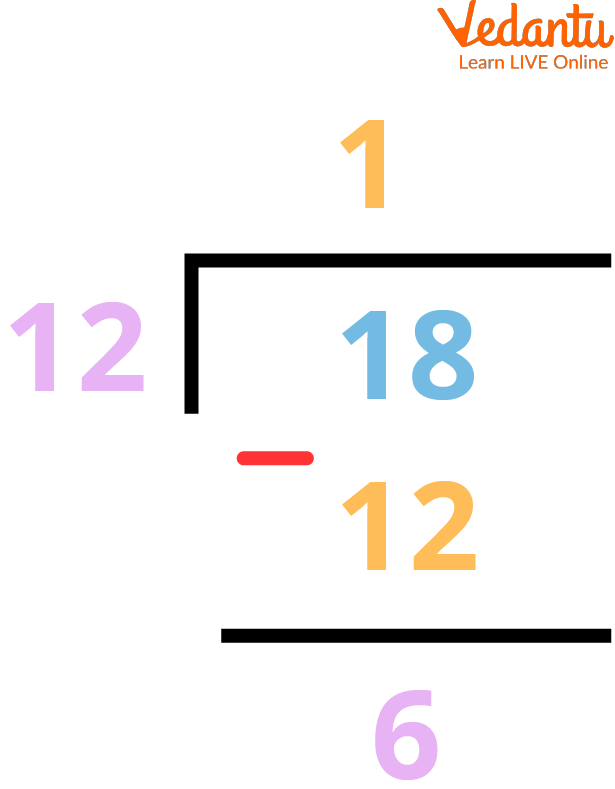
The Long Division Method
Step 3: If the remainder is not 0, then again the remainder becomes the divisor and the divisor becomes the dividend. Therefore, divide the second divisor by the second remainder.
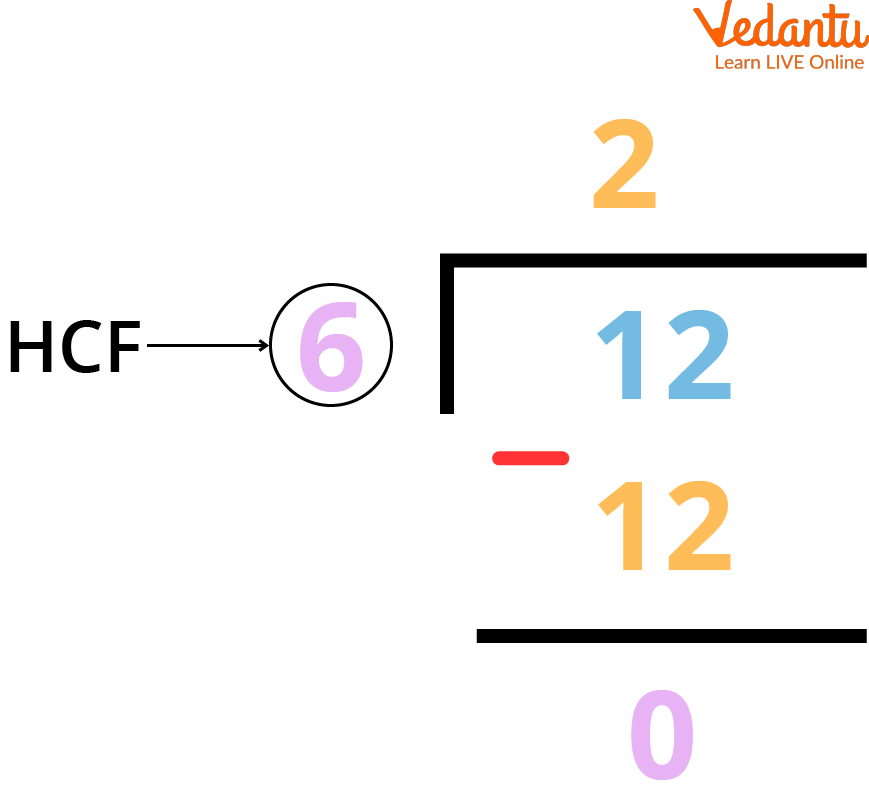
The Long Division Method
Step 4: The divisor which does not leave a remainder is the HCF of the two numbers and thus, the last divisor becomes the HCF of the given two numbers.
Let us try to understand the long division method to find the HCF of given numbers with examples.
Solved Examples
Example 1:Find the HCF of 64 and 144 using the long division method
Step 1: Dividing the larger given number with the smaller given number. So, 144 becomes the dividend and 64 as the divisor.

Long Division Method
Step 2: The remainder becomes the divisor and the divisor becomes the dividend.
Step 3: Therefore, we need to divide 64 (dividend) by 16 (divisor).
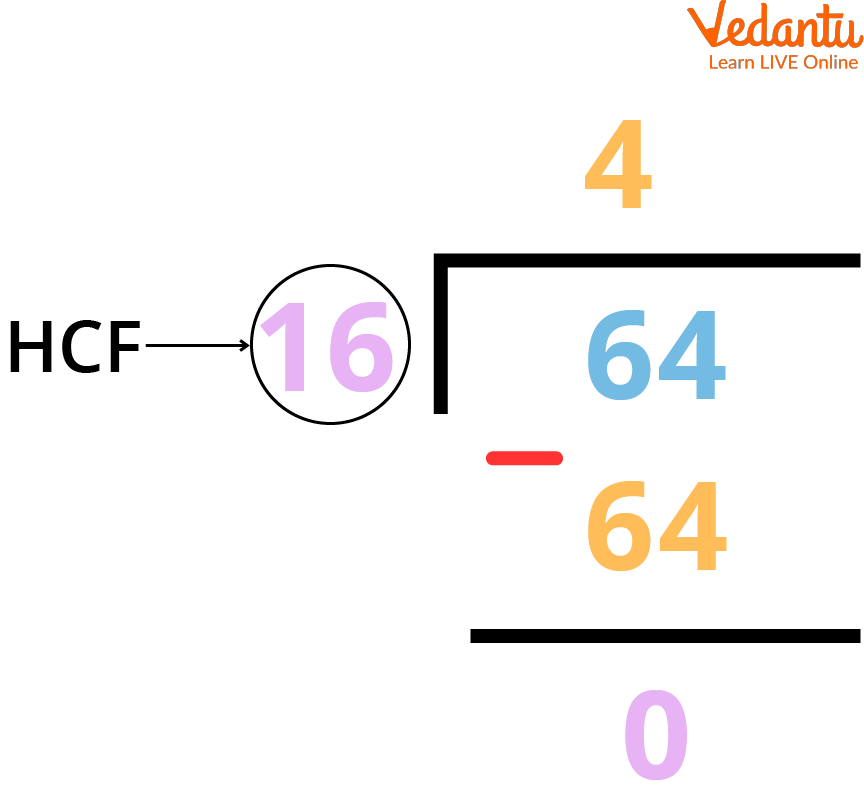
Long Division Method
Once the remainder becomes 0, the divisor of that particular division becomes the HCF.
Therefore, HCF of (64, 144) = 16
Example 2: Find the HCF of 700 and 300 using the long division method.
Step 1: Simply divide the larger given number by the smaller given number. In this case, 300 is the divisor and 700 is the dividend.
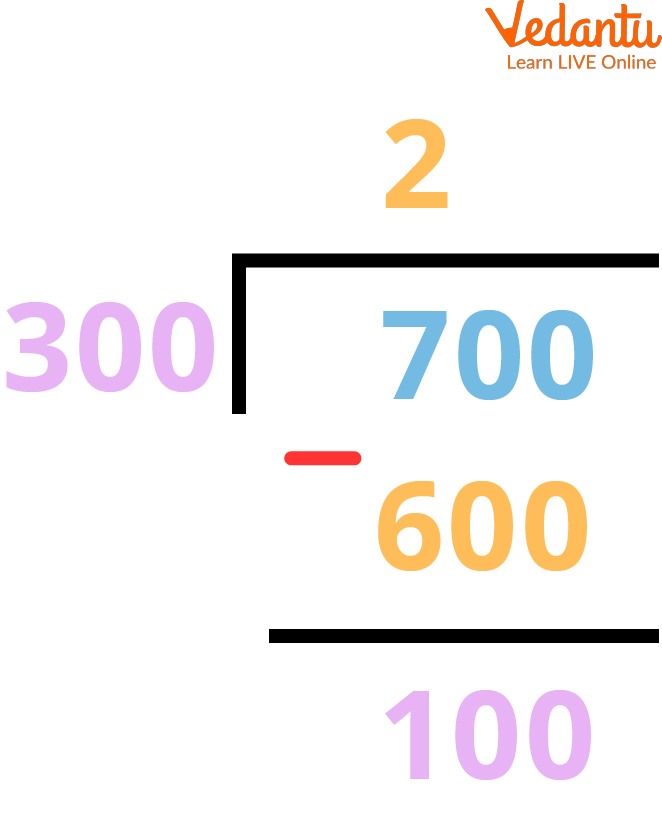
Long Division Method
Step 2: The remainder that we got is 100 therefore the remainder that is 100 becomes the divisor and 300 which was the divisor earlier becomes the dividend.

Long Division Method
Step 3: Now, we simply divide the second divisor with the second remainder. Follow the image down below for a better understanding.
=> HCF of 700 and 300 is 100
Practice questions
1. Find the HCF of 30 and 45
Ans: 15
2. Find the HCF of 162 and 180
Ans: 18
3. Find the HCF of 270 and 9
Ans: 9
4. Find the HCF of 78 and 98
Ans: 2
5. Find the HCF of 702 and 405
Ans: 27
Summary
This article has tried to explain the detailed steps of how to find HCF by using the long Division method for 2 positive given numbers. To find the HCF by division method, the first step is to divide the larger number by the smaller number and then the remainder becomes the divisor and divide the smaller number until the remainder is zero. In this article, you have learn about all other different topics related to HCF.
FAQs on HCF by Long Division Method Explained Simply
1. What is HCF by long division method?
The HCF by long division method is a technique used to find the Highest Common Factor (HCF) of two numbers by repeatedly dividing the larger number by the smaller number until the remainder becomes zero. The last non-zero remainder is the HCF.
- Divide the larger number by the smaller number.
- Replace the larger number with the smaller number and the smaller number with the remainder.
- Repeat the process until the remainder is 0.
- The last non-zero remainder is the HCF.
2. How do you find HCF using the long division method step by step?
To find the HCF using the long division method, divide repeatedly until the remainder becomes zero. Example: Find the HCF of 48 and 18.
- 48 ÷ 18 = 2 remainder 12
- 18 ÷ 12 = 1 remainder 6
- 12 ÷ 6 = 2 remainder 0
3. Why does the long division method work for finding HCF?
The long division method works because the HCF of two numbers also divides their remainder. When we divide a number, the common factors remain unchanged in the remainder. By repeatedly replacing the larger number with the remainder, we reduce the numbers step by step until only the greatest common factor remains. This principle is based on the Euclidean algorithm.
4. Can you give an example of HCF by long division method?
Yes, here is an example of finding HCF by the long division method. Find the HCF of 56 and 98.
- 98 ÷ 56 = 1 remainder 42
- 56 ÷ 42 = 1 remainder 14
- 42 ÷ 14 = 3 remainder 0
5. What is the difference between HCF by long division and prime factorization?
The difference is that the long division method uses repeated division, while prime factorization breaks numbers into prime factors.
- Long division method: Divide numbers step by step until remainder is zero.
- Prime factorization: Express each number as a product of primes and multiply common prime factors.
- Long division is faster for large numbers.
- Prime factorization is useful for smaller numbers and understanding factors.
6. How do you find the HCF of three numbers using long division method?
To find the HCF of three numbers using long division, first find the HCF of any two numbers, then find the HCF of the result with the third number. Example: Find HCF of 24, 36, and 60.
- HCF of 24 and 36 = 12
- Now find HCF of 12 and 60
- 60 ÷ 12 = 5 remainder 0
7. What happens if the remainder is 0 in the first division while finding HCF?
If the remainder is 0 in the first division, the smaller number itself is the HCF. For example, to find the HCF of 20 and 5:
- 20 ÷ 5 = 4 remainder 0
8. Is the long division method the same as the Euclidean algorithm?
Yes, the long division method for HCF is based on the Euclidean algorithm. Both methods use repeated division and replace the larger number with the remainder until it becomes zero. The last non-zero remainder is the Highest Common Factor.
9. What are the common mistakes while finding HCF by long division?
Common mistakes in the HCF by long division method usually involve incorrect division or stopping too early.
- Not dividing correctly and getting the wrong remainder.
- Stopping before the remainder becomes zero.
- Confusing HCF with LCM.
- Not arranging numbers correctly (larger ÷ smaller).
10. How is HCF by long division method used in real life?
The HCF by long division method is used in real life to divide quantities into equal groups with no remainder. For example:
- Cutting ribbons of 48 cm and 18 cm into equal maximum-length pieces.
- Arranging objects in rows and columns equally.
- Simplifying fractions to lowest terms.
