









Customary Units Chart Conversions and Solved Examples
Our life Without the Units of Measurement!
How do we express the measurement of time, weight, length and temperature? There is a specific unit of measurement for each. Imagine what would the scenario be if there was no definite system of measurement.
Inappropriate Answers Without Customary Units

Life without customary units
“What time of the day it is?”
- “The sun is over our head”
“How much is the weight of the trunk?”
- “The trunk is heavier than you”
“What is the temperature today?’
- “The temperature is hotter than yesterday”
You see, we cannot exactly or specifically express time, weight, length or temperature. This happens as there are no defined measurement units.
The Solution?
Thus, the English system of measurement introduced customary units, which are also known as the U.S Customary System.
History of Customary Units - Learn More About Customary Units of Length, Weight, Capacity and Temperature
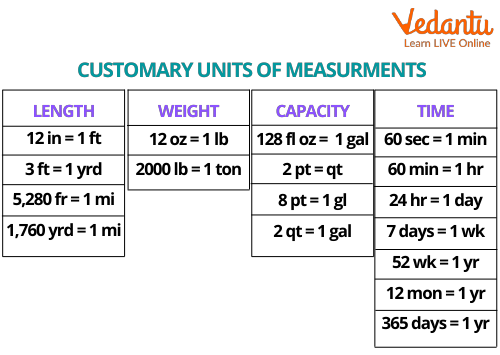
Chart of customary units of measurement
In the year 1832, the U.S started its customary units after developing the idea from the English Units. The usage of the customary units made the life of the people very easy, especially in trades.
When the world witnessed its advantages, other nations slowly started to adopt these customary units. We are going to learn about these customary units. Customary units on length, weight, capacity, and temperature will be discussed by us. Keep reading to gain more knowledge about the customary units.
Study the Customary Units of Length
The customary units which are used for the measurement of length and distances in the customary system are as follows:
Inches
Feet
Yards
You can convert the different units of length into other units as well. The table below shows the conversion:
We will represent an example to show the same:
Converting 9 foot to inches.
We know 1 foot = 12 inches. Thus, 9 foot = 12 ×9 = 108 inches
Study About the Customary Units of Weight
The U.S. designed its customary units for measuring weights, which include ounces, pounds, and tons. Given below is the conversion of pounds to ounces and tons to pounds. Let us check!
Let us take an example to make our understanding clear.
Example: Calculate the ounces in 1 ton.
There is - 1 ton = 2000 pounds
1 pound = 16 ounces
So, 2000 pounds = 2000 × 16 = 32000 ounces. This means 1 ton = 32000 ounces.
Study About the Customary Units of Capacity (Volume)
The U.S. customary capacity or the volume measurement units are ounces, cups, pints, quarts and gallons. We can convert the customary units into customary equivalents as well and then into standard metric equivalents. Let us check how.
Let us take an example:
Converting 6 quarts to cups.
We know 1 quart = 2 pints
So, 6 quarts = 12 pints
then, 1 pint = 2 cups
So, 12 pints = 12 × 2 = 24 cups
Study About the Customary Units of Temperature
The customary measurement unit of temperature is °Fahrenheit. It should be known that 1 °C = 33.8 °F.
As we come to the end of the discussion of customary units, the students are advised to revise and understand the different types of units which are present and which are to be utilised in which specific units. Further, parents must make the study for their kids interesting; they can look up real life examples and show which units have which type of customary units.
FAQs on Customary Units in US Measurement System
1. What are customary units in math?
Customary units are the standard measurement units used mainly in the United States for measuring length, weight, capacity, and time. The U.S. customary system includes units such as inches, feet, yards, miles, ounces, pounds, cups, pints, quarts, and gallons. These units are commonly used in everyday life, such as measuring height in feet or liquid in gallons. Unlike the metric system, customary units do not follow a base-10 pattern.
2. What are the main customary units of length?
The main customary units of length are inch, foot, yard, and mile. Common conversions include:
- 12 inches = 1 foot
- 3 feet = 1 yard
- 5,280 feet = 1 mile
These units are used to measure height, distance, and length in everyday measurements.
3. What are the customary units of weight?
The customary units of weight are ounce, pound, and ton. Key conversions include:
- 16 ounces = 1 pound
- 2,000 pounds = 1 ton
These units are commonly used to measure body weight, groceries, and heavy objects in the United States.
4. What are the customary units of capacity?
The customary units of capacity measure liquid volume and include cup, pint, quart, and gallon. Important conversions are:
- 2 cups = 1 pint
- 2 pints = 1 quart
- 4 quarts = 1 gallon
These units are often used in cooking, baking, and measuring liquids.
5. How do you convert between customary units?
To convert between customary units, multiply or divide using the known conversion factor. Follow these steps:
- Identify the conversion fact (for example, 12 inches = 1 foot).
- Multiply when converting to a smaller unit.
- Divide when converting to a larger unit.
Example: Convert 3 feet to inches → 3 × 12 = 36 inches.
6. What is the difference between customary units and metric units?
The main difference is that customary units are based on varied conversion factors, while metric units are based on powers of 10. In the metric system, conversions are simple (1 meter = 100 centimeters). In the customary system, conversions vary (12 inches = 1 foot, 3 feet = 1 yard). The metric system is used worldwide, while customary units are mainly used in the United States.
7. How many cups are in a gallon?
There are 16 cups in 1 gallon. This is found by multiplying the capacity conversions:
- 2 cups = 1 pint
- 2 pints = 1 quart
- 4 quarts = 1 gallon
So, 2 × 2 × 4 = 16 cups in a gallon.
8. How many feet are in a mile?
There are 5,280 feet in 1 mile. This standard customary conversion is used to measure long distances such as road lengths and travel distances. Knowing this helps when converting miles to feet by multiplying the number of miles by 5,280.
9. Can you give an example of converting customary units?
Yes, for example, to convert 5 yards to feet, multiply by 3 because 1 yard = 3 feet. Calculation:
- 5 × 3 = 15 feet
So, 5 yards equals 15 feet. Always use the correct conversion factor when solving customary unit problems.
10. What are common mistakes when working with customary units?
A common mistake when working with customary units is using the wrong conversion factor or confusing units of length, weight, and capacity. Important tips:
- Memorize key facts like 12 inches = 1 foot and 16 ounces = 1 pound.
- Check whether you should multiply or divide.
- Do not mix customary units with metric units without converting properly.
Careful attention to conversion rules helps avoid calculation errors.
