









Focal Chord of a Parabola Definition Formula Properties and Solved Examples
A parabola is a U-shaped plane curve where any point is equally spaced from a set point (known as the focus) and from a fixed straight line (known as the directrix). The topic of conic sections includes a parabola, and its principles are discussed here. The shape of the banana is like a parabola. A parabola is emerging from the rainbow. Antennas with a parabolic dish are like a parabola. Mirror's concave surface.
In this article, we will learn about chords in parabolas and their properties, such as focal chords, the equation of the chord of a parabola, parabola focal length, the focal distance of parabola formula, the diameter of a parabola, etc.
Parametric Equation of Parabola
If the equation of the parabola is $y^{2}=4ax$, then the parametric Equation will be $x=at^{2},y=2at$ where t is the parameter. Any point on the parabola can be represented by the coordinates $(at^{2},2at)$.
Equation of Chord of Parabola
If we see the below diagram, we can assume the points P and Q as $(at^{2},2at)$ and $(at_{1}^{2},2at_{1})$ respectively. Now, we can calculate its equation using 2 point formula, i.e. $(2at-2at_{1})=m(at^{2}-at_{1}^{2})$ where m is the slope of the chord. $m=\dfrac{2at-2at_{1}}{at^{2}-at_{1}^{2}}=\dfrac{2}{t_{1}+t_{2}}$.
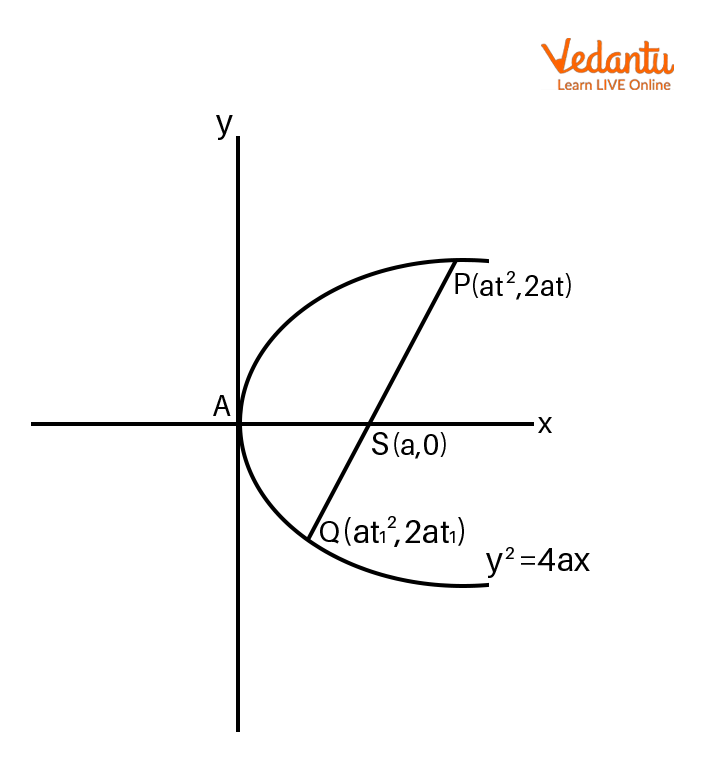
Equation of Chord of Parabola
Chord of Contact of Parabola
If the equation of the parabola is $y^{2}=4ax$ and tangents are drawn from point $P(x_{1},y_{1})$ outside the parabola then the equation of the chord of contact will be calculated using T=0 i.e $yy_{1}=4a(\dfrac{x+x_{1}}{2})$.
Focal Chord of Parabola
When a chord passes through the focus of a parabola then it is called a focal chord. As we can see in the above diagram the chord PQ is a focal chord and we know that the line PS and SQ have the same slope. So,
$\Rightarrow\dfrac{2at-0}{at^{2}-a} =\dfrac{0-2at_{1}}{a-at_{1}^{2}}$
$\Rightarrow\dfrac{2at}{a(t^{2}-1)} =\dfrac{2at_{1}}{a(t_{1}^{2}-1)}$
$\Rightarrow\dfrac{t}{t^{2}-1}=\dfrac{t_{1}^{2}}{t_{1}^{2}-1} $
$\Rightarrow t_{1}^{2}t-t=t^{2}t_{1}-t_{1}$
$\Rightarrow t_{1}(t_{1}t+1)=t(t_{1}t+1) $
$\Rightarrow t_{1}(t_{1}+1)-t(t_{1}t+1)=0 $
$\Rightarrow (t_{1}t+1)(t_{1}-t)=0 $
$Hence, tt_{1}=-1 or t_{1}=\dfrac{-1}{t}$
Focal Distance of Parabola
Focal distance is the length of a point on the parabola to the focus of that parabola. In the below-given figure, the focal distance is PS where P is a random point on that parabola and S is the focus. Now, we know that PS=PM and $PM=at^{2}+a=a(1+t^{2})$
$\Rightarrow PM=a(1+t^{2})$= Focal distance of parabola
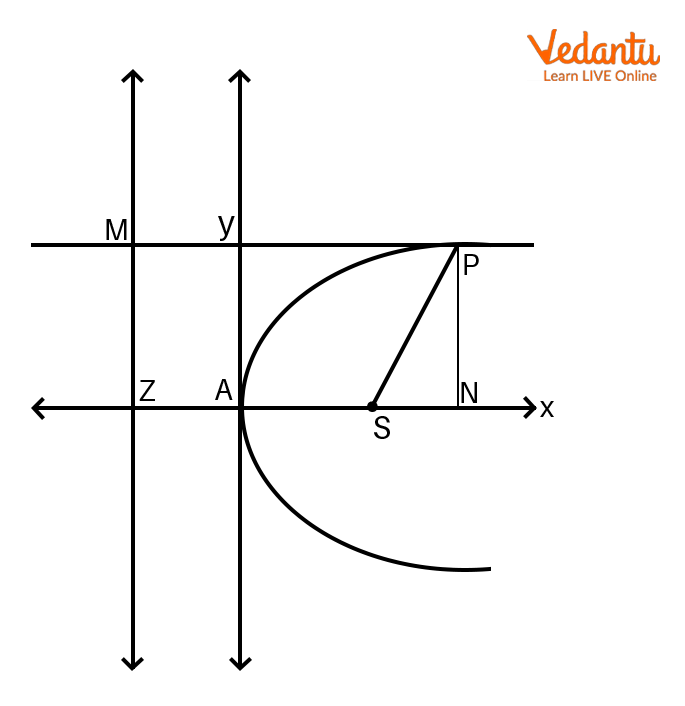
Focal Distance of Parabola
Length of Focal Chord of Parabola
Here, in the figure given below, the length of the focal chord will be PQ and it can be represented as $PS+SQ=a(1+t^{2})+a(1+t_{1}^{2})$
$\Rightarrow a(1+t^{2})+a(1+(\dfrac{-1}{t^{2}}))$ as $t_{1}=\dfrac{-1}{t}$
$\Rightarrow a(1+t^{2}) $
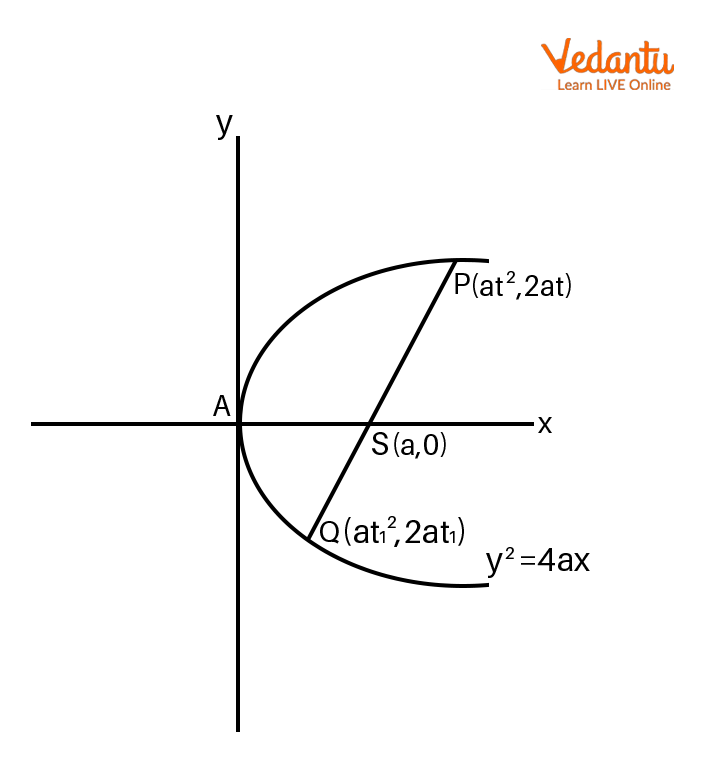
Equation of Chord of Parabola
How to Find the Focus of a Parabola?
If the equation of the parabola is $(x-h)^{2}=4a(y-k)$ then the focus of the parabola will be at $(h,k+a)$ and if the equation of the parabola is $(y-k)^{2}=4a(x-h)$ then the focus of parabola formulas is $(h+a,k)$.
Diameter of Parabola
The locus of the middle point of the chords of the parabola having the same slope is called the diameter of the parabola and the equation of diameter of a parabola if the equation of a parabola is $y^{2}=4ax$ is $y=\dfrac{2a}{m}$ where m is the slope of the parallel chords.
Solved Examples
Q1. Find the length of the focal chord to the parabola $y^{2}=5x$ drawn from (5.-5).
Solution: Given, $y^{2}=4ax$
$\Rightarrow y^{2}=4\times \dfrac{5}{4}\times x$
$\Rightarrow a=\dfrac{5}{4} $
We know that parametric coordinates are $(at^{2},2at)$. So, to calculate the value of t,
$2at=-5$
$\Rightarrow 2\left ( \dfrac{5}{4} \right ) t=-5$
$\Rightarrow t=-2$
So the length of the focal chord is $a(t+\dfrac{1}{t})^{2}$
$=\dfrac{5}{4}(-2+(\dfrac{-1}{2}))^{2}$
$=\dfrac{5}{4}(\dfrac{25}{4})=\dfrac{125}{16}$
Q2. Find the equation of the chord of contact from point (-5,6) to the parabola
$1)y^{2}=3x$
$2)x^{2}=-4y$
Solution: We need to use T=0 to find the chord of contact. So,
$y(6)=3(\dfrac{x-5}{2})$
$\Rightarrow 4y=x-5 $
2.$x(-5)=4(\dfrac{y+6}{2})$
$\Rightarrow -5x=2y+12$
Conclusion
The article summarizes the concept of chords and focal chords in parabolas. We understood the concepts of focal chords, the equation of the chord of parabola, parabola focal length, the focal distance of parabola formula, diameter of the parabola and learned their formulas.
Practice Questions
Q1. The length of the chord of the parabola $x^{2}=4y$ having equation $x-\sqrt{2}y+4\sqrt{2}=0$ is
Q2. If one end of a focal chord of the parabola, $y^{2}=16x$ is at (1,4) then the length of this focal chord is
Q3. Let $y=mx+c$, m>0 be the focal chord of $y^{2}=-64x$, which is tangent to $(x+10)^{2}+y^{2}=4$. Then the value of $4\sqrt{2}(m+c)$ is equal to
Answer:
1. $6\sqrt{3}$
2. 25
3. 34
List of Related Articles


FAQs on Chords in Parabola and Focal Chords Explained with Formulas
1. What is a chord in a parabola?
A chord of a parabola is a line segment that joins any two points on the parabola. In coordinate geometry, if two points satisfy the equation of the parabola (for example, y² = 4ax), then the line joining them forms a chord. If the chord passes through the focus, it is called a focal chord. Chords help in understanding properties like midpoint, slope, and length inside parabola geometry.
2. What is a focal chord of a parabola?
A focal chord is a chord of a parabola that passes through its focus. For the standard parabola y² = 4ax, the focus is (a, 0). Any chord drawn through this point is called a focal chord. Focal chords are important in coordinate geometry because they are used to derive special results such as the length of the latus rectum.
3. What is the length of the latus rectum of a parabola?
The length of the latus rectum of the parabola y² = 4ax is 4a. The latus rectum is a special focal chord perpendicular to the axis of symmetry. Its endpoints are (a, 2a) and (a, −2a). This result is frequently used in problems involving focal chords and properties of parabolas.
4. How do you find the equation of a chord of a parabola joining two given points?
The equation of a chord joining two points on a parabola can be found using the two-point form of a line. Steps:
- Verify both points satisfy the parabola equation (e.g., y² = 4ax).
- Use the slope formula m = (y₂ − y₁)/(x₂ − x₁).
- Substitute into point-slope form: y − y₁ = m(x − x₁).
5. What is the condition for a line to be a focal chord of y² = 4ax?
A line is a focal chord of y² = 4ax if it passes through the focus (a, 0). If the line is written as y = mx + c, then substituting x = a and y = 0 gives the condition c = −ma. Any line satisfying this condition will pass through the focus and hence form a focal chord.
6. What is the midpoint of a focal chord of a parabola?
The midpoint of a focal chord of y² = 4ax lies on a straight line called the director circle-like locus given by x + am² = 0 (in parametric form context). If the ends of the focal chord are taken as parameters t₁ and t₂ satisfying t₁t₂ = −1, the midpoint can be found using the average of coordinates formula. This property is useful in locus problems involving chords in a parabola.
7. How do you find the length of a focal chord in terms of parameter?
The length of a focal chord of y² = 4ax with parameter t is a(t + 1/t)². If the endpoints correspond to parameters t and −1/t (since t₁t₂ = −1 for focal chords), their coordinates are substituted into the distance formula. Simplifying gives the standard result used in parametric form problems of parabolas.
8. What is the difference between a normal chord and a focal chord?
The main difference is that a focal chord passes through the focus, while a normal chord does not necessarily pass through it.
- A normal chord joins any two points on the parabola.
- A focal chord specifically passes through the focus.
- The latus rectum is a special focal chord.
9. What is the parametric form of a point on the parabola y² = 4ax?
The parametric coordinates of a point on y² = 4ax are (at², 2at). Here, t is called the parameter. This form simplifies solving problems involving chords, focal chords, tangents, and normals of a parabola, especially when using the condition t₁t₂ = −1 for focal chords.
10. Can you give an example of a focal chord of y² = 8x?
Yes, for the parabola y² = 8x, the focal chord includes the latus rectum with length 8. Here, 4a = 8 so a = 2 and the focus is (2, 0). The latus rectum endpoints are (2, 4) and (2, −4). The segment joining these points passes through the focus and is therefore a focal chord.
