









What Is a 45 Degree Angle Definition Formula and Real Life Examples
What is a 45 Degree Angle?
Before starting with the definition of a 45 degree angle, let us first understand the meaning of an angle. When two rays are joined at a common point, they form an angle. The common point is known as the node or vertex and the two rays form the arms of an angle. ‘∠’ is the symbol that is used to represent an angle and it is generally measured in degree (°). 30°, 45°, 60°, 90°, and 180° are some commonly known degree angles.
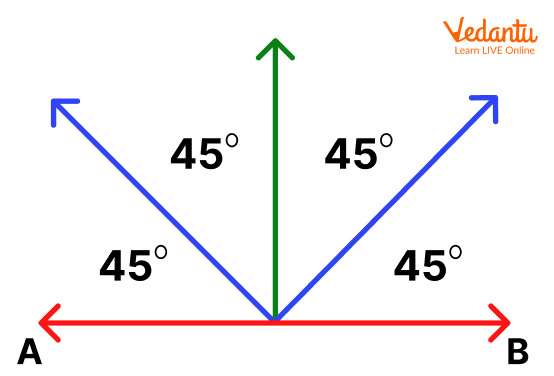
A 45-degree angle can be defined as an acute angle that is formed by bisecting a 90 degree angle into two equal halves. Each half of the 90 degree angle is equal to 45 degrees. To help you understand better, we have also provided a few examples of 45 degree angles and also the step-by-step construction of 45 degree angles.
Look at the 45 degree angle picture that is given below for better understanding.
How can We Construct a 45 Degree Angle?
Constructing a 45 degree angle is very easy. It can be constructed with the help of a protractor or a compass. Here, we have provided a step-by-step method to construct a 45-degree angle using both a protractor and a compass.
Constructing a 45-Degree Angle Using a Protractor
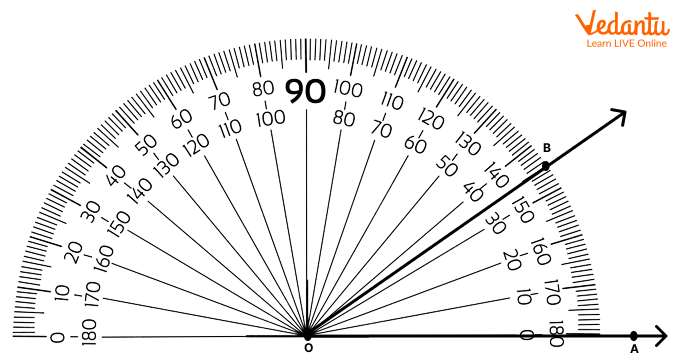
You can draw a 45 degree angle easily by following the steps given below. We have also provided a picture below to help you understand better.
Let us first start by drawing a line segment OA.
Next, place the protractor at point O in such a way that the reading 90° is perpendicular to point O.
Now, you will have to find the reading for 45°. Once you find it, mark a dot at the 45° reading with a pencil and name it B.
Remove the protractor and draw a line using a scale to join the points O and B.
An angle is formed (∠AOB), which is equal to 45°.
Constructing a 45 Degree Angle with a Compass
Drawing a 45 degree angle with a compass might look a little more difficult than the protractor method. But if you follow the correct steps, then it is fun and easy.
Refer to the below-given picture carefully and then follow the instructions given below:
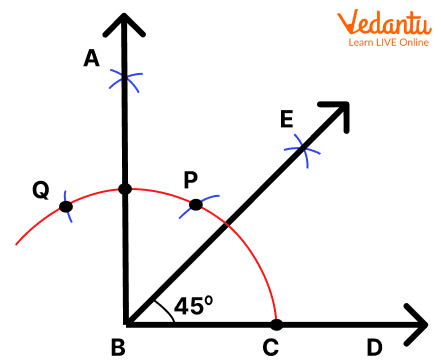
Let us first draw a straight line, BD.
Now, place the tip of the compass at point B. Take a width which should be more than half of BD.
We need to draw an arc which intersects the line BD at a point. Mark this point as D.
Take the same width as mentioned above and place the tip of the compass at point D. Carefully, cut the arc drawn in step 3 and name it as point P.
Now, put the tip of the compass at point P and make another cut to the arc. Name this as point Q.
Keeping the compass at the same point, i.e., point P, draw another arc perpendicular to point B.
Repeat the same step from point Q. Mark the point of intersection of both the arcs as A.
Join both points A and B with a straight line. We now get a 90 degree angle, ∠ABD.
Since we need a 45 degree angle, we will have to bisect the 90 degree angle. Keeping the compass tip at point C, draw an arc anywhere between ∠ABD.
Now, place the compass tip at point A and cut the previous arc which you have drawn between ∠ABD. Name their intersection point as E. Join the points E and B.
Finally, we get our required 45 degree angle, i.e., ∠EBD. We hope you had fun while constructing a 45 degree angle. Although it has a lot of steps and many students can find it difficult, it will be really easy to draw if you practise it regularly.
Examples of 45 Degree Angles in Real Life
Now, after going through this article, you got an idea about the 45 degree angle and how it looks. Let us now see some real-life examples of 45 degree angles. If we observe properly, we can find out that most of the things in our surrounding areas form a 45 degree angle. For example, a door can form a 45 degree angle when kept open or even our laptop lid if we hold it properly in a particular manner.
You can find a few more examples below:
Many solar panels are constructed at an inclination of 45 degree angle as the sun's rays reach the farthest at this angle.
It is also used by many architects while constructing doors, window grills, and buildings.
Conclusion
We hope this article helped you in learning about 45 degree angles and how we can construct them easily. While constructing, we must also be very careful about the measurement and drawing of the arc and rays to avoid any misinterpretation of the result. You can also find out the procedure to draw different angles on our website. This is an important topic under Geometry and regular practice will help you to draw any angle easily in your examination.
FAQs on Understanding the 45 Degree Angle in Geometry
1. What is a 45 degree angle?
A 45 degree angle is an acute angle that measures exactly 45°, which is half of a right angle (90°).
- It is smaller than a right angle.
- It is commonly seen in geometry, trigonometry, and coordinate geometry.
- Two 45° angles together form a 90° right angle.
2. How do you draw a 45 degree angle?
You can draw a 45 degree angle using a protractor or by constructing it from a right angle.
- Using a protractor:
- Draw a base line.
- Place the protractor’s center at one endpoint.
- Mark the point at 45°.
- Draw a line through the mark.
- Without a protractor:
- Construct a 90° angle.
- Bisect the 90° angle to get 45°.
3. What is the radian measure of 45 degrees?
The radian measure of 45 degrees is π/4 radians.
- Use the conversion formula: radians = degrees × (π/180).
- So, 45 × (π/180) = π/4.
4. What are the trigonometric values of 45 degrees?
The exact trigonometric values of 45° are based on the 45-45-90 triangle.
- sin 45° = 1/√2 = √2/2
- cos 45° = 1/√2 = √2/2
- tan 45° = 1
5. What is a 45-45-90 triangle?
A 45-45-90 triangle is a right triangle with two equal angles of 45° and one angle of 90°.
- It is an isosceles right triangle.
- If each leg = x, then hypotenuse = x√2.
- Side ratio: 1 : 1 : √2.
6. Is a 45 degree angle acute or obtuse?
A 45 degree angle is an acute angle because it is less than 90°.
- Acute angles measure between 0° and 90°.
- Since 45° is less than 90°, it fits this category.
7. What is the slope of a 45 degree angle?
The slope of a line making a 45° angle with the positive x-axis is 1.
- Slope = tan θ.
- Since tan 45° = 1, the slope is 1.
8. How do you find the complementary angle of 45 degrees?
The complementary angle of 45° is 45°.
- Complementary angles add up to 90°.
- 90° − 45° = 45°.
9. How do you solve sin 45° or cos 45° without a calculator?
You solve sin 45° and cos 45° using a 45-45-90 triangle with side ratio 1:1:√2.
- Let each leg = 1.
- Hypotenuse = √2.
- sin 45° = opposite/hypotenuse = 1/√2 = √2/2.
- cos 45° = adjacent/hypotenuse = 1/√2 = √2/2.
10. Where is a 45 degree angle used in real life?
A 45 degree angle is commonly used in construction, design, and coordinate geometry.
- In construction for cutting materials at equal angles.
- In roofing and staircase design.
- In graphs where slope = 1 (45° line).
- In physics for projectile motion at optimal angles.
