







Overview of Collision
Have you ever seen two vehicles colliding with each other? Have you ever wondered what happens during a collision? What happens when a big vehicle collides with a smaller vehicle and why does the smaller vehicle sustain more damage than the bigger one? In all these situations collision is a common phenomenon. During the collision transfer of energy occurs between any two objects. A Collision can happen between any two masses having different shapes, weights, and velocities. In this article, we will look at the various reasons behind a collision and we are going to study them and explain how doing work shows a transfer of energy and know at what point in a collision does energy transfer occur.
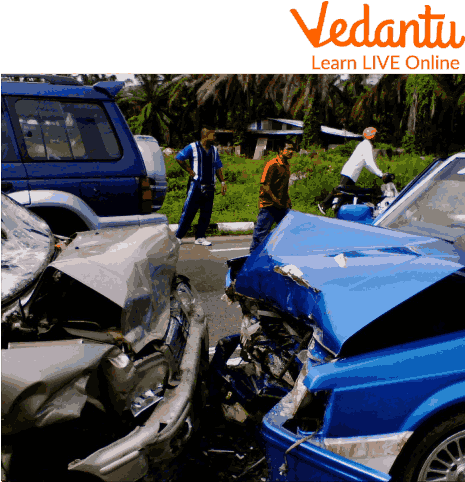
Two Cars Collided with Each Other
What Gets Transferred During a Collision?
To know exactly what happens when objects collide, we first need to know what exactly collision is. In terms of physics, collisions do not necessarily mean an accident. In physics, a collision can happen between any mass at any point of time during its motion. A collision occurs when an object runs into another object. When two masses come in contact with each other during a collision various phenomena and transfers happen. In this part of the article, we will explore those transfer phenomena.
Energy gets transferred from one object to another when they collide with each other.
When two objects collide, momentum or kinetic energy gets transmitted from one object to the other.
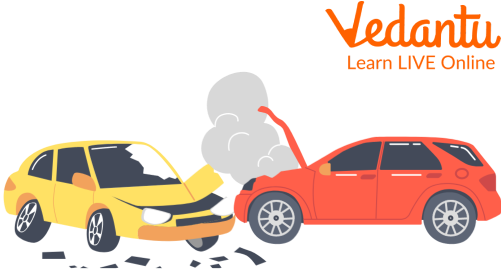
Collision of Two Cars
Definition of Momentum
Momentum is defined as the moving mass of any body or mass that is measured when a body is in motion. It can also be defined as the product of the mass of an object and its velocity.
Definition of Kinetic Energy
Kinetic energy is defined as the energy that is measured during the motion of a body which means it is the moving energy that a body possesses. In simpler words, any moving object possesses kinetic energy.
Examples of Collision
Two balls colliding with each other
Two strikers colliding with each other on a carrom board
A hammer striking an iron nail.
The collision between a fallen object and the floor.
It can also be as simple as an insect landing on a leaf so its legs and the surface of the leaf are to be in a collision.
A collision between microscopic bodies such as atoms colliding with each other.

Carrom Game Depicting Collision Phenomenon
At What Point in a Collision does Energy Transfer Occur?
During a collision, when the two objects touch each other at that point of contact the transfer of Kinetic Energy or momentum occurs. The point at which the transfer of energy occurs is known as the point of Contact. Now it comes to the question, that at the point of contact What happens when objects collide?
Energy is transferred from one object to another when two objects collide. Energy is the capacity to carry out work viz, energy can make things happen. And the amount of energy that is being transferred during collision depends upon various factors such as the speed of the objects and the mass of the objects that are colliding. For example, the objects that run faster experience greater energy transfer and thus suffer a greater impact on them therefore we can conclude that energy being used while objects are touching together.
Explain How Doing Work Shows a Transfer of Energy
In scientific terms, energy is the ability of an object to do work. Therefore as we saw above we can conclude that even if there is a collision then work transfers between objects.
Summary
To conclude all the learnings from the article we can say collision is a phenomenon that can happen at any instance between any object around us. During this phenomenon, various other integrated phenomenons are happening simultaneously which makes the phenomenon of collision a unique one to study in depth. Furthermore, we saw that energy is being used while objects are touching together or are under collision and also explained that where there is an energy transfer there are also work transfers between objects. With this, we would like to finish all the concepts related to collision. In case of any other doubts feel free to ask in the comments.
FAQs on What Gets Transferred During A Collision?
1. What exactly is a collision in the context of physics?
In physics, a collision is a brief event where two or more objects exert strong forces on each other in a very short time. This interaction leads to a change in their motion, and it doesn't necessarily mean they have to physically touch; for instance, the repulsion between two positive charges is also considered a type of collision.
2. What gets transferred from one object to another during a collision?
During a collision, two primary quantities can be transferred between the objects: momentum and kinetic energy. While momentum is always conserved and transferred in an isolated system, the total kinetic energy of the system may or may not be conserved, depending on the type of collision.
3. What is the main difference between an elastic and an inelastic collision? Provide examples.
The main difference lies in the conservation of kinetic energy. Here's a breakdown:
- Elastic Collision: In this type of collision, both momentum and total kinetic energy are conserved. The objects bounce off each other perfectly without any loss of energy to deformation, heat, or sound. A real-world approximation is the collision between two billiard balls.
- Inelastic Collision: In this type, momentum is conserved, but the total kinetic energy is not. Some kinetic energy is converted into other forms like heat, sound, or work done to deform the objects. For example, a car crash is an inelastic collision as energy is used to crumple the car bodies.
4. How is energy transferred in a real-world example, like a cricket bat hitting a ball?
When a moving cricket bat strikes a ball, it's a classic example of an inelastic collision. The bat's kinetic energy is transferred to the ball, causing the ball to fly off at high speed. However, not all the energy is transferred perfectly. A significant portion is converted into sound energy (the 'crack' of the bat) and heat energy due to the slight deformation of the ball and bat upon impact.
5. If kinetic energy is not conserved in an inelastic collision, where does the 'lost' energy go?
The kinetic energy that seems to be 'lost' in an inelastic collision is not actually destroyed; it is simply transformed into other forms of energy. Common transformations include:
- Heat: The objects may become slightly warmer due to friction and internal molecular vibrations.
- Sound: The impact often creates sound waves, which carry energy away.
- Permanent Deformation: Energy is used to change the shape of the objects, such as a dent in a car fender or the squashing of a clay ball.
6. How do an object's speed and mass affect the energy it transfers in a collision?
Both speed (velocity) and mass are crucial. Kinetic energy is calculated as ½ × mass × velocity². This means a faster object or a more massive object will carry significantly more kinetic energy into a collision. Therefore, increasing an object's speed has a greater effect than increasing its mass by the same factor, leading to a much larger transfer of energy upon impact.
7. In any type of collision, is there any quantity that is always conserved?
Yes, in any collision occurring in an isolated system (where no external forces like friction are acting), the total linear momentum of the system is always conserved. This is a fundamental principle of physics. It means the total momentum of all objects before the collision is equal to the total momentum of all objects after the collision, regardless of whether the collision is elastic or inelastic.
8. What is a perfectly inelastic collision and how does it differ from a regular inelastic collision?
A perfectly inelastic collision is a special type of inelastic collision where the maximum possible amount of kinetic energy is lost. The defining characteristic is that the colliding objects stick together after the impact and move with a single, common final velocity. While a car crash is inelastic, if the two cars were to lock bumpers and move as one unit after the crash, it would be considered a perfectly inelastic collision.
