







Practical Applications and Benefits of Potassium Hydroxide
Potassium Hydroxide also denoted by KOH is a chemical of great importance in more than one industrial sector. It is made up of a positive potassium ion and a negative hydroxide ion, in which the K is linked to the oxygen atom by an ionic bond and the oxygen atom is linked to the hydrogen atom by a covalent bond. In this article, we will state various different uses of potassium hydroxide and discuss the different industrial sectors that use it.
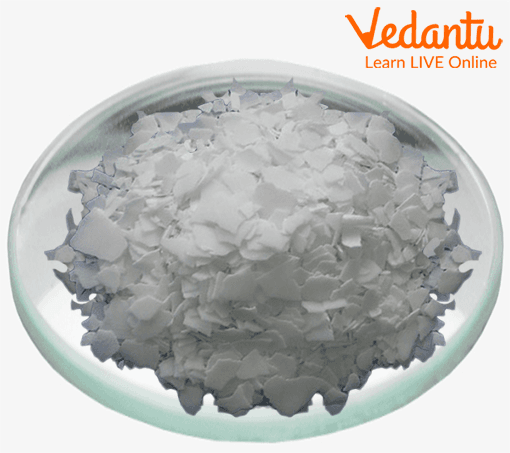
Uses of Potassium Hydroxide
In this section, we will discuss about some of the applications of potassium hydroxide.
Uses of Potassium Hydroxide for Skin
Potassium Hydroxide serves as a disinfectant which is used in cleaning hands, skin, and surfaces. It is also a major component of the soaps which we use for washing hands or bathing. Most commonly bathing soaps are made up of Sodium Hydroxide but these days soaps containing Potassium Hydroxide are gaining popularity because they are comparatively softer than the sodium soaps since potassium hydroxide is soluble in water, thus it is a better cleansing agent as well.

Soap Making Industry Using Potassium Hydroxide
Uses of Potassium Hydroxide in Agriculture
Since Potassium Hydroxide has disinfecting capabilities, it is also used in the agriculture field for that purpose. But more importantly, it is used as a fertiliser. Potassium is a very vital chemical for plant growth, it is mainly associated with the transport of water, nutrients, and carbohydrates in the plant tissues and is also involved in the activation of certain enzymes for the proper functioning of the plant. It is also required for the production of ATP which is the main energy currency of the plant. Since Potassium Hydroxide is an alkaline, it is also used as a fertiliser with the purpose of maintaining the pH of the soil.

Potassium Hydroxide in Agriculture
Uses of Potassium Hydroxide in Food
Potassium Hydroxide is used in food for various different purposes like:
As a pH adjuster
As a Stabiliser
As a thickening Agent
Using a chemical in edibles however poses several issues, thus no matter how small the concentration might be, it has to undergo several lab tests. Potassium Hydroxide is considered a relatively safe ingredient in moderable concentration.
Use of Potassium Hydroxide in a Laboratory
As we stated before in this article, potassium hydroxide is a very salient chemical and serves many purposes not just as our daily life products but also chemically in laboratories.
It is used as an electrolyte in cells involving several Potassium containing chemicals.
It is also used to see fungal elements more clearly by cleaning the clinical materials.
It is also used to produce batteries.
It is also used in acid-base reactions.
Uses of Potassium Hydroxide in Daily Life
Potassium Hydroxide serves many purposes in our day-to-day life that you will be surprised to find that many things that you usually use involve this vital chemical.
Soaps that we use for bathing are mainly made of potassium hydroxide.
It forms a major component of paint remover.
It is also used as a disinfectant.
It forms a component of detergents.
It is also present in shaving creams.
Chemical peeling and washing of fruits and vegetables involve Potassium Hydroxide.
Sample Questions
State whether the statements mentioned below are correctly stated or not.
Soaps made using KOH are softer.
Ans: True.
KOH is also used in shaving creams.
Ans: True.
KOH is an acidic chemical.
Ans: False, KOH is an alkaline or basic chemical.
Learning by Doing
Complete the following statements by filling in the blanks.
In KOH, the K is linked to O with a ________ bond and the O is linked to H with a ________.
Ans: ionic, covalent
Potassium is involved in the activation of _________ in plants.
Ans: enzymes
KOH is more ________ than NaOH in water.
Ans: soluble
Summary
Potassium Hydroxide is simply represented by its chemical formula KOH. It is a very important chemical which has various uses in different industrial sectors such as disinfectant, soap, skin, agriculture, food, and petrochemical industry. It also serves various purposes in our daily lives, some of which are briefly discussed above. Lastly, it is also used in the lab for various different purposes like making batteries and fuel cells, as an electrolyte, etc.
FAQs on Uses of Potassium Hydroxide: Full Guide for Students
1. What is potassium hydroxide and what is its chemical formula?
Potassium hydroxide is a strong inorganic base, also known as a caustic alkali. It is a prototypical strong base. Its chemical formula is KOH, indicating it is composed of one potassium (K) ion and one hydroxide (OH) ion.
2. What are the common names for potassium hydroxide?
Potassium hydroxide is most commonly known as caustic potash. It is also referred to as lye or potash lye. These names are often used interchangeably in industrial and commercial contexts.
3. What are the main physical properties of potassium hydroxide?
Potassium hydroxide (KOH) at room temperature is a white, odourless solid. It is highly soluble in water and also dissolves in alcohols like ethanol. A key property is its deliquescence, meaning it readily absorbs moisture from the air.
4. Why is potassium hydroxide considered a strong base?
Potassium hydroxide is classified as a strong base because it completely or almost completely dissociates in an aqueous solution. When dissolved in water, KOH breaks down into potassium ions (K⁺) and hydroxide ions (OH⁻). This high concentration of free hydroxide ions is what gives it a high pH and its strong alkaline properties.
5. What are the most important uses of potassium hydroxide in industry?
Potassium hydroxide has several key industrial applications, including:
- Soap Manufacturing: It is essential for making soft and liquid soaps through a process called saponification.
- Batteries: It serves as the electrolyte in alkaline batteries.
- Chemical Manufacturing: It is used as a precursor to produce other potassium compounds, like potassium carbonate and potassium permanganate.
- Petroleum Refining: It is used to remove organic acids and sulfur compounds from petroleum products.
6. How is potassium hydroxide used in the food industry?
In the food industry, potassium hydroxide (known by the E number E525) serves multiple functions. It is used as a pH control agent to adjust the acidity of foods, a food stabiliser to maintain texture, and a thickening agent. It is often used in the processing of chocolate, cocoa, and soft drinks.
7. What is the role of potassium hydroxide in cosmetics and medicine?
In cosmetics, potassium hydroxide is used in small amounts to regulate the pH of products. It is also the active ingredient in many cuticle removers and shaving creams due to its ability to break down soft tissues. In medicine, a KOH test is used in dermatology to dissolve skin cells and make it easier to diagnose fungal infections under a microscope.
8. Why is potassium hydroxide deliquescent and what does this mean for its storage?
Potassium hydroxide is deliquescent because of its strong affinity for water. It actively absorbs water vapour directly from the atmosphere. If left exposed to air, the solid pellets will quickly become wet and eventually dissolve into a solution. This property means that KOH must be stored in airtight, non-metallic containers to prevent it from reacting with atmospheric moisture and carbon dioxide.
9. How does the use of potassium hydroxide (KOH) versus sodium hydroxide (NaOH) affect the final soap product?
The choice between KOH and NaOH determines the type of soap produced. Potassium hydroxide (caustic potash) is used to make soft or liquid soaps because potassium soaps have greater solubility in water. In contrast, sodium hydroxide (caustic soda) is used to manufacture hard, solid bar soaps.
10. Is potassium hydroxide dangerous and what safety precautions are necessary when handling it?
Yes, potassium hydroxide is a highly corrosive substance. It can cause severe burns to the skin and eyes upon contact and is harmful if ingested. When handling KOH, it is crucial to wear appropriate personal protective equipment (PPE), including chemical-resistant gloves, safety goggles or a face shield, and a lab coat. It should always be used in a well-ventilated area.
