







An Introduction to High Pitch Sound
What is sound? How do we hear it? It makes sense that questions like this would cross our minds. Let's get more information on it. Sound is a wave that creates vibration. Sounds are made when objects vibrate. We can hear them as sounds. Sound can move through the air, water, wood, and any other solid object. To understand the pitch of the sound, first, we have to know what is the pitch of the sound. The pitch is the highness or lawless sound.
Pitch is measured in hertz. We can easily know how high or low the sound is. The pitch of sound depends upon the frequency of the vibrating body. In this topic, we will learn about sound waves, the high pitch of the sound, the types of sound, and the components of sound.
Pitch of Sound
What is the pitch of sound? Let us know about it in detail. When an object vibrates very loud, it makes a high-pitched sound. A high-pitched sound is also named a shrill sound. The pitch of sound can be high, medium, or low. The higher the pitch of the sound, the higher the frequency of vibration. The pitch of sound is measured by hertz. 1 Hz implies 1 vibration per second. It means 60 vibrations in 1 minute. For example, we can say that a bell in a temple makes a high pitch.
The pitch of the sound is determined by its amplitude. The pitch is increasing with the increase in frequency and decreases with the decrease in frequency. Also, the pitch of the sound is determined by its frequency. Interestingly, the pitch of a woman is higher than a man’s pitch.
Here, let us look at some examples of high-pitch sound and low-pitch sounds.
School or temple/church bell
Whistle
Fireworks
Low pitch sound examples:
Guitar
Drum
Animal sound

Pitch of Sound
Wavelength
The sound of pitch depends on the wavelength. High-pitch sounds have a short wavelength. There are three types of waves.
High pitches have a short wavelength.
Medium pitches have a medium wavelength.
Low pitches have a long wavelength.
Wavelengths can have low, medium, or high frequencies. There is a reverse connection between the pitch of sound and wavelength. We can understand with the help of the diagram below.
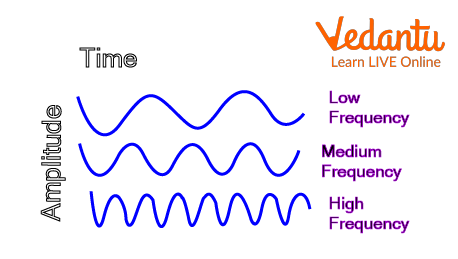
Length of Waves
Types of Sounds
There are three types of sounds:
Infrasonic
sonic
Ultrasonic
Infrasound - A sound that has a frequency below 20 hertz is called infrasound. This sound occurs from light sounds like a waterfall, and slow-speed fans.
Sonic - The sound with a frequency between 20 to 20000 hertz.
Ultrasound - The sound which has a frequency above 20,000 hertz is called ultrasound. These sounds have a very high pitch. It is mainly used for medical purposes.
Components of Sound
The following are the components of sound:
Wavelength - The pitch of a sound depends upon the frequency. Frequency is related to wavelength. The higher the pitch of the sound, the lower the shorter the wavelength.
Pitch - Pitch is also called frequency. The SI unit of pitch is hertz.
Facts about the Pitch of Sound
The following are the facts about the pitch of sound:
Flies cannot hear any sound.
Elephants communicate with a lower pitch of the sound that humans cannot hear.
A cat can hear a higher frequency of sound than humans.
Humans hear sounds up to 17000 hertz
Children can hear at a higher frequency than adults.
Summary
When we speak, in addition to the words we use, we also convey meaning through the gestures and sound patterns we make. These patterns control our daily communication, from the basic rhythms of speech to the precise timing qualities of a consonant.
Sound is a vibration that creates the sensation of hearing. The pitch of sound is a measure by which we can hear sound. Pitch can be high, medium, or lower. Hertz is a tool to measure the pitch of the sound. The best example of sound is music.
FAQs on High Pitch Sound
1. What is a high-pitched sound in simple terms?
A high-pitched sound is a sound that we perceive as being very sharp or shrill. This quality is directly related to the frequency of its sound waves. Objects that vibrate very quickly produce sound waves with a high frequency, which our ears interpret as a high pitch.
2. What are some common examples of high-pitched sounds?
High-pitched sounds are all around us. Some common examples that help explain this concept include:
- The sound of a whistle
- A small bird chirping
- A mosquito buzzing
- A fire engine siren
- A baby's cry
3. On what factor does the pitch of a sound depend?
The pitch of a sound depends entirely on its frequency. Frequency is the measure of how many vibrations a sound wave makes per second. Sounds with a high frequency are perceived as having a high pitch, while sounds with a low frequency are perceived as having a low pitch.
4. How is a high-pitched sound different from a low-pitched sound?
The main difference between high-pitched and low-pitched sounds is their frequency. A high-pitched sound, like a violin note, has sound waves that vibrate very rapidly (high frequency). In contrast, a low-pitched sound, like the rumble of thunder, has sound waves that vibrate slowly (low frequency). This makes high sounds seem 'shrill' and low sounds seem 'deep'.
5. How is the pitch of a sound different from its loudness?
Pitch and loudness are two separate characteristics of sound. Pitch is determined by the frequency of the sound waves and tells us how 'high' or 'low' the sound is. Loudness is determined by the amplitude (or size) of the sound waves and tells us how powerful or intense the sound is. A sound can be high-pitched but quiet (like a whisper) or low-pitched and loud (like a large drum).
6. Why does a woman's voice typically have a higher pitch than a man's voice?
This difference is due to the physical characteristics of the vocal cords. Women generally have shorter and thinner vocal cords. When air passes over them, these smaller vocal cords vibrate at a faster rate, producing a higher frequency and therefore a higher-pitched voice. Men's longer and thicker vocal cords vibrate more slowly, resulting in a lower-pitched voice.
7. Can humans hear all high-pitched sounds?
No, the human ear has a limited hearing range. Sounds with frequencies above 20,000 Hertz (Hz) are known as ultrasound and are too high-pitched for humans to detect. While we cannot hear them, many animals, such as dogs, bats, and dolphins, can both produce and hear these ultrasonic sounds for communication and navigation.
8. How do some musical instruments, like a flute, produce very high-pitched sounds?
Musical instruments produce sound by causing something to vibrate. In a flute, a column of air vibrates. The pitch is changed by altering the length of this air column. A shorter vibrating air column (achieved by pressing keys) vibrates faster, creating a higher frequency and a high-pitched note. This principle applies to other instruments as well; for example, thinner and tighter guitar strings also vibrate faster to produce high pitches.
