







Overview of Pluto
As all of us are aware that we live on the planet Earth. But have you guys ever wondered where our planets come from, how many more planets are there, and which bigger body are they a part of? Let us begin with what planets are. A planet is a large celestial body that keeps on revolving around the Sun in its fixed orbit. There were a total of 9 planets in the Solar System: Mercury, Venus, Earth, Mars, Jupiter, Saturn, Uranus, Neptune, and Pluto. An important question is, is Pluto a planet? It was a planet, but in 2006, Pluto was removed from the list of 9 planets. Today, let us all gather some information and knowledge on this planet. Let’s learn more about Pluto, the size of Pluto, the moons of Pluto and much more.

The 9th Planet - Pluto
Introduction of the Planet Pluto
Even though Pluto as a planet has always been in controversy and a topic of debate, how wonderful is it to know more about the last planet in our solar system? When Pluto was not named as a planet, scientists thought there was a planet beyond Neptune and named it Planet X. But in 1930, a young scientist found that planet Pluto is one of the largest known dwarf planets in our Solar System. It was the ninth planet and the farthest planet from the Sun.

The Coldest Planet
Characteristics of Pluto
The characteristics of pluto are as follows:
Pluto is the coldest planet in the solar system as it is farthest from the Sun and gets very little energy and sunlight.
Pluto is comparatively a small planetoid and has a distinctive orbit around the Sun.
All the planets that travel around the sun, have a round orbit but the orbit of Pluto is an egg or oval shape path.
Even when Pluto is closest to the Sun, it is still 2.8 billion miles away from the Sun. If it is farthest, then it is 5 billion miles away.
Sunlight takes 5 hours to reach Pluto, whereas it takes sunlight 8 minutes to reach Earth.
The planet has mountains, valleys, and craters.
Pluto is made up of a mantle of ice, which is largely nitrogen ice.
Nitrogen gas major constitutes Pluto’s surface and cannot support high mountain peaks. Therefore, scientists believe that mountains are formed on the water-ice beds.
It does not have any Ring System.
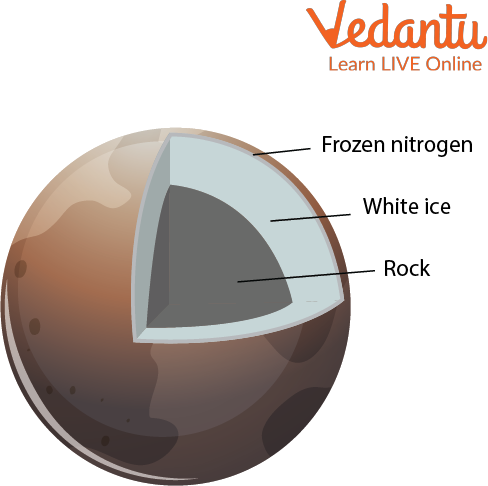
Internal Structure of Pluto
Interesting Facts About Pluto
Now, let’s have a look at some interesting facts about pluto:
Moons: The planet Pluto has 5 moons- Chaton, Styx, Nix, Kerberos, and Hydra.
Diameter: It is about 1,473 miles (2.370 in diameter)
Distance From Sun: It is 3.5 billion miles from the sun. That is approximately 5-7.5 billion km.
Year: One year on Pluto is 248 years on Earth.
Day: One day on Pluto is around 6 ½ days and nights on Earth.
Average Temperature: It is minus 388 degrees Fahrenheit. (-233 degree C)

Mountains on The Planet
Amazing Fun Facts About Pluto
You will be amazed to learn the following details about Pluto.
If you are standing on Pluto’s land, your weight will be 1/15th of your weight on Earth. If your weight on Earth is 100 pounds, then your weight will only be 7 pounds on Pluto.
To know the time to travel from Earth to Pluto, it will take a radio signal which is moving at the speed of light about 4 hours to reach Pluto.
Surprisingly, when Pluto is orbiting around the Sun, it crosses Neptune’s orbit. So, for about 20 years it is closer to Neptune than the Sun out of its 248 years.
It is amazing how Pluto’s surface is much like Earth- a hard and rocky surface but still, there can be no life there.
Did you know that the size of Pluto is even smaller than that of the Earth’s moon?
Strangely, Pluto rotates backwards. It moves from east to west and also rotates on its side.
Summary
From the above learning, we have learnt about the temperature and facts of pluto, we safely say that even though Pluto has been taken off the 9 planets, it is still being studied regularly by scientists. NASA had sent a robot spacecraft - New Horizons to Pluto, which landed there after 9 long years in 2015. With this modern technology, scientists are discovering new things about the planet and solar system as a whole. Walt Disney also named one of their characters Pluto, as Mickey Mouse’s friend. Even though scientists have disregarded it as a planet, many people still regard it as one of the 9 planets.
FAQs on Fun Facts About Pluto
1. Who discovered Pluto and how did it get its name?
Pluto was discovered on February 18, 1930, by a young astronomer named Clyde Tombaugh. The name "Pluto" was suggested by an 11-year-old girl from England, Venetia Burney. She named it after the Roman god of the underworld because it is so far away from the Sun in constant darkness.
2. Why is Pluto no longer classified as a planet?
In 2006, the International Astronomical Union (IAU) reclassified Pluto as a "dwarf planet". This is because it meets two of the three criteria for being a planet: it orbits the Sun and is massive enough to be nearly round. However, it fails the third rule, which requires it to have "cleared its orbital neighbourhood" of other objects. Pluto's orbit is full of other icy bodies in the Kuiper Belt.
3. What makes Pluto so special and different from other planets?
Pluto is special for several reasons. Its orbit is highly elliptical (oval-shaped) and tilted, unlike the other planets' more circular orbits. This unique path means it sometimes gets closer to the Sun than Neptune! It also has a giant heart-shaped glacier made of frozen nitrogen, a thin blue atmosphere, and five moons, the largest of which, Charon, is so big that they are often considered a binary system.
4. How big is Pluto compared to Earth's Moon?
Pluto is extremely small. It has a diameter of about 2,377 kilometres (1,477 miles), which is smaller than Earth's Moon. To give you an idea, it is only about one-sixth the mass of our Moon, making it much smaller than any of the eight major planets in our solar system.
5. How long is a day and a year on Pluto?
A single day on Pluto (one full rotation) is very long, lasting about 6.4 Earth days. A year on Pluto is even longer! Because it is so far from the Sun, it takes Pluto about 248 Earth years to complete just one orbit. This means no one has ever lived long enough to see a full Plutonian year pass.
6. What is the famous 'heart' on Pluto's surface?
The famous 'heart' on Pluto is a massive, light-coloured glacier named Tombaugh Regio. It is not a real heart, but a vast plain of frozen nitrogen, methane, and carbon monoxide. This striking feature is one of the most prominent and surprising discoveries made by the New Horizons spacecraft when it flew past Pluto in 2015.
7. Does Pluto have moons?
Yes, Pluto has a system of five known moons. The largest moon is Charon, which is almost half the size of Pluto itself. The other four moons are much smaller and have irregular shapes. Their names are Styx, Nix, Kerberos, and Hydra. Charon and Pluto are tidally locked and orbit a common centre of gravity, almost like a double-planet system.
8. How can Pluto sometimes be closer to the Sun than Neptune?
This is possible due to Pluto's highly eccentric or oval-shaped orbit. While the major planets have orbits that are mostly circular, Pluto's path is stretched out. For about 20 years out of its 248-year orbit, this elliptical path brings it inside Neptune's orbit, making it temporarily closer to the Sun. This last happened between 1979 and 1999.
