







Introduction to Caterpillars
Kids, have you seen any insects crawling in your garden? Today we will talk about a very cute insect, a caterpillar. The larva or baby of butterflies is known as caterpillar. Caterpillar word formed from the Latin word catta pilosa which means hairy cat. We can easily identify caterpillars, but sometimes, it is confused with some worms like cabbage worms. They have three body parts, the head, thorax, and abdomen, and two antennae on their head.
In this article, we are going to discuss caterpillar facts for kids, caterpillar kids, and parts of a caterpillar. So, let us learn about this beautiful creature.
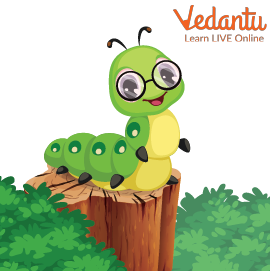
Caterpillar
Physical Features of Caterpillar
Parts of the Body
Caterpillars have three body parts, the head, thorax, and abdomen, and two antennae on their head. There are 12to 13 segments after the head of caterpillars. They have three pairs of permanent legs. One pair is present in each first three segments. The legs are commonly hard and jointed.
In some caterpillars, tiny claws are present at the tip, but it is absent in some of them. They have five pairs of soft, thick legs to support the rest of their body. These legs are disappeared when caterpillars are converted into moths or butterflies. There are six tiny eyes on each side of the head. There are nine small openings on their body for breathing purposes. These are known as the trachea.
Size of the Caterpillar
The size of the caterpillar can vary from less than an inch to a few inches. The hawk moth caterpillar is one of the largest caterpillars. It can be 4 inches long. The cloth moth caterpillar is the smallest. It is 0.25 inches in size.
Defence Mechanisms
Caterpillars are tiny insects, but God has gifted them some tricks to defend themselves from birds and insects. Some caterpillars have the same colour as their surroundings. Some have dots on their bodies which give them a bigger size appearance. Few caterpillars release foul smells, which keep the attackers away. Some of them have poisonous hair on their body.
Where do Caterpillars Come From?
A caterpillar comes from the eggs laid by the female butterfly. It grows at a faster rate. After some time, a caterpillar comes out by splitting the skin. The process is known as moulting. This process occurs four to five times. Some caterpillars eat up the old skin that they have left out.
Lifecycle of Caterpillars to Butterflies for Kids
Now, let's talk about the life cycle of a caterpillar. The process by which a caterpillar converts into a butterfly is called metamorphosis. Some caterpillars soon transform into butterflies, but some take years to convert. There are four stages:
Egg
Caterpillar (larva)
Chrysalis (pupa)
Butterfly (adult)
Egg
An egg is the first stage of the life cycle. Generally, eggs are laid by female butterflies on leaves. Eggs can be different in size, shape, and colour, but they are always small. This stage is between 3 and 7 days, depending on the species of the butterfly.
Larva
The larva is the next stage. In this stage, the tiny caterpillar hatches from the egg. Caterpillars spend most of their time eating and growing. They shed their skin when they grow. The larval stage lasts 2 or more weeks, depending on the species, available food, and other environmental conditions.
Pupa
The next stage is the pupa. It is also known as a chrysalis. Chrysalises are different for different species of butterflies. Many caterpillars hang upside down during this stage This stage is of a week or two.
Adult
The last stage is the adult stage. Now, it is a butterfly. Butterflies come out from their chrysalises and dry their wings. Then they can fly. Butterflies are of different shapes, sizes, and colours. Generally, this stage is 2 to 3 weeks, but few species live for a few months. Next, they find a mate and lay eggs, and life starts again.
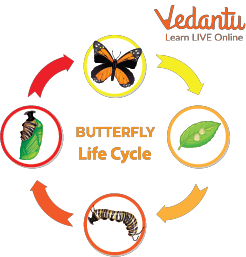
Butterfly life Cycle
Caterpillar Pictures with Names
Now let us have a look at caterpillar pictures with names.
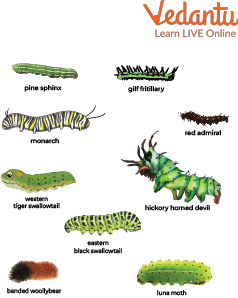
Caterpillar Names with Pictures
Summary
The baby of butterflies is called caterpillars. They are considered insects. They have two antennae on their head and three body parts the head, thorax, and abdomen. There are Three pairs of permanent legs they have. Their size can vary from less than an inch to a few inches. Some of them show defence mechanisms like poisonous body hair and bad smell released when they are in danger. Caterpillar is converted into a butterfly in four stages: egg, larva, pupa, and adult. In this article, we read about caterpillar facts for kids and parts of a caterpillar.
FAQs on Caterpillars - The Beautiful Creature
1. What is a caterpillar?
A caterpillar is the larva or baby stage of a butterfly or a moth. It hatches from an egg and its main job is to eat and grow before transforming into its adult form. It is a crucial part of an insect's life cycle known as metamorphosis.
2. What beautiful creature does a caterpillar turn into?
A caterpillar undergoes a magical transformation called metamorphosis to become a beautiful, winged insect. Most caterpillars turn into butterflies, while some become moths.
3. Is a caterpillar an insect or a worm?
A caterpillar is an insect, not a worm. Although it has a long body like a worm, it has distinct insect features like six true legs on its thorax and a head with chewing mouthparts. Worms do not have legs and do not transform into butterflies or moths.
4. What are the main body parts of a caterpillar?
A caterpillar's body consists of three main parts:
- The Head: This part has its mouth for eating leaves and simple eyes to see light and dark.
- The Thorax: The upper body section where its six true, jointed legs are attached.
- The Abdomen: This is the long, segmented part of the body that has several pairs of fleshy, false legs called prolegs, which help it grip onto leaves and stems.
5. What do caterpillars eat to grow so big?
A caterpillar's first meal is usually its own egg-shell, which is rich in nutrients. After that, it spends almost all its time eating leaves. Different types of caterpillars prefer leaves from specific host plants. Their primary purpose is to eat constantly to store energy for their transformation.
6. Why are caterpillars important for the environment?
Caterpillars are very important for the environment. They are a crucial source of food for many animals like birds, wasps, and mice, forming a key link in the food chain. Later, when they become butterflies or moths, they play a vital role in pollinating flowers, which helps plants produce fruit and seeds.
7. Why do caterpillars have different colours and patterns?
The colours and patterns on a caterpillar are mainly for protection and survival.
- Some colours, like green and brown, help them camouflage or blend in with leaves and twigs to hide from predators.
- Bright, bold colours often serve as a warning to predators that the caterpillar might be poisonous or taste bad.
8. Why does a caterpillar shed its skin?
A caterpillar sheds its skin because its skin (exoskeleton) does not grow. As the caterpillar eats and gets bigger, its skin becomes too tight. The process of shedding this old, tight skin to reveal a new, larger one underneath is called moulting. A caterpillar may moult four or five times before it is fully grown.
9. How is a butterfly caterpillar different from a moth caterpillar?
While they look similar, there are some common differences. Butterfly caterpillars are often smooth-bodied and form a hard, smooth shell called a chrysalis when they transform. In contrast, many moth caterpillars are hairy or spiky and spin a silky cocoon to protect themselves during their transformation stage.
10. What useful material do some caterpillars produce?
All caterpillars produce silk from special glands near their mouths. The most famous example is the silkworm, which is the caterpillar of the domestic silk moth. It spins a cocoon made of a single, continuous thread of raw silk. This silk is harvested and used by humans to make silk fabric.
