







What Are the Basic Grammar Rules and Parts of Speech
Learning different subjects throughout our life and learning the rules of those subjects is necessary for all of us. Subjects are vital. Hence, to master the subject of English, one has to understand the basic grammar for beginners and go through the English grammar notes for a better understanding of the language.
Each language requires us to learn some specific terms and conditions in that particular language to master it. And, for the English language, we have to understand the English grammar rules. Here are some basic rules and notes for the language through which kids can easily understand the different English grammar topics and learn the language thoroughly.
Grammar Rules for Forming Sentences
There are several English grammar rules that play an important role in forming sentences without which the sentences might be incomplete. These rules are important for the perfect construction of sentences that play to be meaningful.
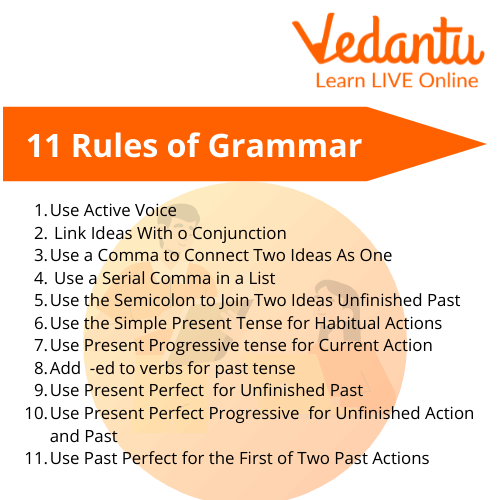
Rules of Grammar
Above are some of the major English grammar rules that any kid must know about. There are many grammar rules, such as subjects and predicates, punctuations, etc., which form a meaningful sentence. Let's start learning about basic grammar for beginners.
Subjects and Predicates
Predicates and subjects are vital English grammar rules which are considered the building blocks of any sentence. No person can form a sentence without having a subject in it. Even the smallest sentences contain subjects.
The subject is considered to be the name of the place, animal, or thing depicted through nouns. While the action which is expressed by the subject is considered as the predicate of the sentence. Any sentence, whether big or small, contains both a subject and a predicate.
For example, Nina’s hair colour changes every week.
Here, Nina is considered as the subject, while the action of the sentence, which changes every week, is considered as the predicate.
Subject-Verb Agreement
Another topic that is considered a crucial aspect of the basics of English grammar is subject-verb agreement. As suggested by the topic itself, subject-verb agreement tells us how the subject of the sentence should be in agreement with its action.
In easy terms, if the subject is in the singular form, then the action should also be in the singular form. Similarly, if the subject is plural, then the object (action) should also be in plural form.
For example, Rita and Sita are excited to start their journey.
Here, since there are two people involved in the sentence, then the subject is considered as a plural which is in agreement with the sentence that is their journey, which is plural.
Correctly Expressing a Sentence
Choosing the correct words while writing a sentence to express the right emotion is necessary. Different types of sentences are made using punctuation in them.

Different Types of Sentences
Here are the four main types of senses present in English grammar.
1. Declarative Sentence
The role of a declarative sentence is to make a statement, and it involves the period(end) of any sentence.
For example- He is a boy with dark hair.
2. Interrogative Sentence
A sentence which consists of a question and expresses the emotion of questioning is considered an interrogative sentence. Such types of sentences have a question mark(?) at the end of them.
For example- Is she going home today?
3. Exclamatory Sentence
The sentences which have an expression of surprise and consist of different sudden feelings are called exclamatory sentences. Such sentences consist of an exclamation mark(!) at the end.
For example - Wow what a beautiful day!
4. Imperative Sentence
The imperative sentence can be considered as another form of exclamatory sentence which contains a request/an order/a command and sometimes the use of an exclamation mark at the end also.
For example, Follow the head’s orders! (command/order
Please give me that book. (request)
Capitalization and Punctuations
Other building blocks of any sentence are capital letters and punctuation marks for the clarity of the meaning of sentences. Capitalization of words is done at the beginning of the sentences and is also used to emphasise the proper nouns like names of different places or a person.
Moreover, the punctuation marks are used to express the emotions in the sentences through different symbols like a comma(,) which is used for a small break, an exclamation mark which denotes several moods like surprise, anger or a command and the question mark that is used to denote a question while reading or speaking.
Other than this, there are several other punctuation marks like colon(:), semicolon(;), dash(-), etc., which are further useful in English Grammar topics.
Summary
The English language has different and numerous grammar rules which help in the proper formation and expression of a sentence. Learning these rules is necessary since they help in the proper construction of sentences. One can take up one topic at a time and eventually learn the basics of English grammar. The English grammar notes discussed in this article are very important for your kids to learn all the English grammar topics thoroughly. We have tried to cover all the points that are important to know basic grammar for beginners.
Subjects are vital, and so is the English language. For kids, grammar serves to be the paving path of their future and teaches a child basic manners as well.
FAQs on Basics of Grammar in English Language
1. What is grammar in English?
Grammar is the system of rules that governs how words are formed and arranged to create meaningful sentences in English. It explains how parts of speech like nouns, verbs, and adjectives work together.
- It controls sentence structure and word order.
- It ensures correct use of tenses, punctuation, and agreement.
- It helps make writing and speaking clear and accurate.
2. What are the basic parts of speech in English grammar?
The basic parts of speech are categories of words based on their function in a sentence. The main parts of speech in English include:
- Noun – names a person, place, thing, or idea (e.g., teacher).
- Pronoun – replaces a noun (e.g., she).
- Verb – shows action or state (e.g., run, is).
- Adjective – describes a noun (e.g., happy).
- Adverb – modifies a verb, adjective, or adverb (e.g., quickly).
- Preposition, Conjunction, and Interjection.
3. What is a sentence in English grammar?
A sentence is a group of words that expresses a complete thought and contains a subject and a verb. Every complete sentence must have:
- A subject – who or what the sentence is about.
- A predicate – what the subject does or is.
4. What is the difference between a phrase and a clause?
The difference between a phrase and a clause is that a clause has a subject and a verb, while a phrase does not.
- Phrase: A group of words without a subject-verb pair (e.g., in the morning).
- Clause: A group of words with a subject and verb (e.g., she wakes up early).
5. What are the basic rules of subject-verb agreement?
Subject-verb agreement means the verb must match the subject in number and person. The basic rules are:
- Singular subject + singular verb (e.g., She runs.)
- Plural subject + plural verb (e.g., They run.)
- With he/she/it in the present simple, add -s to the verb.
6. What are the main types of sentences in English?
The main types of sentences in English grammar are classified by their purpose. These include:
- Declarative – makes a statement (e.g., I like coffee.)
- Interrogative – asks a question (e.g., Do you like coffee?)
- Imperative – gives a command (e.g., Close the door.)
- Exclamatory – shows strong feeling (e.g., What a great day!)
7. What is a tense in English grammar?
A tense shows the time of an action or state in a sentence. The three main tenses are:
- Present tense – action happening now (e.g., She writes.)
- Past tense – action completed before now (e.g., She wrote.)
- Future tense – action that will happen (e.g., She will write.)
8. Why is punctuation important in English grammar?
Punctuation is important because it clarifies meaning and separates ideas in written English. Common punctuation marks include:
- Period (.) – ends a statement.
- Comma (,) – separates items or clauses.
- Question mark (?) – ends a question.
- Apostrophe (’) – shows possession or contractions.
9. What is the difference between active voice and passive voice?
The difference between active voice and passive voice is that active voice emphasizes the doer of the action, while passive voice emphasizes the action or receiver.
- Active: The teacher explained the lesson.
- Passive: The lesson was explained by the teacher.
10. What are common grammar mistakes in English?
Common grammar mistakes in English include errors in agreement, tense, and word usage. Frequent mistakes are:
- Incorrect subject-verb agreement (e.g., “She go” instead of “She goes”).
- Wrong tense consistency in a sentence.
- Confusing words like their/there/they’re.
- Missing or incorrect punctuation.
