









What Is Mail Merge in MS Word and How It Works with Steps and Examples
Mail Merge is a powerful feature used in word processing software to create multiple documents at once using a single template and a data source. It is widely used for sending personalised letters, invitations, certificates, and emails to a large group of recipients. In computer science, Mail Merge is an important concept because it demonstrates how data integration and document automation work together. By combining a main document with a data file, users can efficiently generate customised outputs without manually editing each document.
Definition and Meaning
Mail Merge definition refers to a feature in word processing applications that allows users to generate multiple personalised documents by combining a standard template with a data source.
- Main Document - The template containing common text and placeholders.
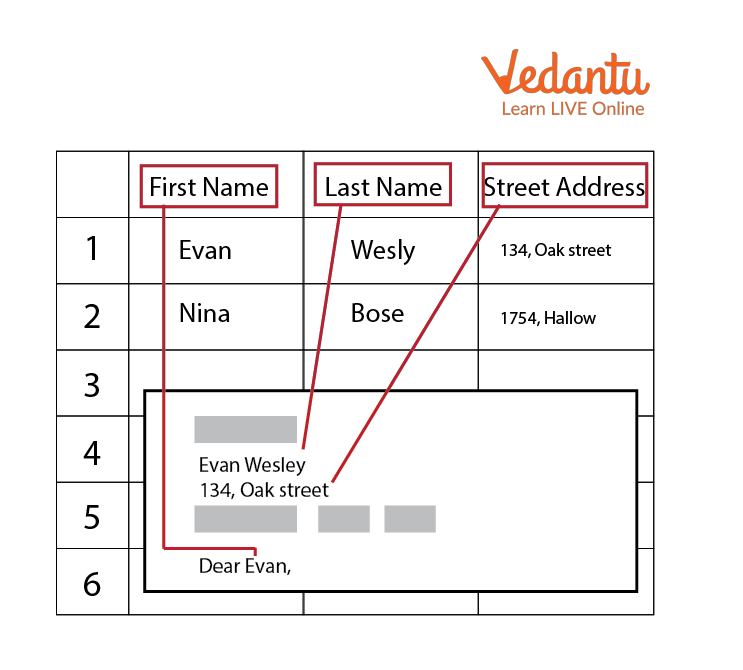
- Data Source - A file containing variable data such as names, addresses, or phone numbers.
- Merge Fields - Special fields inserted into the main document to pull data from the data source.
- Output Document - The final generated personalised documents.
How It Works / Working Principle
Mail Merge working is based on combining two components - a template and a database. The software automatically replaces placeholders in the template with actual data from the data source to create personalised documents.
- Create a Main Document with fixed content and insert merge fields such as Name, Address, or Email.
- Prepare a Data Source using a spreadsheet, database, or table containing recipient details.
- Link the data source to the main document.
- Match the merge fields with the corresponding columns in the data source.
- Preview the merged results to check accuracy.
- Generate or print the final personalised documents.
Types and Classification
Mail Merge types depend on the kind of output document being created.
- Letters - Personalised letters sent to multiple recipients.
- Email Messages - Bulk personalised emails.
- Envelopes - Printed envelopes with different recipient addresses.
- Labels - Address or product labels generated in bulk.
- Directory - Combined information into a single document such as a contact list.
Components and Structure
- Main Document - Contains standard text and merge fields.
- Data Source - Usually a spreadsheet or table containing records.
- Merge Fields - Placeholders like <
> or <>. - Mail Merge Tool - Software feature that processes and combines data.
Features and Characteristics
- Automation of repetitive document creation.
- Personalisation using dynamic data fields.
- Supports multiple output formats such as print and email.
- Integration with spreadsheets and databases.
- Preview option before final merging.
Advantages
- Saves time when sending bulk communication.
- Reduces manual errors.
- Ensures consistency in document formatting.
- Improves productivity in offices and institutions.
Disadvantages / Limitations
- Incorrect data in the source file affects all documents.
- Requires proper formatting of data fields.
- Limited advanced customization compared to manual editing.
- May require basic technical knowledge to set up correctly.
Applications and Use Cases
- Sending examination results to students.
- Generating salary slips for employees.
- Creating invitation cards for events.
- Mass mail sending for marketing campaigns.
- Printing address labels for shipping.
Quick Facts About Mail Merge
| Category | Details | Common Use |
|---|---|---|
| Type | Document Automation Tool | Bulk Personalised Documents |
| Used In | Word Processing Software | Letters, Emails, Labels |
| Key Feature | Data Integration | Mass Communication |
Mail Merge is widely used in offices, schools, businesses, and government institutions for efficient communication management.
Interesting Facts About Mail Merge
- Mail Merge can connect to spreadsheet files like CSV and Excel.
- It supports conditional fields for advanced personalization.
- Used in marketing automation systems.
- Can generate thousands of documents within seconds.
- Helps maintain uniform formatting across all documents.
- Email Mail Merge can include attachments automatically.
- Widely taught in basic computer education courses.
Conclusion
Mail Merge in computer science is an essential document automation feature that combines a standard template with a data source to produce personalised documents efficiently. It simplifies bulk communication, saves time, and improves accuracy. Understanding Mail Merge helps students and professionals manage large scale document generation effectively. Its role in business communication, education, and administration makes it an important concept in modern computing.
FAQs on Mail Merge in MS Word Explained for Students and Beginners
1. What is Mail Merge in Computer Science?
Mail Merge is a word processing feature that allows users to create multiple personalized documents by combining a main document with a data source.
- Commonly used in Microsoft Word and other office software
- Combines a template document with a database or data file
- Widely used for letters, emails, labels, and certificates
2. How does Mail Merge work?
Mail Merge works by linking a main document containing fixed text with a data source containing variable information such as names and addresses.
- Create a main document (template)
- Connect a data source like Excel or CSV file
- Insert merge fields such as FirstName or Address
- Generate multiple personalized outputs automatically
3. What are the main components of Mail Merge?
The main components of Mail Merge are the main document, data source, and merge fields.
- Main Document contains fixed content and placeholders
- Data Source stores records in tabular format
- Merge Fields act as dynamic variables inserted into the document
4. What are the types of documents that can be created using Mail Merge?
Mail Merge can generate different types of bulk personalized documents for communication and documentation purposes.
- Letters for official communication
- Email messages for marketing or announcements
- Labels and envelopes for mailing
- Certificates and reports for academic or corporate use
5. What are the advantages of using Mail Merge?
Mail Merge improves productivity by automating the creation of multiple personalized documents.
- Saves time and manual effort
- Reduces human errors in repetitive typing
- Ensures consistency and accuracy in bulk communication
- Useful for business, education, and administrative tasks
6. What are the disadvantages or limitations of Mail Merge?
Mail Merge has some limitations related to data formatting and software compatibility.
- Requires correctly formatted data source
- Errors occur if merge fields are mismatched
- Limited customization compared to advanced database-driven systems
- May require technical knowledge for complex formatting
7. What is a data source in Mail Merge?
A data source in Mail Merge is a structured file that contains variable information used to personalize documents.
- Usually created in Microsoft Excel, Access, or CSV format
- Organized in rows (records) and columns (fields)
- Each row represents one recipient’s data
8. How is Mail Merge different from manually typing documents?
Mail Merge automatically generates multiple personalized documents, while manual typing requires creating each document separately.
- Uses automation instead of repetition
- Integrates with databases and spreadsheets
- Faster and more efficient for bulk operations
- Reduces chances of data entry mistakes
9. What are common applications of Mail Merge in real-world scenarios?
Mail Merge is widely used in business, education, and government sectors for bulk communication and document generation.
- Sending marketing emails and newsletters
- Generating student report cards and certificates
- Creating salary slips and invoices
- Preparing official notices and invitations
10. Why is Mail Merge important for exams and interviews?
Mail Merge is an important topic in computer fundamentals and office automation for exams and job interviews.
- Frequently asked in school and competitive exams
- Tests understanding of word processing tools
- Important for roles involving data handling and documentation
- Demonstrates knowledge of automation in office software
