









How to Change Background Color in CSS and HTML with Syntax and Examples
Changing background color is one of the most basic and important design tasks in web development. In HTML and web design, background color helps improve readability, highlight sections, and enhance the visual appeal of a webpage. Understanding how to change background color is essential for beginners learning HTML and CSS, as it forms the foundation of webpage styling. By using attributes and styling methods, developers can easily customize the look and feel of a website. This concept plays a key role in creating attractive and user friendly web pages.
Definition and Meaning
Changing Background Color refers to modifying the color that appears behind the content of a webpage or a specific HTML element. It is an important concept in HTML in computer science and web design.
- It can be done using the bgcolor attribute in older HTML versions.
- Modern web development uses CSS background-color property.
- Colors can be specified using color names, RGB values, or hexadecimal notation.
- It can be applied to the entire page or individual elements like tables, paragraphs, or div sections.
How It Works - Working Principle
The working of changing background color in HTML depends on assigning a color value to a specific element. The browser reads the color value and renders the background accordingly.
- The developer selects an HTML element such as <body> or <div>.
- A color value is defined using a color name, RGB value, or hexadecimal code.
- The browser interprets the color code.
- The selected element is displayed with the chosen background color.
Earlier versions of HTML used the bgcolor attribute, but modern websites mainly use CSS for better control and flexibility.
Types and Classification
There are different ways to specify background color in HTML.
Types of Background Color Specification
| Type | Description | Example |
|---|---|---|
| Color Name | Uses predefined color names | red, blue, green |
| RGB Value | Defines color using Red, Green, Blue values | rgb(255,0,0) |
| Hexadecimal | Uses hex code representation | #FF0000 |
Among these, hexadecimal notation is widely used because it provides precise color control.
Syntax and Example
Using bgcolor Attribute in HTML
The older HTML syntax for changing background color uses the bgcolor attribute inside the body tag.
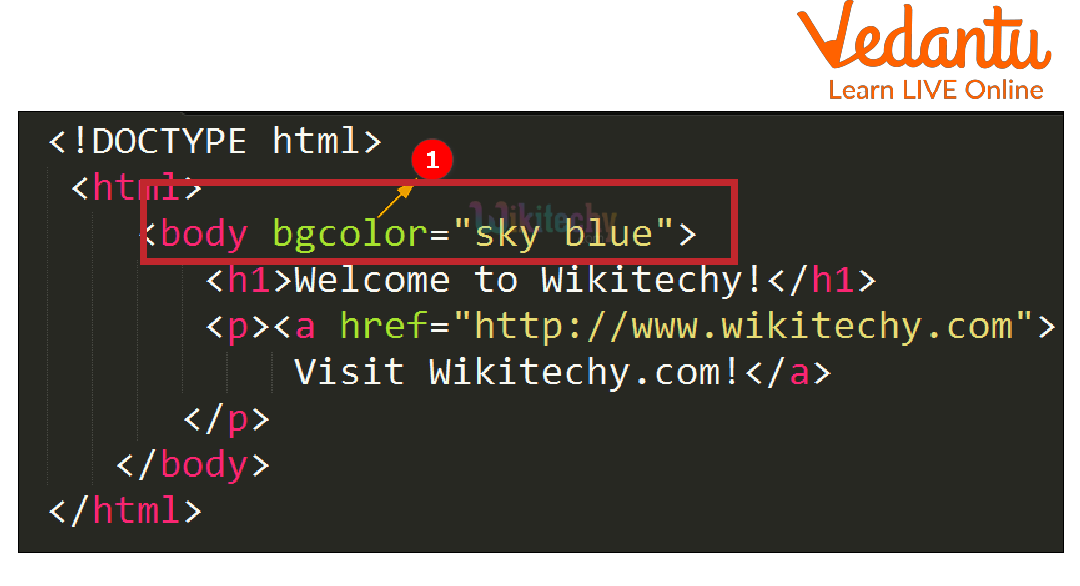
<body bgcolor="yellow">
  <h1>Welcome to Vedantu</h1>
</body>
Using CSS background-color Property
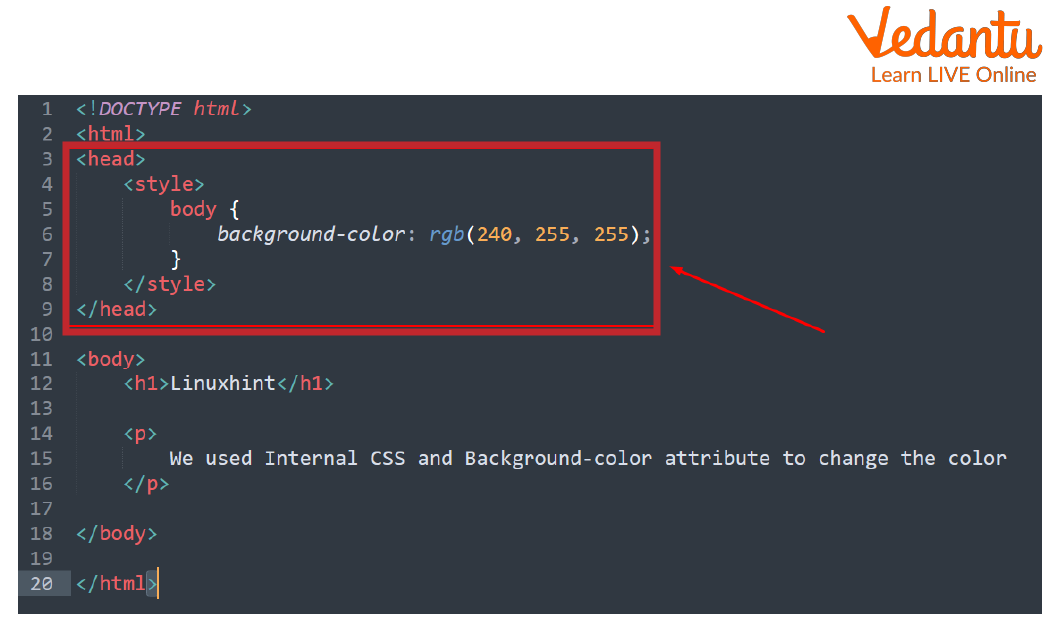
Modern websites use CSS to change background color.
<body style="background-color: lightblue;">
  <h1>Changing Background Color Example</h1>
</body>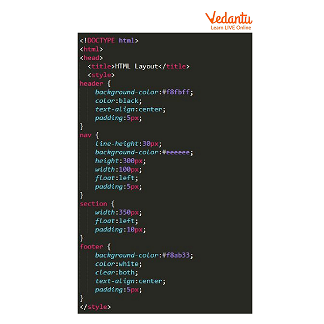
Hexadecimal Notation Example
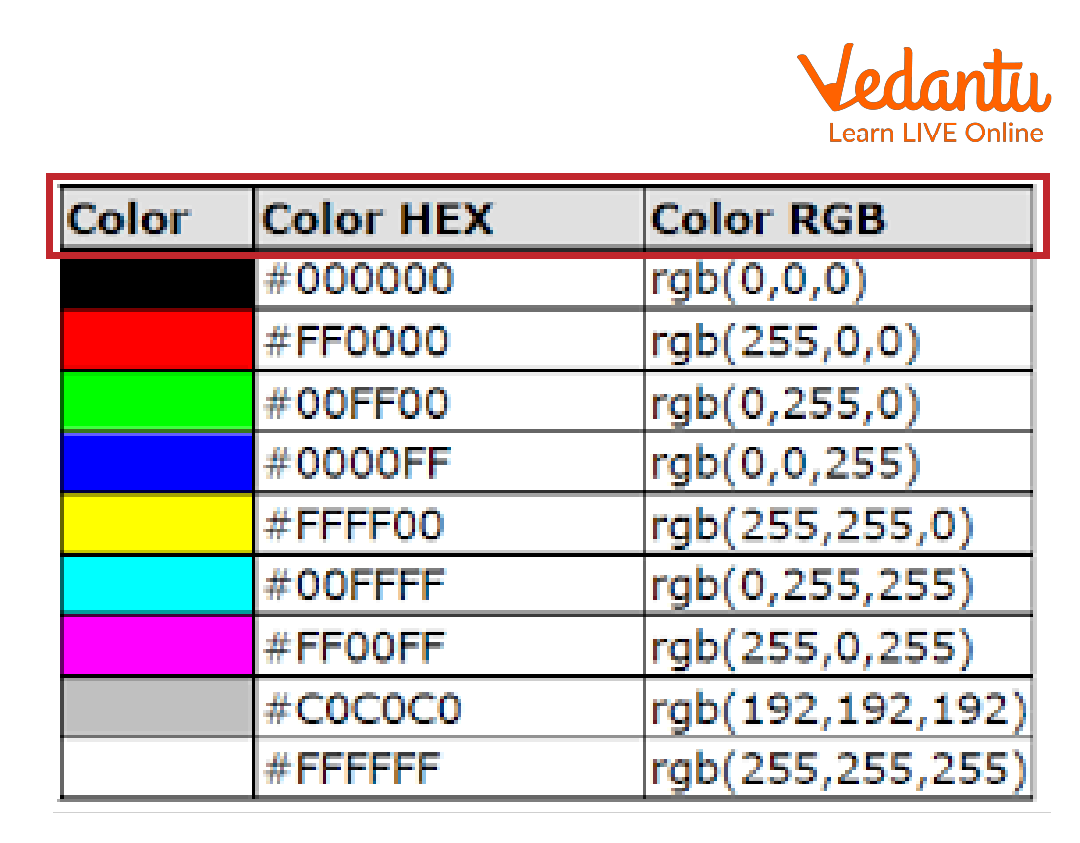
<body style="background-color:#FF5733;">
  <p>This page has a custom background color.</p>
</body>
Features and Characteristics
- Supports multiple color formats such as name, RGB, and hexadecimal.
- Can be applied to entire page or specific elements.
- Improves visual design and readability.
- Easy to implement using simple syntax.
- Fully supported by all modern browsers.
Advantages
- Enhances user experience and website aesthetics.
- Highlights important sections of a webpage.
- Improves readability when proper contrast is used.
- Simple and beginner friendly concept.
Disadvantages / Limitations
- Incorrect color combinations can reduce readability.
- The bgcolor attribute is outdated in HTML5.
- Excessive use of bright colors may affect user experience.
Applications and Use Cases
- Designing websites and web applications.
- Creating visually appealing landing pages.
- Highlighting headers, footers, and content sections.
- Improving accessibility with proper color contrast.
Quick Facts About Changing Background Color
| Category | Details |
|---|---|
| Type | Web Design / HTML Styling |
| Used In | HTML and CSS |
| Modern Method | CSS background-color property |
| Color Formats | Name, RGB, Hexadecimal |
| Common Use | Web page styling and design |
These quick facts summarize essential details about changing background color in computer science and web development.
Interesting Facts About Changing Background Color
- HTML originally supported background color using the bgcolor attribute.
- CSS provides more flexibility than HTML attributes.
- There are more than 140 standard color names in HTML.
- Hexadecimal color codes are based on base 16 number system.
- Good color contrast improves accessibility for visually impaired users.
- Background colors can also be combined with images and gradients using CSS.
Conclusion
Changing background color is a fundamental concept in HTML and web development. It enhances the visual appearance, improves readability, and helps structure webpage content effectively. While older HTML versions used the bgcolor attribute, modern development relies on CSS for better flexibility and control. Understanding changing background color in computer science is essential for students and beginners who want to build attractive and user friendly websites. Mastering this concept forms the foundation of effective web design and styling.


FAQs on Changing Background Color in Web Design and Programming
1. What does changing background color mean in Computer Science?
Changing background color means modifying the background property of a user interface element in web development, applications, or software to improve design and user experience.
- Common in HTML, CSS, JavaScript and GUI programming
- Used in web pages, mobile apps, desktop software
- Enhances readability and visual appearance
2. How do you change background color using CSS?
In CSS, background color is changed using the background-color property applied to an HTML element.
- Example syntax: body { background-color: blue; }
- Can use color names, HEX, RGB, RGBA, HSL
- Widely used in front-end web development
3. How can JavaScript be used to change background color dynamically?
JavaScript changes background color dynamically by modifying the DOM style property of an element at runtime.
- Example: document.body.style.backgroundColor = "yellow";
- Used in event handling like button clicks
- Important for interactive web applications
4. What are different color formats used for changing background color?
Background color can be specified using different color value formats in programming and web development.
- Color names like red, blue, green
- HEX codes like #FFFFFF
- RGB and RGBA values
- HSL and HSLA values
5. How is background color changed in HTML without CSS?
Background color can be changed using the style attribute directly inside an HTML tag, although CSS is recommended for best practice.
- Example: <body style="background-color: lightblue;">
- Not preferred for large projects
- Used mainly for basic learning and testing
6. What is the difference between background color and background image?
Background color sets a solid color, while background image sets a graphic file as the background of an element.
- background-color uses color values
- background-image uses image URLs
- Both are CSS properties used in UI design
7. Why is changing background color important in UI/UX design?
Changing background color improves user interface design, readability, accessibility, and overall user experience.
- Enhances visual hierarchy
- Improves contrast and accessibility
- Used in dark mode and theme customization
8. How do you change background color in programming languages like Python?
In Python, background color is changed using GUI libraries such as Tkinter by configuring widget properties.
- Example: root.configure(bg="blue")
- Used in desktop application development
- Common in basic GUI programming
9. What are the advantages and disadvantages of frequently changing background color?
Frequently changing background color can enhance interactivity but may affect usability if overused.
- Advantages: better engagement, dynamic UI, theme switching
- Disadvantages: distraction, readability issues, performance impact in heavy animations
- Important consideration in web performance optimization
10. Is changing background color an important topic for exams and interviews?
Yes, changing background color is a fundamental concept in HTML, CSS, and JavaScript often asked in practical exams and front-end developer interviews.
- Tests understanding of CSS syntax and DOM manipulation
- Common in school, college, and coding interviews
- Forms the basis of responsive and interactive web design
