




Write the inclination of a line parallel to the y-axis.
Answer
 Verified
648k+ views
Hint: To measure the inclination, we should try to find out the angle made by the line with the x-axis. This angle $\theta $ will be the inclination of the line.
Complete step-by-step answer:
It is given that the line is parallel to the y axis. Now, from the figure below(in which the points A and C lie on the line), we find that angle $\angle ACB$ is a corresponding angle of alpha (as the y-axis and the line are parallel).
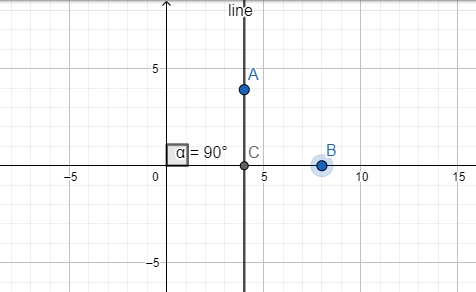
Also, by the rule of geometry, we should have that corresponding angles should be equal.
Also, in the figure, the angle of the line with the x-axis is equal to $\angle ACB$.
Therefore, we find that the slope of the line, given by the angle $\angle ACB$ will be equal to $\alpha ={{90}^{\circ }}$ and thus the inclination of the line w.r.t. the x-axis should be equal to ${{90}^{\circ }}$. Also, as the line and y-axis are parallel to each other, the inclination w.r.t. the y-axis should be zero.
Note: We can also use the equation of the line to find the slope. Two parallel lines will have the same slope. Thus as the y-axis can be represented by the equation $y=mx+c$where $m=\infty $ and thus equivalently as $x=0$, we find that the line parallel to it should also have $m=\infty $and thus its slope should be infinity. The angle with x-axis can be found from the slope using the formula $angle={{\tan }^{-1}}(m)$. And thus $angle={{\tan }^{-1}}\left( \infty \right)={{90}^{\circ }}$ which is the which we had obtained earlier.
Complete step-by-step answer:
It is given that the line is parallel to the y axis. Now, from the figure below(in which the points A and C lie on the line), we find that angle $\angle ACB$ is a corresponding angle of alpha (as the y-axis and the line are parallel).
Also, by the rule of geometry, we should have that corresponding angles should be equal.
Also, in the figure, the angle of the line with the x-axis is equal to $\angle ACB$.
Therefore, we find that the slope of the line, given by the angle $\angle ACB$ will be equal to $\alpha ={{90}^{\circ }}$ and thus the inclination of the line w.r.t. the x-axis should be equal to ${{90}^{\circ }}$. Also, as the line and y-axis are parallel to each other, the inclination w.r.t. the y-axis should be zero.
Note: We can also use the equation of the line to find the slope. Two parallel lines will have the same slope. Thus as the y-axis can be represented by the equation $y=mx+c$where $m=\infty $ and thus equivalently as $x=0$, we find that the line parallel to it should also have $m=\infty $and thus its slope should be infinity. The angle with x-axis can be found from the slope using the formula $angle={{\tan }^{-1}}(m)$. And thus $angle={{\tan }^{-1}}\left( \infty \right)={{90}^{\circ }}$ which is the which we had obtained earlier.
Recently Updated Pages
Master Class 12 Economics: Engaging Questions & Answers for Success

Master Class 12 English: Engaging Questions & Answers for Success
Master Class 12 Social Science: Engaging Questions & Answers for Success
Master Class 12 Maths: Engaging Questions & Answers for Success
Master Class 12 Physics: Engaging Questions & Answers for Success
Master Class 10 English: Engaging Questions & Answers for Success
Trending doubts
Explain the Treaty of Vienna of 1815 class 10 social science CBSE
Who Won 36 Oscar Awards? Record Holder Revealed
Why is it 530 pm in india when it is 1200 afternoon class 10 social science CBSE
What is the full form of POSCO class 10 social science CBSE
Define Potential, Developed, Stock and Reserved resources
The speaker of the Lok Sabha is elected by the APresident class 10 social science CBSE