




Two bodies of mass 4 kg and 6 kg are attached to the end of a string passing over a pulley. The 4 kg mass is starched to the table top by another string. What is the free body?
Answer
 Verified
634.8k+ views
Hint: First, start by drawing the diagram of the arrangement and denoting all the possible forces that are acting on the body like the tensions on the string of pulley that are $T_1$ and $T_2$ and the force due to the gravitation that is mg. Then draw the free body diagram for each mass and denote all the forces on the body. After that add all the forces and equate to zero to find the unknown forces.
Complete Step-by-Step solution:
First we will be drawing the diagram for the given arrangement as shown in figure 1
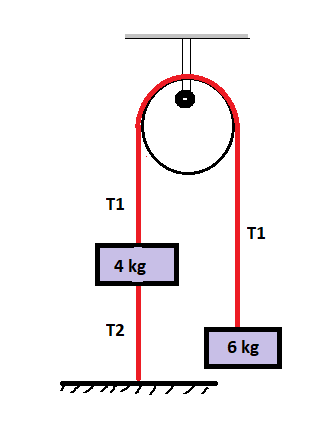
We know that the tension on both ends of the string over the pulley will be equal so tension $T_1$ is developed across both the ends of the pulley. And a tension is also developed in the string connecting the 4 kg mass to the ground. Now looking at the free body diagram as shown in figure 2.
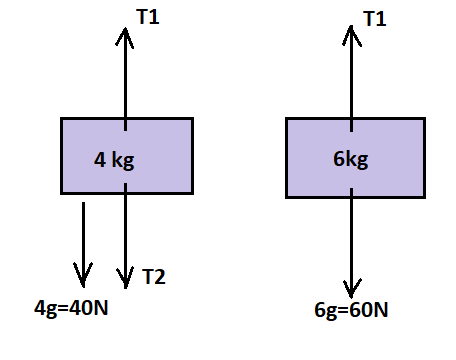
First considering the free body diagram 4kg mass we can see all the forces and their direction in which they are acting on. That is tension $T_1$ is acting upward, Tension $T_2$ is acting downward and the force due to gravity is acting on the downward.
\[T_1 = {m_4}g + T_2\]
\[ \Rightarrow T_1 = 4 \times 9.8 + T_2\]
\[ \Rightarrow T_1 = 39.2N + T_2\]--------------- (1)
Here we take acceleration due to gravity as g= 9.8 $m/s^2$
Similarly considering the free body diagram of the 6 kg mass we can see that there are only two forces that are acting in the opposite direction that is tension $T_1$ is acting upward and the force due to the gravity is acting downward.
\[ \Rightarrow T_1 = {m_6}g\]
\[ \Rightarrow T_1 = 6 \times 9.8\]
\[ \Rightarrow T_1 = 58.8N\]----------------- (2)
We can equate equation (1) and (2) to get the value of $T_2$ that is
\[ \Rightarrow 58.8 = 39.2 + T_2\]
\[ \Rightarrow T_2 = 58.8 - 39.2 = 19.6N\]---------- (3)
Now substituting (3) in equation (1) we get
\[ \Rightarrow T_1 = 39.2 + 19.6\]
\[ \Rightarrow T_1 = 58.8N\]
Hence, using these we can easily draw the free body diagram.
Note: To solve these types of questions we need to have a clear understanding of how to draw the free body diagram and representing all the forces that are acting. We need to be careful with the direction in which the forces are acting and the equation to find the values of unknown forces.
Complete Step-by-Step solution:
First we will be drawing the diagram for the given arrangement as shown in figure 1
Figure 1
We know that the tension on both ends of the string over the pulley will be equal so tension $T_1$ is developed across both the ends of the pulley. And a tension is also developed in the string connecting the 4 kg mass to the ground. Now looking at the free body diagram as shown in figure 2.
Figure 2
First considering the free body diagram 4kg mass we can see all the forces and their direction in which they are acting on. That is tension $T_1$ is acting upward, Tension $T_2$ is acting downward and the force due to gravity is acting on the downward.
\[T_1 = {m_4}g + T_2\]
\[ \Rightarrow T_1 = 4 \times 9.8 + T_2\]
\[ \Rightarrow T_1 = 39.2N + T_2\]--------------- (1)
Here we take acceleration due to gravity as g= 9.8 $m/s^2$
Similarly considering the free body diagram of the 6 kg mass we can see that there are only two forces that are acting in the opposite direction that is tension $T_1$ is acting upward and the force due to the gravity is acting downward.
\[ \Rightarrow T_1 = {m_6}g\]
\[ \Rightarrow T_1 = 6 \times 9.8\]
\[ \Rightarrow T_1 = 58.8N\]----------------- (2)
We can equate equation (1) and (2) to get the value of $T_2$ that is
\[ \Rightarrow 58.8 = 39.2 + T_2\]
\[ \Rightarrow T_2 = 58.8 - 39.2 = 19.6N\]---------- (3)
Now substituting (3) in equation (1) we get
\[ \Rightarrow T_1 = 39.2 + 19.6\]
\[ \Rightarrow T_1 = 58.8N\]
Hence, using these we can easily draw the free body diagram.
Note: To solve these types of questions we need to have a clear understanding of how to draw the free body diagram and representing all the forces that are acting. We need to be careful with the direction in which the forces are acting and the equation to find the values of unknown forces.
Recently Updated Pages
Master Class 12 Business Studies: Engaging Questions & Answers for Success

Master Class 12 Biology: Engaging Questions & Answers for Success
Master Class 12 Chemistry: Engaging Questions & Answers for Success
Class 12 Question and Answer - Your Ultimate Solutions Guide
Master Class 11 Social Science: Engaging Questions & Answers for Success
Master Class 11 English: Engaging Questions & Answers for Success
Trending doubts
What is the full form of NDA a National Democratic class 10 social science CBSE
Explain the Treaty of Vienna of 1815 class 10 social science CBSE
Who Won 36 Oscar Awards? Record Holder Revealed
Bharatiya Janata Party was founded in the year A 1979 class 10 social science CBSE
What is the median of the first 10 natural numbers class 10 maths CBSE
Why is it 530 pm in india when it is 1200 afternoon class 10 social science CBSE