




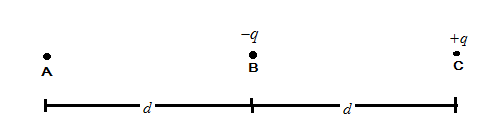
Three particles A, B and C are set in a line, with a distance of $ d $ between each of them, as shown above. If particle B is attracted more towards particle A, what can we say about the charge $ {q_A} $ , of particle A?
(A) $ {q_A} < q $
(B) $ q < {q_A} < 0 $
(C) $ {q_A} = 0 $
(D) $ 0 < {q_A} < + q $
(E) $ {q_A} > + q $
Answer
 Verified
599.1k+ views
Hint :Here, we have been given the three particles as shown in the figure and we have to compare between the forces on these charges. It can be possible only when we use Coulomb's law and find electrostatic forces between these charges.
Coulomb’s law is given by: $ F = k\dfrac{{{q_1}{q_2}}}{{{d^2}}} $
Where, $ {q_1} $ , $ {q_2} $ are the charges on two particles and $ d $ is the distance between them.
Complete Step By Step Answer:
Here, three particles are set in the line and particle B is in the influence of two charges from particle A and particle C. To find out the comparison between the charges we have to find out the force exerted by A and C on B by using Coulomb’s law. It is given as:
$ F = k\dfrac{{{q_1}{q_2}}}{{{d^2}}} $ …. $ (1) $
It is given that on particle B there is negative charge and this particle B is attracted towards particle A. From this it is clear that A is positively charged.
Now, by using coulomb’s law, electrostatic force between particle A and B is
$ F = k\dfrac{{{q_A}q}}{{{d^2}}} $ …. $ (2) $
And force between particle B and C,
$ F' = k\dfrac{{qq}}{{{d^2}}} $ …. $ (3) $
As the particle B is attracted towards A, therefore A exerts a greater force on B than C i.e. $ F > F' $
$ k\dfrac{{{q_A}q}}{{{d^2}}} > k\dfrac{{qq}}{{{d^2}}} $ ….. (From $ (2) $ and $ (3) $ )
$ {q_A} > + q $
Thus, the charge on A is greater than that of on C, and B is therefore more attracted towards A.
The correct answer is option E.
Note :
It is important to study the significance and application of Coulomb’s law so that we can find out the comparison between charges in this question. We have to understand that the like charges always repel each other so we have seen that the B is attracted towards A it is because the A must be oppositely charged of B.
Coulomb’s law is given by: $ F = k\dfrac{{{q_1}{q_2}}}{{{d^2}}} $
Where, $ {q_1} $ , $ {q_2} $ are the charges on two particles and $ d $ is the distance between them.
Complete Step By Step Answer:
Here, three particles are set in the line and particle B is in the influence of two charges from particle A and particle C. To find out the comparison between the charges we have to find out the force exerted by A and C on B by using Coulomb’s law. It is given as:
$ F = k\dfrac{{{q_1}{q_2}}}{{{d^2}}} $ …. $ (1) $
It is given that on particle B there is negative charge and this particle B is attracted towards particle A. From this it is clear that A is positively charged.
Now, by using coulomb’s law, electrostatic force between particle A and B is
$ F = k\dfrac{{{q_A}q}}{{{d^2}}} $ …. $ (2) $
And force between particle B and C,
$ F' = k\dfrac{{qq}}{{{d^2}}} $ …. $ (3) $
As the particle B is attracted towards A, therefore A exerts a greater force on B than C i.e. $ F > F' $
$ k\dfrac{{{q_A}q}}{{{d^2}}} > k\dfrac{{qq}}{{{d^2}}} $ ….. (From $ (2) $ and $ (3) $ )
$ {q_A} > + q $
Thus, the charge on A is greater than that of on C, and B is therefore more attracted towards A.
The correct answer is option E.
Note :
It is important to study the significance and application of Coulomb’s law so that we can find out the comparison between charges in this question. We have to understand that the like charges always repel each other so we have seen that the B is attracted towards A it is because the A must be oppositely charged of B.
Recently Updated Pages
Which of the following graphs shows the variation of class 12 physics CBSE

Draw a labelled diagram of the human male reproductive class 12 biology CBSE
Describe the experiment to compare the emf of two cells class 12 physics CBSE
What is standard hydrogen electrode
What is conventional current and electric current class 12 physics CBSE
2Bromopentane is treated with an alcoholic KOH solution class 12 chemistry CBSE
Trending doubts
Draw a labelled sketch of the human eye class 12 physics CBSE
Which are the Top 10 Largest Countries of the World?
A member of Simon commission later became Prime Minister class 12 social science CBSE
Differentiate between homogeneous and heterogeneous class 12 chemistry CBSE
Draw ray diagrams each showing i myopic eye and ii class 12 physics CBSE
Which is the correct genotypic ratio of mendel dihybrid class 12 biology CBSE