



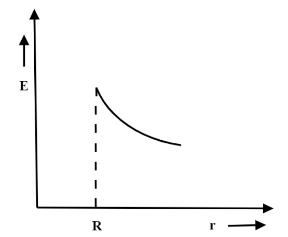
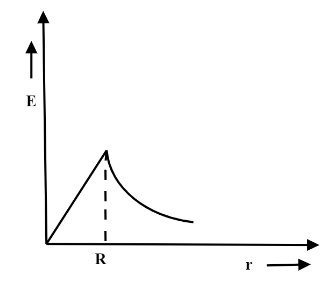
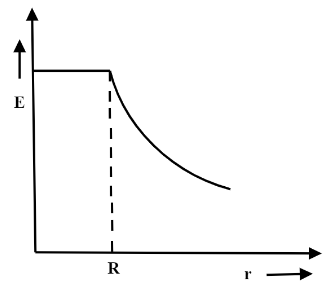
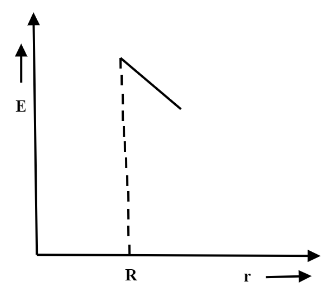
Which of the following graphs shows the variation of electric field strength E with distance r from the centre of a hollow conducting sphere?
(A)
(B)
(C)
(D)
Answer
 Verified
550.8k+ views
Hint: The electric field inside the sphere is zero, while the electric field outside the sphere is equal to the field from a point charge with a net charge of Q, according to Gauss' law. Inside a conducting sphere, the electric field is zero. Outside the sphere the field will decrease rapidly.
Complete Step By Step Answer:
The electric field inside a uniformly charged conducting sphere is E=0, which means there is no charge inside the conductor.
Inside the hollow conducting sphere, the electric field is zero. Outside the sphere the electric field $ E = \dfrac{{kq}}{{{r^2}}} $ , so the graph decreases uniformly.
Because the charge inside the gaussian surface is zero. As a result, E is also zero inside the gaussian surface. When the electric charge dispersion is known and the electric field must be registered, the issue is substantially more difficult. There will be no net charge inside the Gaussian surface if any hypothetical sphere is placed within the charged sphere. q = 0 is the result. As a result, the net flux is equal to zero. So, inside a hollow sphere, the electric field is zero.
The correct answer is option A.
Note:
The electric field inside the sphere is inversely proportional to the square of the distance from the centre, this is true until reaching the surface. Outside the surface the field vanishes more rapidly with distance. The decrease is not in a linear manner.
Complete Step By Step Answer:
The electric field inside a uniformly charged conducting sphere is E=0, which means there is no charge inside the conductor.
Inside the hollow conducting sphere, the electric field is zero. Outside the sphere the electric field $ E = \dfrac{{kq}}{{{r^2}}} $ , so the graph decreases uniformly.
Because the charge inside the gaussian surface is zero. As a result, E is also zero inside the gaussian surface. When the electric charge dispersion is known and the electric field must be registered, the issue is substantially more difficult. There will be no net charge inside the Gaussian surface if any hypothetical sphere is placed within the charged sphere. q = 0 is the result. As a result, the net flux is equal to zero. So, inside a hollow sphere, the electric field is zero.
The correct answer is option A.
Note:
The electric field inside the sphere is inversely proportional to the square of the distance from the centre, this is true until reaching the surface. Outside the surface the field vanishes more rapidly with distance. The decrease is not in a linear manner.
Recently Updated Pages
What is BLO What is the full form of BLO class 8 social science CBSE

Explain the Treaty of Vienna of 1815 class 10 social science CBSE
10 examples of friction in our daily life
Draw a diagram of nephron and explain its structur class 11 biology CBSE
Write structures of the following compounds i 2 Chloro3methylpentane class 11 chemistry CBSE
A Paragraph on Pollution in about 100-150 Words
Trending doubts
Draw a labelled sketch of the human eye class 12 physics CBSE
Which are the Top 10 Largest Countries of the World?
Differentiate between homogeneous and heterogeneous class 12 chemistry CBSE
Draw ray diagrams each showing i myopic eye and ii class 12 physics CBSE
Materials which do not allow an electric current to class 12 physics CBSE
Which is the correct genotypic ratio of mendel dihybrid class 12 biology CBSE