



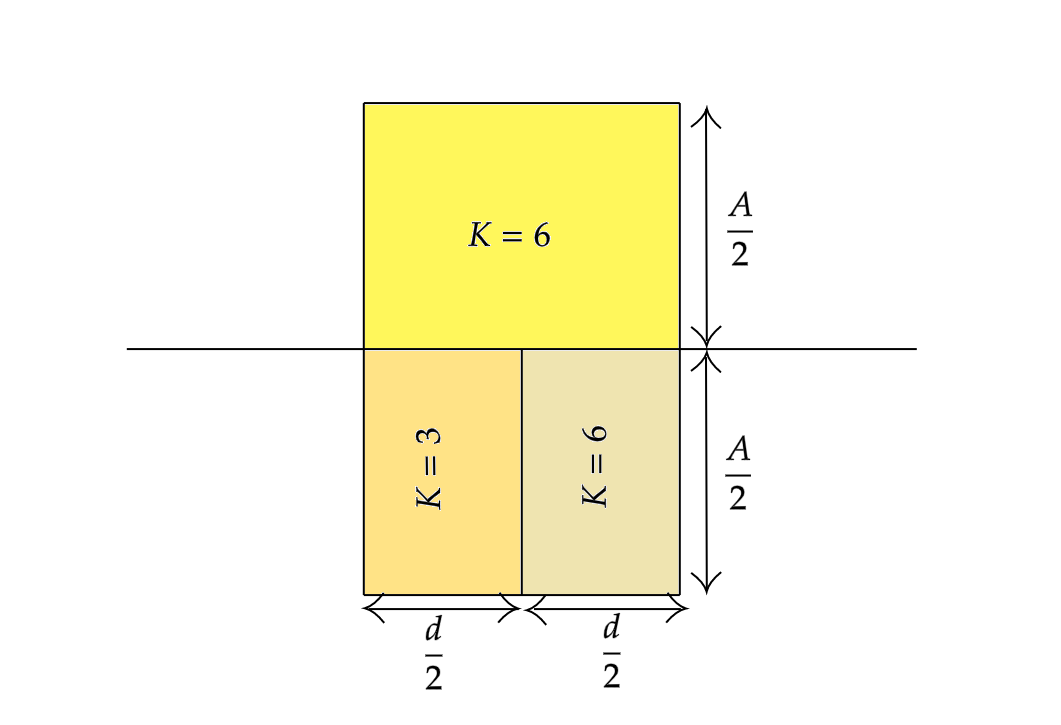
Three different dielectrics are filled in a parallel plate capacitor as shown. What should be the dielectric constant of a material, which when fully filled between the plates produces the same capacitance?
$ \left( A \right)4 $
$ \left( B \right)6 $
$ \left( C \right)5 $
$ \left( D \right)9 $
Answer
 Verified
560.7k+ views
Hint: Whenever a dielectric is inserted between a parallel plate of a capacitor then the new value of the capacitor increases by k time the original capacitor. And if more than one dietetic material is inserted in between the parallel plated then each medium will act as a separate capacitor. Now using this concept first convert each dielectric into a separate capacitor so as to analyze their connection that they are in series or parallel. Now find the equivalent capacitor of the three dielectric materials and equate it with the original capacitance.
Complete answer:
We know that capacitance of a capacitor is given by,
$ C = \dfrac{{\varepsilon 0A}}{d} $
Where,
A is the area between the two parallel plates.
Distance between the two parallel plates is represented as d.
And $ \varepsilon 0 $ is the permittivity of the space between the two parallel plates.
This is the case when it is between the two parallel plates.
But in this case three dielectric constants are inserted and in total let the dielectric constant be K which is always greater than one.
Therefore the new capacitance will become,
$ C' = \dfrac{{K\varepsilon 0A}}{d} $
Which is K time greater $ C $ .
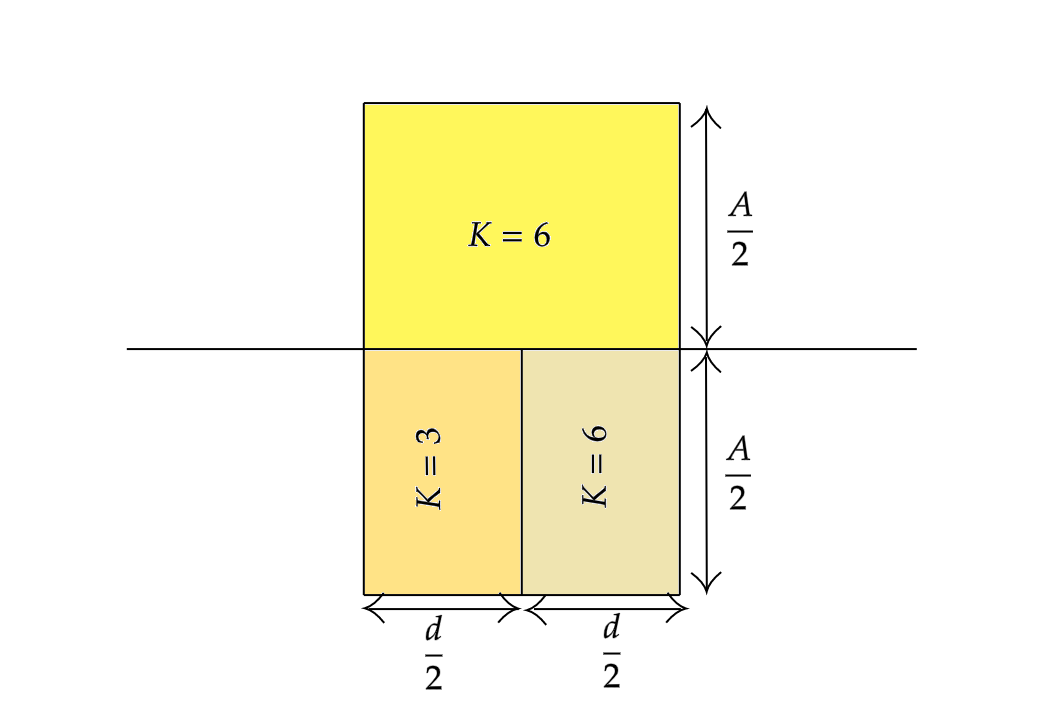
Now from the above figure we can divide the capacitor into three different capacitors having different dielectric constant.
Case i:
$ K = 3 $
$ C_3 = \dfrac{{3\varepsilon 0\dfrac{A}{2}}}{{\dfrac{d}{2}}} $
Now on simplifying we will get,
$ C_3 = \dfrac{{3\varepsilon 0A}}{d} $
Case II:
In series with $ K = 3 $
$ K = 6 $
$ C_6 = \dfrac{{6\varepsilon 0\dfrac{A}{2}}}{{\dfrac{d}{2}}} $
Now on simplifying we will get,
$ C_6 = \dfrac{{6\varepsilon 0A}}{d} $
Case III:
In parallel with $ K = 3 $ and $ K = 6 $
$ K = 6 $
$ C_6 = \dfrac{{6\varepsilon 0\dfrac{A}{2}}}{d} $
Now on simplifying we will get,
$ C_6 = \dfrac{{3\varepsilon 0A}}{d} $
Now we can draw,
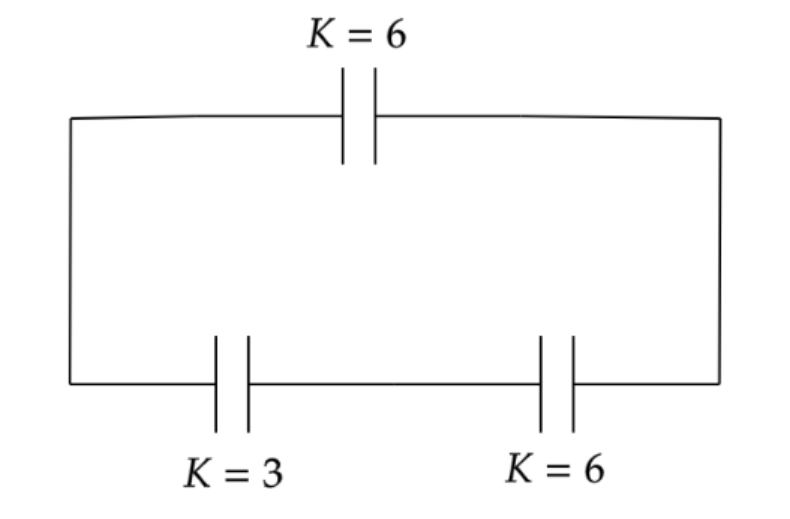
Now the equivalent capacitance from the above diagram will be,
$ C_{eq} = C_6||\dfrac{{\left( {C_3\, \times C_6} \right)}}{{C_3 + C_6}} $
Putting the values we will get,
$ C_{eq} = \dfrac{{3\varepsilon 0A}}{d}||\dfrac{{\left( {\dfrac{{3\varepsilon 0A}}{d} \times \dfrac{{6\varepsilon 0A}}{d}} \right)}}{{\dfrac{{3\varepsilon 0A}}{d} + \dfrac{{6\varepsilon 0A}}{d}}} $
Cancelling the common terms qe will get,
$ C_{eq} = \dfrac{{3\varepsilon 0A}}{d}||\dfrac{{\left( {\dfrac{{18\varepsilon 0A}}{d}} \right)}}{9} $
Parallel capacitance are added,
$ C_{eq} = \dfrac{{3\varepsilon 0A}}{d} + \dfrac{{2\varepsilon 0A}}{d} $
$ \Rightarrow C_{eq} = \dfrac{{5\varepsilon 0A}}{d} $
As per the problem now equating this equivalent capacitance with $ C' $ we will get,
$ C' = C_{eq} $
Putting the respective values we will get,
$ \dfrac{{K\varepsilon 0A}}{d} = \dfrac{{5\varepsilon 0A}}{d} $
Cancelling the given terms we will get,
$ K = 5 $
Therefore the correct option is $ \left( C \right) $ .
Note:
Remember that different materials have different dielectric constants like a perfectly conducting material has a dielectric constant of infinity while a perfectly insulating parallel has dielectric constant as zero. And note that while solving this type of problem first convert the dielectric into a separate category to solve the problem easily.
Complete answer:
We know that capacitance of a capacitor is given by,
$ C = \dfrac{{\varepsilon 0A}}{d} $
Where,
A is the area between the two parallel plates.
Distance between the two parallel plates is represented as d.
And $ \varepsilon 0 $ is the permittivity of the space between the two parallel plates.
This is the case when it is between the two parallel plates.
But in this case three dielectric constants are inserted and in total let the dielectric constant be K which is always greater than one.
Therefore the new capacitance will become,
$ C' = \dfrac{{K\varepsilon 0A}}{d} $
Which is K time greater $ C $ .
Now from the above figure we can divide the capacitor into three different capacitors having different dielectric constant.
Case i:
$ K = 3 $
$ C_3 = \dfrac{{3\varepsilon 0\dfrac{A}{2}}}{{\dfrac{d}{2}}} $
Now on simplifying we will get,
$ C_3 = \dfrac{{3\varepsilon 0A}}{d} $
Case II:
In series with $ K = 3 $
$ K = 6 $
$ C_6 = \dfrac{{6\varepsilon 0\dfrac{A}{2}}}{{\dfrac{d}{2}}} $
Now on simplifying we will get,
$ C_6 = \dfrac{{6\varepsilon 0A}}{d} $
Case III:
In parallel with $ K = 3 $ and $ K = 6 $
$ K = 6 $
$ C_6 = \dfrac{{6\varepsilon 0\dfrac{A}{2}}}{d} $
Now on simplifying we will get,
$ C_6 = \dfrac{{3\varepsilon 0A}}{d} $
Now we can draw,
Now the equivalent capacitance from the above diagram will be,
$ C_{eq} = C_6||\dfrac{{\left( {C_3\, \times C_6} \right)}}{{C_3 + C_6}} $
Putting the values we will get,
$ C_{eq} = \dfrac{{3\varepsilon 0A}}{d}||\dfrac{{\left( {\dfrac{{3\varepsilon 0A}}{d} \times \dfrac{{6\varepsilon 0A}}{d}} \right)}}{{\dfrac{{3\varepsilon 0A}}{d} + \dfrac{{6\varepsilon 0A}}{d}}} $
Cancelling the common terms qe will get,
$ C_{eq} = \dfrac{{3\varepsilon 0A}}{d}||\dfrac{{\left( {\dfrac{{18\varepsilon 0A}}{d}} \right)}}{9} $
Parallel capacitance are added,
$ C_{eq} = \dfrac{{3\varepsilon 0A}}{d} + \dfrac{{2\varepsilon 0A}}{d} $
$ \Rightarrow C_{eq} = \dfrac{{5\varepsilon 0A}}{d} $
As per the problem now equating this equivalent capacitance with $ C' $ we will get,
$ C' = C_{eq} $
Putting the respective values we will get,
$ \dfrac{{K\varepsilon 0A}}{d} = \dfrac{{5\varepsilon 0A}}{d} $
Cancelling the given terms we will get,
$ K = 5 $
Therefore the correct option is $ \left( C \right) $ .
Note:
Remember that different materials have different dielectric constants like a perfectly conducting material has a dielectric constant of infinity while a perfectly insulating parallel has dielectric constant as zero. And note that while solving this type of problem first convert the dielectric into a separate category to solve the problem easily.
Recently Updated Pages
Which of the following graphs shows the variation of class 12 physics CBSE

Draw a labelled diagram of the human male reproductive class 12 biology CBSE
Describe the experiment to compare the emf of two cells class 12 physics CBSE
What is standard hydrogen electrode
What is conventional current and electric current class 12 physics CBSE
2Bromopentane is treated with an alcoholic KOH solution class 12 chemistry CBSE
Trending doubts
A member of Simon commission later became Prime Minister class 12 social science CBSE
What is the Full Form of PVC, PET, HDPE, LDPE, PP and PS ?
Differentiate between internal fertilization and external class 12 biology CBSE
Differentiate between lanthanoids and actinoids class 12 chemistry CBSE
Sketch and label the Malpighian body class 12 biology CBSE
State the principle of an ac generator and explain class 12 physics CBSE